
 Worksheets
Unit 2 Summary (Forces, Newton's Laws, Freefall, Mass, Wt)
Total questions: 27
Worksheet time: 31mins

If the Net Force is pointed to the right, what must the object be doing?
It must be at rest
It must be accelerating to the right
It must be accelerating to the left
It must be moving at a constant rate

The 'symbol or label' for the WEIGHT of any object is:


When a car drives down the road, this force is always opposing the car's motion:
inertia
momentum
friction
applied force
mass
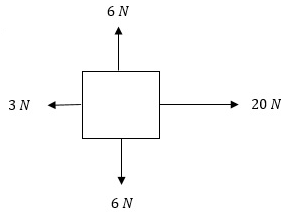
Is this object accelerating? If so, which direction, if no, why?
Yes, downward due to the Net Force of 6 N
No, there is NO NET FORCE acting horizontally
Yes, to the right due to the Net Force of 17 N
No, forces are balanced in all directions (Net Force of zero N)

Which of the FBD shows an object that is experiencing freefall?
A
B
C
D
E
Which of the FBD shows an object that is experiencing a Net Force to the LEFT?
A
B
C
D
E
Which of the FBD shows an object that is experiencing a Net Force to the RIGHT?
There is NO FBD showing a Net Force to the right
B
C
D
E
What can be said about FBD letters C and D?
Both are experiencing a Net Force
Both are in equilibrium
Neither have a force acting on them
Both are accelerating

Assume object A is falling toward Earth's surface. What 'term' best describes the FBD?
Freefall
Static equilibrium
Terminal velocity
Unbalanced forces

Find the Percent Error (%). A student manually times a freefalling object to take 1.1 seconds when falling from 5 meters. What is the % Error of the student's data based on the theoretical time for it to fall 5 meters?
d=5t2
Solving: Isolate 't' to find the theoretical freefall time
+10% (In theory it SHOULD take 1 second to freefall 5 meters)
+1% (In theory it SHOULD take 1 second to freefall 5 meters)
-10% (In theory it SHOULD take 1 second to freefall 5 meters)
-1% (In theory it SHOULD take 1 second to freefall 5 meters)
Find the Percent Error (%). A student manually times a freefalling object to take 1.9 seconds when falling from 20 meters. What is the % Error of the student's data based on the theoretical time for it to fall 20 meters?
d=5t2
Solving: Isolate 't' to find the theoretical freefall time
+10% (In theory it SHOULD take 2 seconds to freefall 20 meters)
+19% (In theory it SHOULD take 2 seconds to freefall 20 meters)
-5% (In theory it SHOULD take 2 seconds to freefall 20 meters)
+5% (In theory it SHOULD take 2 seconds to freefall 20 meters)
Object A is at rest.
Object B is moving at a constant speed in a straight line. Which of the following is correct?
Both objects are experiencing balanced forces
Object A is experiencing static equilibrium
Object B is experiencing dynamic equilibrium
All choices are correct/true

A skydiver jumps out of a helicopter and falls toward Earth. Based on the forces shown in the pictures, which of the following is TRUE?
Position A shows Terminal Velocity
Position B shows balanced forces and NO acceleration
Positions C and F show two different Terminal Velocities
Positions D and E show the object speeding up on its downward fall

Solve (use a calculator): An object freefalls for a TIME of 1.5 seconds on Earth. About what DISTANCE (meters) does it fall on the Earth's surface? d=5t2
Solving: Isolate 't', then solve
1.1 meters
3.5 meters
6.7 meters
11 meters
Solve (use a calculator): An object freefalls for a TIME of 3.3 seconds on Earth. About what DISTANCE (meters) does it fall on the Earth's surface? d=5t2
Solving: Isolate 't', then solve
54 meters
47 meters
33 meters
11 meters
Solve (use a calculator): An object freefalls for a distance of 45 meters on Earth. How much TIME (seconds) does it take to reach the Earth's surface? d=5t2
Solving: Isolate 't', then solve
45 seconds
9 seconds
3 seconds
1.5 seconds
Solve (use a calculator): An object freefalls for a distance of 110 meters on Earth. About how much TIME (seconds) does it take to reach the Earth's surface? d=5t2
Solving: Isolate 't', then solve
11.1 seconds
6.5 seconds
5.2 seconds
4.7 seconds

A person would weigh less on on the Moon than on the Earth because . . .
Moon has more gravity
Moon has the same amount of gravity as Earth
You would be completely weightless on the Moon so no weight at all
Moon has less gravity than Earth
If an object mass =30 Kg on the Earth, what would be it's weight on Earth?
(Fg = mg)
30 N
300 kg
3000N
300 N

A ball is tossed upward (freefall), travels upward, stops, and falls back down. At ALL points in its flight, it is experiencing a constant:
Speed
Velocity
Force and Acceleration
+ velocity

A ball is tossed upward and caught at the same position of throw. In the absence of air resistance, the speed of the ball when it is caught would be
less than the speed it had when tossed upwards
the same as the speed it had when tossed upwards
more than the speed it had when tossed upwards

An object is tossed upward at 20m/s and is in the air for 4 seconds total time. Which of the following is TRUE?
Speed at A is the same as speed at E
Speed at B is the same as speed at D
The object is stopped at letter C (v=0m/s)
All answers are true

You drop an object from 20 meters off of the ground. You time it and find that your time you measured was 2.1 seconds. (*Assume freefall) What is your % Error from the Theoretical value?
-1%
+1%
+5%
+10%

An object experiences an upward launch. Which is TRUE?
It slows down going upward while speeding up going downward
It travels at a constant speed its entire flight
It speeds up going upward, slows down going downward

