Wayground logo

Free Printable Worksheets

Font size

S
M
L
XL
Worksheets

Density

Total questions: 40

Worksheet time: 49mins

Name
Class
Date
1.
What two types of measurements make up DENSITY? 
a)
Mass and Volume
b)
Temperature and Mass
c)
Grams and Centimeters
d)
Volume and Weight
2.
Look at this image.  Which object has the LOWEST density in water? How? 
a)
The Ping Pong Ball because it floats to the top 
b)
The bolt because it has sunk to the bottom
c)
The soda cap because it is not just full of air like the Ping Pong ball
3.
Jack has a rock. The rock has a mass of 14g and a volume of 2cm3. What is the density of the rock?
a)
7 mL
b)
7 g/cm3
c)
28 g/cm3
d)
1/7 g/cm3
4.
If an object has a density of .6 g/mL and you put it into water, will it sink or float?  
a)
sink
b)
float
5.
Frank has an eraser. It has a mass of 4g, and a volume of 2cm3. What is its density?
a)
8 g/cm3
b)
2 g/cm3
c)
1/2 g/cm3
d)
24 g/cm3
6.
If an object has a density of 3.6 g/mL and you put it into water, will it sink or float?  
a)
sink
b)
float
7.
What units are used to measure mass?
a)
g
b)
cm3
c)
g/cm3
d)
cm3/g
8.
What is the formula for density?
a)
density = mass x volume
b)
density = mass / volume
c)
density = mass + volume
d)
density = mass - volume
9.
Helium balloons rise on earth because
a)
helium is less dense than air
b)
helium is more dense than air
c)
helium is cooler than air
d)
helium is warmer than air
10.
True or False:  The density of a specific type of material never changes.  
a)
True
b)
False
11.
Calculate the density of the cube.
a)
2 g/cm3
b)
4 g/cm3
c)
6 g/cm3
d)
8 g/cm3
12.

A bar of copper has a mass of 216g and a volume of 24 cm3. What is the density of copper?

a)

9g/cm3

b)

5184g/cm3

c)

.11g/cm3

d)

322mL

13.

Using the picture, tell me which object is the least dense and why?

a)

The fish because he is in the middle

b)

The cork because it is floating at the top of the water

c)

The rock because it is at the bottom

d)

The cork and the rock because they have the same about of atoms.

14.

Frank has an eraser. It has a mass of 4 g and a volume of 2cm3. What is the density?

a)

2 g/cm3

b)

4 g/cm3

c)

8 g/cm3

d)

2 g/in3

15.

What is density?

a)

The amount of mass per volume

b)

The amount of volume per mass

c)

The amount of pressure per volume

d)

The amount of pressure per mass

16.

How could two objects have different volumes, but still have the same mass?

a)

If they both have the same density

b)

If the larger object has a lower density

c)

If the smaller object has a lower density

d)

If the larger object has a higher density.

17.

If I add salt to water, the mixture becomes...

a)

less dense than before

b)

no change

c)

more dense than before

18.

How can an object float on water?

a)

If it is more dense than water

b)

If it is less dense than water

c)

If it has the same density as water

19.

If a gas's density decreases, its particles are now...

a)

smaller

b)

farther apart

c)

bigger

d)

closer together

20.

Typically, the particles in a gas are not interacting.

a)

True

b)

False

21.
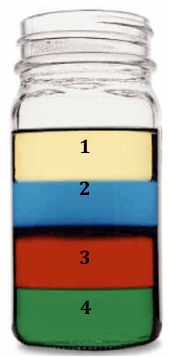
Put the liquids in order from most dense to least dense?
a)
4, 3, 2, 1
b)
1, 2, 3, 4
c)
3, 4, 2, 1, 
d)
4, 3, 1, 2
22.

Why do objects sink or float in H2O?

a)

Because their densities are higher or lower than compared to water

b)

Because their densities are using gravity to pull down

c)

Because their densities are heavier or lighter

d)

Because their mass and volumes are equal

23.
What is the volume of Object X?
a)
10.0 cm3
b)
15.0 cm3
c)
20.0 cm3
d)
25.0 cm3
24.
Find the volume of this piece of brass.  
a)
50 g
b)
10 cm
c)
6 cm3
d)
12 cm3
25.
Which box has a higher density?  
a)
Box A
b)
Box B
c)
cannot be determined
d)
they are the same
26.
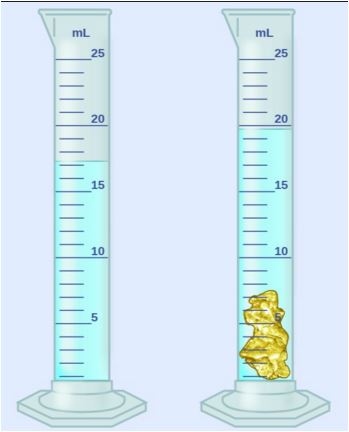
An irregularly shaped piece of gold was lowered into a graduated cylinder holding a volume of water equal to 17 ml. The height of the water rose to 20 ml. If the mass of the gold was 27 g, what was its density?
a)
9 g/mL
b)
10.5 g/mL
c)
6.5 g/mL
d)
8 g/mL
27.

Which has the greatest volume?

a)

One on left

b)

One on right

c)

Both the same

d)

Volume cannot be determined

28.

Which has the greatest density?

a)

A

b)

B

c)

C

d)

All the same density

29.

Which are measurable physical properties? (may be more than one)

a)

volume

b)

density

c)

mass

d)

temperature

30.
Which is least dense? 
a)
A
b)
B
c)
C
31.

The objects that are les dense the water will....

a)

FLOAT

b)

SINK

c)

DAMAGED

d)

NOTHING HAPPENED

32.

Objects that are more dense than the water will...

a)

FLOAT

b)

SINK

c)

DAMAGED

d)

DESTROYED

33.

A sponge that is less dense than water will...

a)

SINK

b)

FLOAT

c)

FLYING

d)

WALKING

34.

Logs that are less dense than water will..

a)

SINK

b)

FLOAT

c)

TURN TO A DREAM HOUSE

35.
Archimedes used density to discover if the crown of gold was real because
a)
Substances have their own unique densities
b)
Substances can change densities depending on their size
c)
Substances can change densities depending on their mass
d)
Substances can change densities depending on their volume
36.

What is the formula for Mass?

a)

Mass/Volume

b)

Density x Volume

c)

Mass/Density

37.

What is the formula for Volume?

a)

Mass/Volume

b)

Density x Volume

c)

Mass/Density

38.

What lab equipment do you use to measure volume?

a)

balance

b)

graduated cylinder

c)

test tube

d)

goggles

39.

what is density?

a)

the amount of space

b)

the amount of mass in an object

c)

the amount of mass in a given space.

d)

the amount of space.

40.
Why do objects sink or float in H2O? 
a)
Because their densities are higher or lower than compared to water
b)
Because their densities are using gravity to pull down
c)
Because their densities are heavier or lighter
d)
Because their mass and volumes are equal