
 Worksheets
Magnetism and Electricity
Total questions: 35
Worksheet time: 21mins
Small particles of metal are scattered near a bar magnet to show the pattern of the magnetic field. Which metal is suitable?
aluminium
copper
iron
brass

A strong electromagnet is used to attract pins.
What happens when the current in the coil is halved?
No pins are attracted.
Fewer pins are attracted.
The same number of pins is attracted.
Many more pins are attracted.

The strongest parts of the magnet are ...
fronts
backs
poles
middle

Why does the compass needle move at different locations?
Because the needle is attracted to the magnetic field produced by the magnet
Because north is up
Because it is being attracted to the Magnetic North Pole
Because north is down

To make this electromagnet stronger you could:
use less wire
have fewer wire coils around the nail
have more wire coils around the nail
use a plastic core

Static electricity is the build up of ___________.
protons
electrons
neutrons
none of the above

What statement would most likely explain why the charges would cause this boys hair to separate when touching the Van de Graaf Generator?
Charges in his hair became neutral causing it to repel.
Charges in his hair became mostly positive causing it to attract.
Charges in his hair became mostly negative causing it to repel.

A current of 2 A is flowing through a conductor.
How long does it take for 10 C of charge to pass any point?
0.2 s
5 s
12 s
20 s
The potential difference between the ends of a conductor is 12 V. How much electrical energy is converted to other forms of energy in the conductor when 100 C of charge flows through it?
0.12 J
8.3 J
88 J
1200 J
The resistance of a length of wire is R Ω.
What is the resistance of a wire of the same material and length, but with half the cross-sectional area?
R/4
R/2
R
2R

A positively charged plastic rod is placed just above a thick metal plate. The metal plate rests on
an insulator and is connected to the earth by a wire.
A student disconnects the earthing wire and then removes the positively charged rod.
The experiment is repeated.
This time the student removes the positively charged rod and then removes the earthing wire.
Which statement is correct?
When the earthing wire is disconnected first, the metal plate becomes positively charged.
When the earthing wire is disconnected first, the metal plate becomes negatively charged.
When the plastic rod is removed first, the metal plate becomes positively charged.
When the plastic rod is removed first, the metal plate becomes negatively charged.

The diagram shows part of an electrical circuit.
The current in the 4.0 Ω resistor is 3.0 A.
What is the current in the ammeter?
4.5 A
9.0 A
6.0 A
12.0 A

The graph shows the output of an a.c. generator. The coil in the generator rotates 20 times in one
second.
The speed of rotation of the coil steadily increases.
Which graph best shows how the output changes?


What are the factors affecting the resistance in a current carrying wire?
Length of wire
Insulation around the wire
Cross-sectional area of wire
Type of wire
What makes aluminium suitable to be used to make cables that transmit electricity over a large distance?
Abundant
Shiny
Good conductor of electricity
Low density
How can you demagnetise a permanent magnet?
Place it in a solenoid with a dc supply
Heat it until it is red hot
Repeatedly hammer it
Cool it below 0 degree Celsius
4 identical lamps are connected in a circuit with a constant dc supply of 6V. Each lamp has a resistance of 10 ohms. What is the smallest combined resistance of the circuit?
40 ohms
10 ohms
5 ohms
2.5 ohms
Which component can vary it's resistance based on the surrounding temperature?
Thermometer
Thermistor
LDR
Variable resistor
Which is true of the power of an electrical equipment?
rate of change of momentum
rate of change of temperature
rate of flow of current
rate of transfer of energy
A student wants to identify the direction of current flow when a wire is moved perpendicular to the magnetic field. He should use the ............
Right Hand Grip Rule
Fleming's Right Hand Rule
Fleming's Left Hand Rule
None of the above
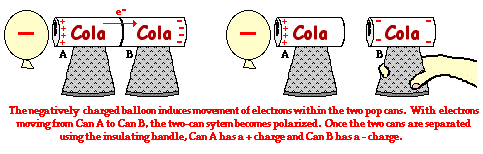
If a neutral metal comb is held near an object with a negative charge, the comb will become charged by....
static discharge
contact
friction
induction
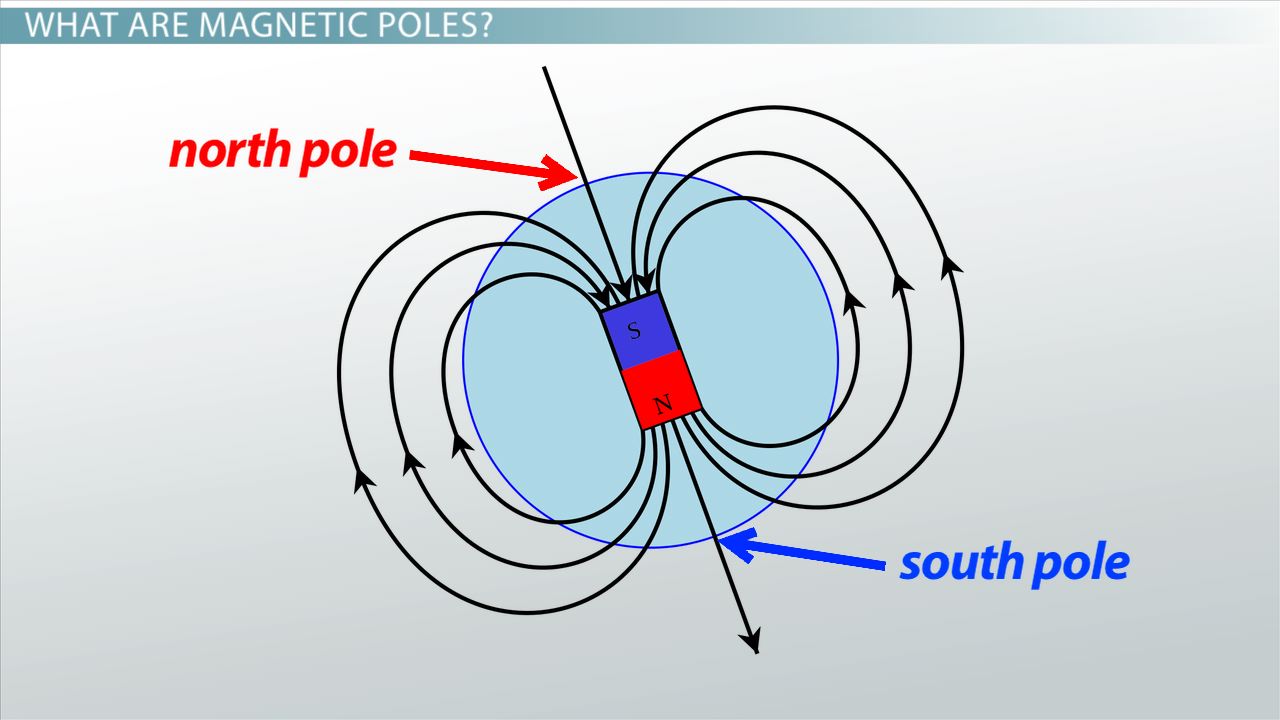
Which of the following statements describes the interaction between magnetic poles?
Like poles attract each other.
Like poles repel each other, and opposite poles attract each other.
Opposite poles repel each other.
Like poles attract each other, and opposite poles repel each other.
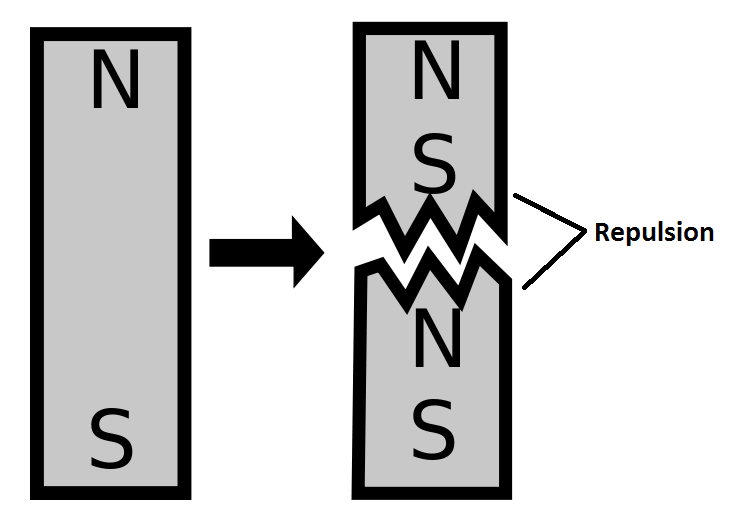
If you break a bar magnet in half, each half...
contains one magnetic pole.
becomes a bar magnet with two poles.
becomes unmagnetized.
is only temporarily magnetized.

Identical resistors are connected together to form arrangements X, Y and Z.
What is the correct order of the resistances of the arrangements from the largest to the smallest?
X → Y → Z
Y → X → Z
Z → X → Y
Z → Y → X
Where must a fuse be connected in a mains electric circuit?
the earth wire only
the live wire only
the neutral wire only
the live wire and the earth wire
A student investigates the output voltage induced across a coil of wire by a bar magnet.
When will the induced voltage have the greatest value?
The student slowly moves the bar magnet into the coil of wire.
The student leaves the bar magnet stationary in the coil of wire.
The student quickly removes the bar magnet from the coil of wire.
The student places the bar magnet at rest outside the coil of wire.
There is a current in a wire. The direction of the current is out of the page.
Which diagram shows the magnetic field pattern produced?


A plastic rod is rubbed with a dry cloth. The rod becomes positively charged.
Why has the rod become positively charged?
It has gained electrons.
It has gained neutrons.
It has lost electrons.
It has lost neutrons.
A circuit contains a cell of electromotive force (e.m.f.) of 2.0 V. The current in the circuit is 2.0 A.
How much energy is converted by the cell in 2.0 minutes?
2.0 J
4.0 J
8.0 J
480 J

The circuit diagram shows a cell connected in series to a resistor and a component X.
What is component X?
bell
diode
heater
thermistor
Resistors of 1.0 Ω, 2.0 Ω and 3.0 Ω are connected in parallel with a cell.
Which statement is correct?
The current in each resistor is different but the potential difference (p.d.) across each resistor
is the same.
The current in each resistor is the same but the potential difference across each resistor is
different.
The potential difference across the 3.0 Ω is greater than the potential difference across the
1.0 Ω resistor.
The sum of the potential differences across each resistor is equal to the electromotive force
(e.m.f.) of the cell.

