
 Worksheets
Acids, Bases and Salts
Total questions: 60
Worksheet time: 1hrs 15mins
Which of the following values would represent the pH of a strong base?
1
8
7
13
Which among the following is not a base?
NaOH
KOH
HCl
NH4OH
Acids are __________, which means they "eat away" at other materials.
transitional metal
alkaline
flammable
corrosive
Acidic solutions exhibit a higher ratio of H3O+ ions, known as...
neutrons
hydroxide
electrons
hydronium
When you place blue litmus paper into an unknown clear solution, the blue litmus paper turns red.
Which of the following represents the most logical conclusion?
The substance has a pH value of "2".
The substance is a base.
The substance has a pH value of "7".
The substance is acidic.
What range of values on the pH scale represent solutions with a higher ratio of hydroxide (OH-) ions?
below 7
7
above 7
0-14
Identify the products of the following reaction:
CaCO3 + 2HCl -->
Calcium hydrogen carbonate and chlorine gas
Calcium chloride and water
Calcium oxide, carbon dioxide and water
Calcium chloride, carbon dioxide and water
What are acids?
Acids are substances that taste sweet, can dissolve metals (depending on the type of acid) and are acidic in nature.
Acids are substances that taste sour, can dissolve metals (depending on the type of acid) and are acidic in nature.
Acids are substances that taste sour, can dissolve metals (depending on the type of acid) and are basic in nature.
What are Bases?
Bases are substances that are bitter in taste, feel soapy when touched and are acidic in nature.
Bases are substances that are sour in taste, feel soapy when touched and are basic in nature.
Bases are substances that are bitter in taste, feel soapy when touched and are basic in nature.
Acids are substances that are bitter in taste, feel soapy when touched and are basic in nature.
What are the substances used to test whether another substance is acidic or basic in nature?
Spoon
Bases
Acids
Indicators
Which one of these is an indicator?
Litmus Paper
Orange Juice
Shampoo
Lotion
What is the process of Acid and Bases mixed together called?
Explosion
Indication
Inflamation
Neutralisation
Metallic oxides are basic in nature.
True
False
Antacids are used......
to produce acid in the stomach
to produce water in the stomach
to neutralize excess base in the stomach
to neutralize excess acid in the stomach
Which one of the following metals reacts both with acid and base and releases hydrogen gas?
Na
Fe
Zn
Cu
A solution turns red litmus blue, its PH is likely to be
1
4
5
10
If a base dissolves in water by what name is it better known?
neutralization
basic
acid
alkali
What colour would hydrochloric acid turn universal indicator?
orange
yellow
purple
red
Metal oxides are .....
bases only
bases and alkalis
alkalis only
Metal hydroxides are ....
bases only
both bases and alkalis
alkalis only
Which of these general equations are correct?
acid + base makes a salt + water
acid + metal carbonate makes a salt + carbon dioxide + water
acid + metal makes a salt + Hydrogen gas
Acid + metal oxide makes a salt + water
Acid + metal hydroxide makes a salt and water
Sulphuric acid + sodium carbonate
-->
Hydrochloric acid + magnesium hydroxide -->

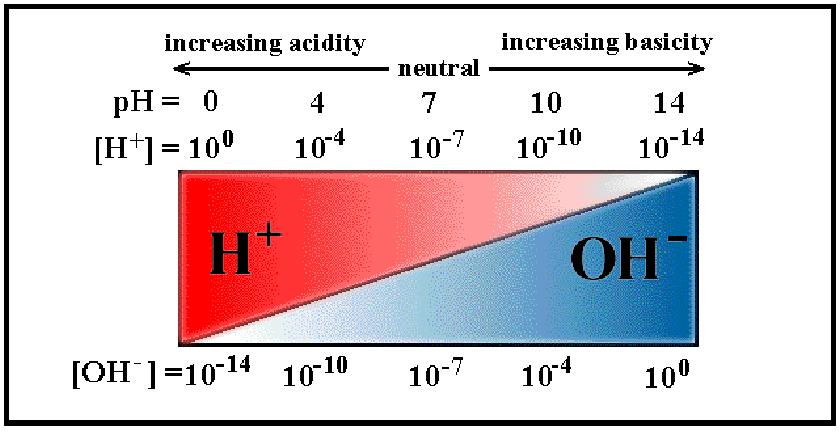
True or false: a neutral solution has equal amounts of H+ and OH-.
True
False
Basic oxide
BaO
P2O5
ZnO
CO2
Which is NOT an amphoteric oxide?
zinc oxide
aluminium oxide
lead (II) oxid
sodium oxide
Which of the followings is an acidic oxide?
SO2
H2O
CO
ZnO
Sulfuric acid reacts with sodium hydroxide to form salt X and water. Name the salt.
sodium sulphate
sodium nitrate
sodium chloride
Potassium carbonate reacts with an acid Y to form potassium nitrate, water and carbon dioxide. What is the acid used for this reaction?
HNO3
H2SO4
HCl
Ocean water has a pH value near "8". It would be classified as...
slightly acidic
a strong base
a neutral substance
slightly basic (alkaline)
Four solutions are tested and found to have the following pH values. Which of these substances would be considered the weakest acid?
Lemon Juice - pH=2
Apple Juice - pH=4.5
Shower Cleaner - pH=5.5
Hydrogen Peroxide - pH=7
Mg + H2SO4 ------------> _________ + H2
MgH2
MgS + 2O2
MgSO4
Mg(SO4)2
Na + HNO3 ------------>
Na + H2O + O2
NaH + NO2
Na(NO3)2 + H2
NaNO3 + H2
CaCO3 + HCl ----------->
H2O + CO2
CaCl2 + H2O + CO2
CaCl3 + H2O+ CO2
CaCl3 + H2O + CO
NaHCO3 + H2SO4 ------------> H2O +
CO2
NaSO4 + CO2
Na2SO4 + CO2
Na2(SO4)2 + CO2

Which of the following describes a precipitate?
a liquid forms when a block of metal is heated
a solid forms when one liquid is poured into another
a gas forms when a solid is placed in a liquid
bubbles form when an acid is poured on a rock
ZnO + H2SO4 --------->
ZnSO4 + H2 + O2
Zn(SO4)2 + H2O
Zn(SO4)2 + H2
ZnSO4 + H2O
Ca(OH)2 + 2HNO3 ------->
Ca(NO)3 + H2O
CaNO3 + H2O
Ca(NO3)2 + 2H2O
Ca(NO3)2 + H2O
Complete the reaction.
Ca(OH)2 + 2NH4Cl ----------> CaCl2 +
NH3
NH3 + H2O
NH3 + 2H2O
2H2O + NO2
Which of the following salts is prepared by precipitation method?
sodium chloride
barium sulfate
calcium nitrate
ammonium carbonate
Which of the following methods is used to prepare zinc sulfate?
Add excess zinc chloride to aqueous sodium sulfate
Tiltrate dilute H2SO4 with aqueous Zn(OH)2 with an indicator, then again without
Add excess solid zinc oxide to dilute sulfuric acid
Mix aqueous zinc nitrate with aqueous potassium sulfate
After titrating aqueous NaOH with dilute HCl without indicator, what is my next step to obtain a sample of NaCl ?
Filtration
Evaporation to dryness
Repeat the titration
Evaporate to saturation, then cool the solution
After adding aqueous Ca(NO3)2 to dilute H2SO4, what is my next step to prepare a sample of CaSO4?
Crystallisation
Evaporation to dryness
Filtration to get the filtrate
Filtration to get the residue
Which two solutions, when mixed together, will form a precipitate?
dilute hydrochloric acid and barium nitrate
dilute sulfuric acid and sodium hydroxide
dilute hydrochloric acid and lead (II) nitrate
dilute nitric acid and zinc chloride
How can I prepare a sample of copper(II) sulfate?
Add excess Cu metal to H2SO4
Add Cu(NO3)2 (aq) to Na2SO4(aq)
Add excess CuCO3 to H2SO4
Titrate Cu(OH)2 to NaOH

What is a Salt?
Food seasoning
When a hydrogen ion is replaced by a metal to form a compound
When a metal ion is replaced by a hydrogen ion to form a compound
None of the above
Sodium, Potassium and Ammonium salts are insoluble
TRUE
FALSE
Are all nitrates soluble?
YES
NO
All chlorides are soluble
TRUE
FALSE

Which of the following preparation of salt is incorrect?
acid + alkali
acid + metal oxide
acid + carbonate
acid + acid

