
 Worksheets
Continental Drift and Seafloor Spreading
Total questions: 46
Worksheet time: 45mins

What did Wegener name the large supercontinent where all the continents were joined together?
Wegenerland
Gondwanaland
Laurasia
Pangaea

Most geologists rejected Wegener's idea of Continental Drift because _________.
He used too many pieces of evidence to support the idea.
He wanted to know what Earth looked like millions of years ago, which is impossible.
He couldn't identify "how" continents to move around.
They were afraid of the new idea.

Wegener used the fit of the continents as evidence to support his hypothesis of Continental Drift.
true
false

Wegener used matching mountain ranges across different continents as evidence to support his hypothesis of Continental Drift.
true
false

Wegener used evidence of glaciers in places now too warm as evidence to support his hypothesis of Continental Drift.
true
false

Wegener used matching matching fossils of the same organisms on different continents as evidence to support his hypothesis of Continental Drift.
true
false

What were 2 kinds of evidence were used to prove that the seafloor spread?
rock formations, WWII shipwrecks,
magnetic seafloor stripes, WWII ship logs
magnetic seafloor stripes, age of rock samples

What technology was used during WWII to detect enemy submarines and produce the first map of the seafloor?
Sonar
Radiam
GPS

Process by which new ocean crust forms.
Seafloor spreading
Continental drift
Mid-ocean ridge
Rift

The zone where one plate slides under another is called the
Convergent zone
Subduction zone
Transform zone
Mantle zone

Undersea mountain ranges are called a_________.
Rift
Mid-ocean ridge
seafloor spreading
Continental drift

Wegener used matching rock types and ages across different continents as evidence to support his hypothesis of Continental Drift.
true
false

Wegener used evidence of convection currents in the mantle as evidence to support his hypothesis of Continental Drift.
true
false

The OLDEST seafloor is located?
Closest to the mid-ocean ridge
Farthest from the mid-ocean ridge

Sea-floor spreading begins at the
Deep ocean trench
Mid-ocean ridge
Continent's edge

Older crust is found towards the...
Mid-ocean ridge
Deep-ocean trench
Asthenosphere

Why does oceanic crust (density 3ish) sink below the continental crust (density 2.6ish) during subduction
oceanic crust is less dense
oceanic crust is more dense
oceanic crust is older
oceanic crust is warmer

Wegener's idea of Continental Drift was rejected by geologists because _________.
He used too many pieces of evidence to support the idea.
He wanted to know what Earth looked like millions of years ago, which is impossible.
He couldn't identify how or even why the continents to moved around.
They were afraid of the new idea.

Who came up with the theory of seafloor spreading?
Harry Hess
Alfred Wegner
Mrs. White
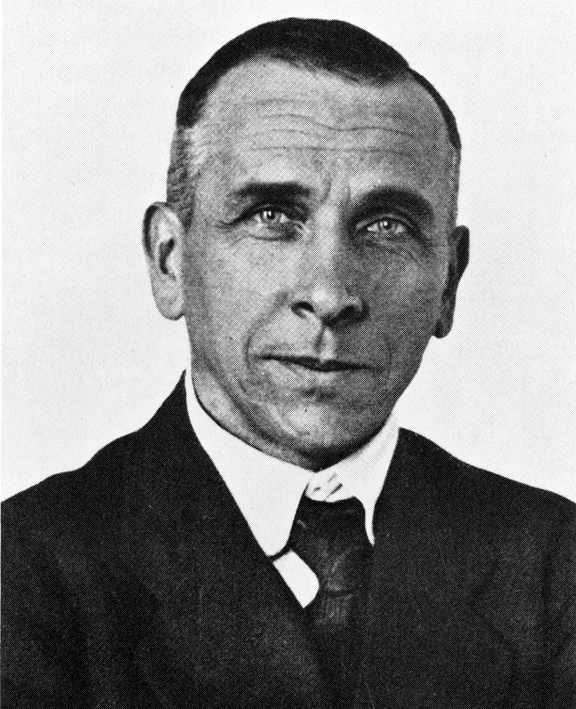
Who is the person credited with developing the theory of continental drift?
Harry Hess
Albert Einstein
Alfred Wegener
Isaac Newton

What are the two types of crust?
continental and oceanic
ocean and basin
lower and upper
thick and thin

Younger sea floor crust is located...
farther from the mid-ocean ridges
at the mid ocean ridges
near the continents

What causes the crust to move?
convection currents
conduction
tension
radiation

Why were magnetic patterns found on the ocean floor puzzling?
They showed alternating bands of rock crystals pointing north and south.
No rocks were magnetic.
They did not show alternating bands of rock crystals pointing north and south.
All rocks were magnetic.


What are Mid-Ocean Ridges?
A chain of underwater waterfalls
A chain of underwater mountains where the magma oozes out.
A chain of underwater rocks

Which is NOT evidence of sea-floor spreading?
Molten magma constantly erupting
Drilling samples of rock
Magnetic stripes
Fossil evidence
What is label D
Trench
Mid ocean ridge
abyssal plain
sea mount

How long did it take the continents to move into their current position?
Hundreds of years
Thousands of years
Almost a million years
Hundreds of millions of years

What do you call the evidence of Wegener's Theory that tells about the remains of an organism that lived long time ago?
ashes
follicles
bones
fossils

What causes continents to move?
seafloor spreading
convection currents swirling
magma oozing out of a mid ocean ridge
all of the above

True or False: Our continents will eventually become a supercontinent (like Pangaea) again, far in the future
False
True

What is the rate at which the Atlantic Ocean is expanding?
5-10 cm per year- like how our fingernails grow
5-10 feet per year
5-10 km per year

True or False: The plates will never stop moving
True
False

Alfred Wegener proposed his theory of Continental Drift in the early 20th century. Why did scientists refuse to believe him?
He was not a REAL scientist
He could not explain HOW the plates moved
Scientists did not think his evidence was real

Which layer of Earth contains the tectonic plates?
crust and the uppermost mantle
lower and middle mantle
outer core
inner core

What is this image trying to show?
How the shape of the continents match
Rock evidence showing that the continents were connected
Fossil evidence suggesting that the continents were connected

The force in the MANTLE that makes the plate move is called _________
Convection currents
conduction
condensation

During WWII the navy mapped the ocean floor with _______.
a robotic rover
radiation evidence
SONAR waves
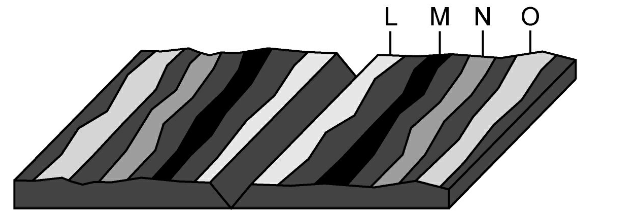

The average density of continental crust is 2.8 g/cm3 and the average density of oceanic crusts is 3.2 g/cm3. If these two plates came together, what would happen?
The two plates would push apart and form a rift zone.
The oceanic plate would rise up over the continental plate.
The oceanic plate would sink under the continental plate.
The two plates would meet head on and rise up to form mountains.

Seafloor spreading...
creates new oceanic crust
destroys or recycles crust
creates new continental crust
creates old crust
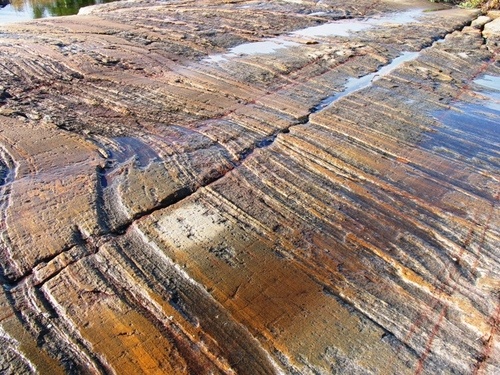

The Glomar Challenger_____
is a space shuttle
is an oil rig
has been drilling seafloor samples for over 50 years

Before sonar waves evidence, people believed that the ocean was ______.
had mountains just like on land
was coral reefs
flat and sandy

The temperature gets _______ closer to the ocean ridge.
cooler since magma is farther from the ocean floor
hotter since magma is closer to the ocean floor
stays the same since magma is very far from the ocean floor

