Wayground logo

Free Printable Worksheets

Font size

S
M
L
XL
Worksheets

Science Chapter 7 Form 2

Total questions: 35

Worksheet time: 41mins

Name
Class
Date
1.
What type of energy is stored in an object due to its high position?
a)
Gravitational potential energy
b)
Elastic potential energy
c)
Kinetic energy
d)
Electrical energy
2.

Which one is renewable energy?

(there is more than 1 answer)

a)

fossil fuel

b)

water

c)

solar

d)

radioactive substances

e)

wind

3.
What is produced on a balloon after it is rubbed with a woolen cloth?
a)
Electrostatic charges
b)
Electric current
c)
Voltage
d)
Resistance
4.
What instrument can be used to detect electrostatic charges?
a)
Electroscope
b)
Telescope
c)
Microscope
d)
Periscope
5.
Which of the following statements about charges is TRUE?
a)
Same charges repel while opposite charges attract
b)
Same charges repel and opposite charges also repel
c)
Same charges attract and opposite charges also attract
d)
Same charges attract while opposite charges repel
6.

What type of charge would the substance pictured above have?

a)

positive

b)

negative

c)

neutral

7.
What is electricity?
a)
The flow of electrons in the form of an electric charge
b)
The flow of neutrons in the form of an electric charge
c)
The flow of protons in the form of an electric charge
d)
A charge that produces light
8.

Which of these is the source of energy within the circuit?

a)

battery

b)

bulb

c)

switch

d)

wire

9.

What is the unit for electric current?

a)

Ampere

b)

Volt

c)

Ohm

d)

Joules

10.
What is this symbol for?
a)
light bulb
b)
switch
c)
battery
d)
resistor
11.
What is a voltmeter used to measure?
a)
Electric current
b)
Voltage
c)
Resistance
d)
Magnetism
12.

Which of the following is a poor conductor of electricity?

a)

rubber

b)

copper

c)

steel

d)

aluminum

13.
What is the unit for resistance?
a)
Ampere
b)
Volt
c)
Ohm
d)
Tesla
14.
As a voltage goes up, what happens to the current? 
a)
Current stays the same. 
b)
Current goes up. 
c)
Current goes down. 
d)
Current drops to 0 A. 
15.

The longer the wire,

the _________ the resistance.

a)

smaller

b)

greater

16.
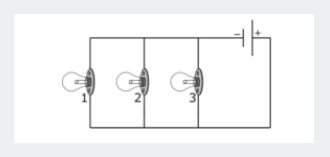
What kind of circuit is this?
a)
Series
b)
Consecutive
c)
Parallel
d)
Training
17.

Which one is the circuit diagram of this picture?

a)
b)
c)
d)
18.

If bulb 1 burns out in the circuit, what will occur?

a)

bulbs 2 and 3 will go out

b)

bulbs 2 and 3 receive more volts

c)

bulbs 2 and 3 will stay lit

d)

nothing will happen

19.

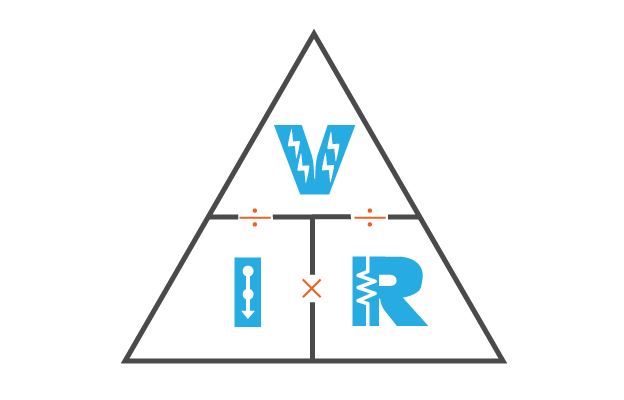
The current in a hair dryer measures 15.0 A. The resistance of the appliance is 8.0 Ω. What is the voltage?

a)

120 V

b)

0.5 V

c)

7.0 V

d)

1800 V

20.
Each time a lightbulb is added to a series circuit, the other bulbs in the circuit 
a)
get brighter
b)
get dimmer
c)
stay the same brightness
d)
release more heat
21.

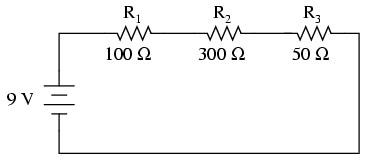
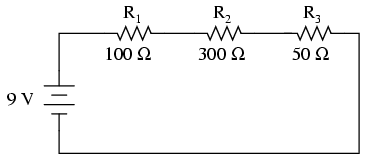
The total current through this circuit is

a)

0.02 A

b)

0.2 A

c)

2.0 A

d)

0.04 A

22.

The total resistance in this circuit is

a)

100 Ω

b)

450 Ω

c)

400 Ω

d)

30 Ω

23.
What is one problem with using a series circuit? 
a)
It has a lot of series. 
b)
If one light goes down, they all go down! 
c)
It doesn't work properly.
d)
There are no problems. 
24.

The total resistance of this circuit is

a)

1.05 Ω

b)

11.0 Ω

c)

2.05 Ω

d)

3.67 Ω

25.

A magnet is placed the same distance away from four objects made from different materials. Which object would a magnet pull?

a)

aluminum can

b)

copper pipe

c)

an iron nail

d)

a glass bowl

26.
What do the lines around this magnet represent?
a)
North Pole
b)
South Pole
c)
Magnetic Declination
d)
Magnetic Field
27.

Items containing nickel, iron, and ______ will attract to the magnet.

a)

glass

b)

aluminum

c)

wood

d)

cobalt

28.
Where is the strongest attraction force of the magnet?
a)
at the poles
b)
in the middle
c)
above the magnet
d)
below the magnet
29.
What is the direction of a magnetic field?
a)
From the north pole to the south pole
b)
From the south pole to the north pole
c)
From the east pole to the west pole
d)
From the west pole to the east pole
30.
A scientist observed that the needle of a compass moved when it was placed near a wire carrying an electric current.  What did this observation show?
a)
Opposite charges attract.
b)
Electric current generates a magnetic field.
c)
Magnetized wires generate electricity.
d)
Like charges repel.
31.

What makes an electromagnet stronger?

a)

greater number of coils

b)

smaller number of coils

c)

decreasing the current

d)

decreasing the voltage

32.
Which of the following could be used as the core of a simple electromagnet?
a)
drinking straw
b)
iron nail 
c)
a soda bottle
d)
an ink pen
33.

How are electromagnets different from magnets?

a)

Electromagnet is bigger than magnet

b)

Electromagnet can be turned on and off

c)

Electromagnet does not have magnetic force

d)

Electromagnet does not have a North and South pole

34.

Which of the following devices does not used an electromagnet?

a)

Television

b)

Cranes

c)

Electric bells

d)

Credit cards

35.

Based on the diagram, which is the North pole for the electromagnet?

a)

X

b)

Y

c)

W

d)

V