wayground logo

Free Printable Worksheets

NEW

Font size

S
M
L
XL
Worksheets

Unit 5 PS: Waves

Total questions: 40

Worksheet time: 33mins

Name
Class
Date
1.

Which is a Transverse Wave?

a)
b)
2.
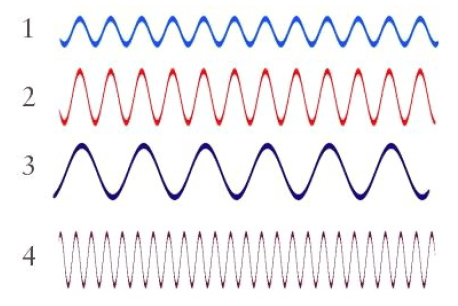
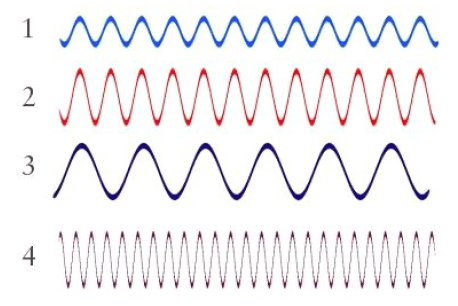
Which wave in the diagram has the greatest frequency?
a)
1
b)
2
c)
3
d)
4
3.
Which wave in the diagram has the greatest wavelength?
a)
1
b)
2
c)
3
d)
4
4.

The number of wavelengths that pass a fixed point each second.

a)

Amplitude

b)

Frequency

c)

Crest

d)

Trough

5.
 A wave has frequency of 50 Hz and a wavelength of 10 m. What is the speed of the wave?
a)
500 m/s
b)
50 m/s
c)
5 m/s
d)
0.5 m/s
6.

Which is a Longitudinal Wave?

a)
b)
7.

Shorter wavelengths result in _____________ frequencies.

a)

higher

b)

longer

c)

louder

d)

shorter

8.

Longitudinal Waves have dense regions called _______________

a)

compressions

b)

wavelength

c)

rarefactions

d)

amplitudes

9.

A wave that can travel with or without a medium is called a(n)

a)

electromagnetic wave

b)

mechanical wave

c)

surface wave

d)

all waves can travel in any way

10.
If a wave is traveling at 260 m/s and has a wavelength of 0.8 m/s, what is its frequency?
a)
208 Hz
b)
325 Hz
c)
430 Hz
d)
160 Hz
11.
 A wave has frequency of 50 Hz and a wavelength of 10 m. What is the speed of the wave?
a)
500 m/s
b)
50 m/s
c)
5 m/s
d)
0.5 m/s
12.
A wave has wavelength of 10 m and a speed of 340 m/s. What is the frequency of the wave?
a)
34 m/s
b)
3400 Hz
c)
3400 m/s
d)
34 Hz
13.
A part in a longitudinal wave where the particles are spread apart
a)
compression
b)
rarefaction
c)
crest
d)
trough
14.
The highest point on a wave is:
a)
the crest
b)
the trough
c)
the top
d)
the coast 
15.
The most dense part of a longitudinal wave.
a)
Density
b)
Compression
c)
Rarefaction
d)
Amplitude
16.
What types of waves carry energy at a right angle or perpendicular to the direction of the energy flow?
a)
Longitudinal waves
b)
Transverse waves
c)
Sound waves
d)
P-waves
17.
Which wave travels parallel in relation to a medium?
a)
Transverse
b)
Longitudinal
c)
Both
d)
Neither
18.
Sound is an example of which type of wave?
a)
Transverse
b)
Longitudinal
c)
Both
d)
Neither
19.

A wave has frequency of 5 Hz and a speed of 25 m/s. What is the wavelength of the wave?

a)

25 m

b)

125 m

c)

5 m

d)

25 m/s

20.
How many cycles are in this wave?
a)
1
b)
2
c)
3
d)
4
21.
The longer the _____________  the ______________ the frequency.
a)
wavelength, lower
b)
wavelength, higher
c)
amplitude, lower
d)
amplitude, higher
22.

Standing waves are created by

a)

Two identical waves reflecting off each other

b)

Two identical waves being diffracted together

c)

Two identical waves move through each other in opposite directions

d)

Two identical waves are diffracted from two identical sources

23.

In the diagram which letters represent the nodes

a)

A B C

b)

A C E

c)

B D

d)

B D E

e)

A C D

24.

How many antinodes does this standing wave have?

a)

5

b)

6

c)

7

d)

8

25.
The stationary dot is called:
a)
a node.
b)
an anti-node.
c)
the amplitude.
d)
the not moving bit.
26.
The moving black dot is called:
a)
a node
b)
an anti-node
c)
an anti-amplitude
d)
the wangy bit
27.
When two waves combine to form a new wave with a smaller amplitude, it is called 
a)
Refraction
b)
Constructive Interference
c)
Resonance
d)
Destructive Interference
28.
_______ is the number of waves that past in a given amount of time.
a)
frequency
b)
amplitude
c)
wavelength
d)
resonance
29.
a)
Constructive Interference
b)
Destructive Interference
c)
Refraction
d)
Diffraction
30.

When two waves experience constructive interference, the result is….

a)

A bigger wave

b)

A smaller wave

c)

A wave that is completely destroyed

d)

They simply pass through each other

31.

A wave with a very long wavelength has a ...

a)

high frequency

b)

low frequency

c)

large amplitude

d)

short amplitude

32.

Waves with a higher frequency have a ...

a)

longer wavelength

b)

shorter wavelength

c)

higher amplitude

d)

shorter amplitude

33.

Which describes how sound travels through a substance?

a)

Sound waves travel slowest through air

b)

Sound waves travel slowest through ice

c)

Sound waves travel fastest through water

d)

Sound waves travel the same through all types of substances

34.

What happens to the speed of a wave as it moves from a less dense medium to a more dense medium?

a)

The speed increases

b)

The speed decreases

c)

The speed remains the same

d)

The speed becomes zero

35.
What type of wave is this?
a)
Surface Wave 
b)
Standing Wave
c)
Electromagnetic Wave
d)
Transverse Wave
36.
A string is clamped at both ends and plucked so it vibrates in a standing mode as shown below. How many nodes and antinodes are there?
a)
2 nodes, 3 antinodes
b)
3 nodes, 2 antinodes
c)
4 nodes, 3 antinodes
d)
3 nodes, 4 antinodes
37.

If a wave has a frequency of 40 Hz, what is it's period?

a)

λ=\lambda= v/f = 343/40 = 8.6 m

b)

T = 1/f = 1/40 = 0.025 seconds

c)

T = v/f = 340/40 = 8.6 seconds

d)

λ=\lambda= 1/f = 1/40 = 0.025 m

38.

While sitting on the dock of the bay, you notice that 4 wave crests pass by you in 8 seconds. You have calculated that the frequency is 0.5 Hz, so how do you calculate the period?

a)

T =1/ 0.5 = 2 sec

b)

T = 1/ f = 1/8 = 0.125 sec

c)

f = 1/T = 1/8 = 0.125 Hz

d)

the period is given, T = 8 sec

39.

How many wavelengths are in this wave?

a)

1

b)

2

c)

2.5

d)

3

40.

The wavelength of this wave is ...

a)

.25 m

b)

.75 m

c)

2 m

d)

4 m