wayground logo

Free Printable Worksheets

NEW

Font size

S
M
L
XL
Worksheets

Neurons & Action Potential

Total questions: 50

Worksheet time: 39mins
Name
Class
Date
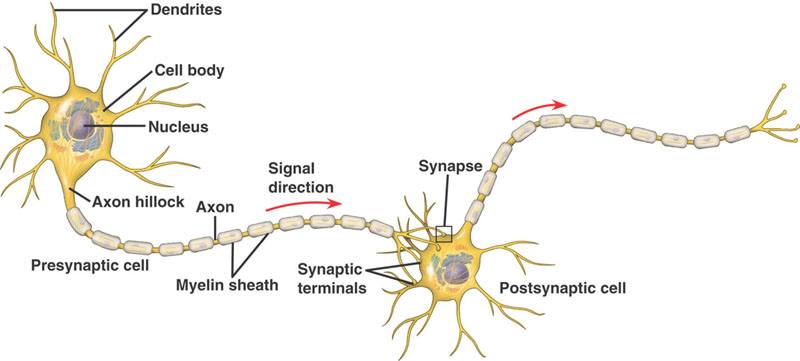
1.
a)

Nucleus

b)

Cell Body

c)

Axon

d)

Node of Ranvier

2.

What is the function of the nerve cells?

a)

They are responsable of your defense mechanism.

b)

They transmit signals or messages to other neurons, organs or glands.

c)

They transmit substances to your endocrine system to produce hormones.

3.

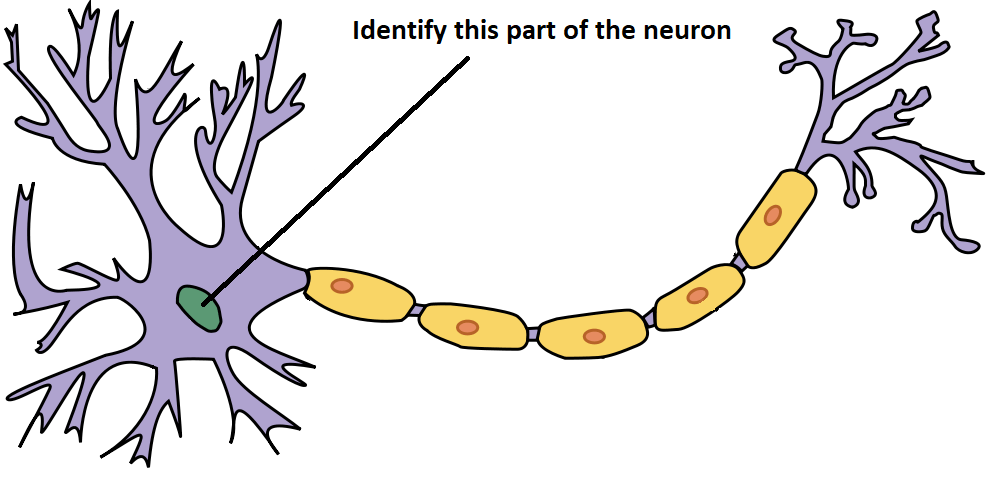
What is the name of the part of the neuron that is pointed out in the image?

a)

Cell Body (Soma)

b)

Axon

c)

Myelin Sheats

d)

Dendrites

4.

What is the name of the part of the neuron that is pointed out in the image?

a)

Myelin sheaths

b)

Cell Body (Soma)

c)

Axon

d)

Dendrites

5.

What is the name of the part of the neuron that is pointed out in the image?

a)

Myelin Sheats

b)

Axon

c)

Dendrites

d)

Cell Body (Soma)

6.

What is the name of the part of the neuron that is pointed out in the image?

a)

Myelin Sheats

b)

Cell Body (Soma)

c)

Dendrites

d)

Axon

7.

The protective fatty tissue that speeds up the transmission of messages is:

a)

Myelin Sheaths

b)

Axon

c)

Dendrites

d)

Soma

8.
Label the Neuron-What does the letter "A" represent?
a)
Axon
b)
Dendrite
c)
Axon Terminal
d)
Cell Body
9.
The part of the neuron that takes information away from the cell body is called a(n) _____________.
a)
dendrite
b)
axon
c)
cell body
d)
Schwann cell
10.
Location (space) where a neuron can transfer an impulse to another cell with the use of neurotransmitters is called __________.
a)
myelin sheath
b)
axon
c)
threshold
d)
synapse
11.
A chemical produced by neurons that carries messages to other neurons
a)
myelin sheath
b)
neurotransmitter
c)
axon
d)
axon terminal
12.
The tiny gap between neurons where nerve impulses are sent from one neuron to another.  It is where communication occurs between an axon and dendrite
a)
synapse
b)
axon terminal
c)
impulse
d)
myelin
13.

Approximately how many nerve cells does the brain contain?

a)

100 million

b)

55 billion

c)

86 million

d)

100 billion

14.
What is the brain made of?
a)
Nerve tissue
b)
Brain tissue
c)
Cortex tissue 
d)
Stem tissue
15.
This releases neurotransmitters which are sent into the synaptic cleft for receptors on the dendrite to taste
a)
axon
b)
axon terminal
c)
gene
d)
neuron
16.
The long, fiber like part of a neuron which the cell sends information to receiving neurons
a)
axon 
b)
dendrite
c)
axon terminal
d)
gene
17.
This releases neurotransmitters which are sent into the synaptic cleft for receptors on the dendrite to taste
a)
axon
b)
axon terminal
c)
gene
d)
neuron
18.
A network of branches coming from individual cells.  They carry information and electrical signals in the brain and nervous system
a)
axon
b)
axon terminal
c)
dendrite
d)
neuron
19.
A nerve cell that is the basic working unit of the brain and nervous system which processes and transmits information
a)
axon
b)
neuron
c)
dendrite
d)
neurotransmitter
20.
This insulating material forms a layer, around the axon of a neuron.  It enables electrical signals to travel down the axon at higher speeds.
a)
neuron
b)
myelin sheath
c)
dendrite
d)
neurotransmitter
21.
A chemical produced by neurons that carries messages to other neurons
a)
myelin sheath
b)
neurotransmitter
c)
axon
d)
axon terminal
22.
The tiny gap between neurons where nerve impulses are sent from one neuron to another.  It is where communication occurs between an axon and dendrite
a)
synapse
b)
axon terminal
c)
impulse
d)
myelin
23.
How many nerve cells does the brain contain?
a)
100 million
b)
86 billion
c)
86 million 
d)
100 billion
24.
What is the brain made of?
a)
Nerve tissue
b)
Brain tissue
c)
Cortex tissue 
d)
Stem tissue
25.
In order for a neuron to have an action potential, the neuron must receive more
a)
excitatory neurotransmitters
b)
inhibitory neurotransmitters
c)
agnostic neurotransmitters
d)
antagonistic neurotransmitters
26.
Excess neurotransmitters in the synapse that goes back into the presynaptic neuron.
a)
Resting potential
b)
Reuptake
c)
Retroactivity
d)
Repolarization
27.
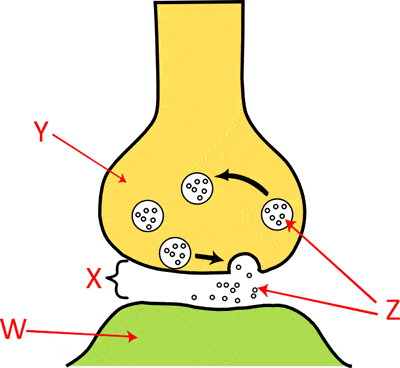
W
a)
Axon Terminal Button
b)
Neurotransmitters
c)
Dendrite
d)
Synapse
28.
Y
a)
Axon Terminal Button
b)
Neurotransmitters
c)
Dendrite
d)
Synapse
29.
What is the chemical used by a neuron to transmit an impulse across a synapse to another nerve cell?
a)
Neurotransmitters
b)
Synapse
c)
Threshold
d)
Impulse
30.
What generates a nerve impulse on the post-synaptic membrane? 
a)
Calcium binding with a receptor site
b)
Potassium leaking into the post-synaptic membrane 
c)
Neurotransmitter binding with receptor sites
d)
Neurotransmitter being removed from the synapse
31.

Z

a)

Axon Terminal Button

b)

Neurotransmitters

c)

Dendrite

d)

Synapse

32.

X

a)

Axon Terminal Button

b)

Neurotransmitters

c)

Dendrite

d)

Synapse

33.
What part of the neuron houses the nucleus?
a)
Cell Body
b)
Dendrites
c)
Axon Terminal
d)
Synapse
34.

Label the Neuron-What space does the letter "G"

represent?

a)

Axon Terminal

b)

Node of Ranvier

c)

Nucleus

d)

Myelin Sheath

35.
What is the insulating membrane that surrounds parts of the axon that helps to protect & propagate action potential?
a)
Axon
b)
Dendrites
c)
Node of Ranvier
d)
Myelin Sheath
36.
Which ions are involved in an action potential?
a)
Na; Cl
b)
Na; K
c)
K; Cl
d)
Na; Ca
37.
The sodium potassium pump restores the resting potential. By which process does this work? 
a)
Osmosis
b)
Diffusion
c)
Facilitated diffusion
d)
Active transport
38.
When a neuron is not engaged in an impulse.
a)
Resting potential
b)
Action potential
c)
Neural potential
d)
Synaptic potential
39.
When a neuron is resting, the inside of the axon has a ____________ charge.
a)
positive
b)
negative
40.
In resting potential, neurons have more _________ on the outside of the cell membrane.
a)
K+
b)
NaCl
c)
Na+
d)
Cl-
41.
In resting potential, neurons have more ____________ on the inside of the cell membrane.
a)
NaCl
b)
Na+
c)
K+
d)
Cl-
42.
Which ions are involved in the electrical nerve impulse?
a)
Iodine and Sodium
b)
Potassium and Sodium
c)
Iron and Sodium
d)
Calcium and Iodine
43.
At what stages do Sodium/Potassium Channels open?
a)
Repolarization/ Repolarization
b)
Depolarization/ Hyperpolarization
c)
Hyperpolarization/ Repolarization
d)
Depolarization/ Repolarization
44.

Which one of the following is involved in maintaining a resting membrane potential?

a)

Na+/K+ ATPase pump moves 3Na+ in for every 2K+ out

b)

Na+/K+ ATPase pump moves 3K+ in for every 2Na+ out

c)

Na+/K+ ATPase pump moves 3Na+ out for every 2K+ in

d)

Na+/K+ ATPase pump moves 3K+ out for every 2Na+ in

45.

Depolarization occurs when

a)

sodium channels open

b)

potassium channels open

c)

sodium channels close

d)

potassium channels close

46.

Depolarization is occuring at number

a)

1

b)

2

c)

4

d)

5

47.
What number(s) on the graph represents the Resting Potential?
a)
1 and 2
b)
1 and 5
c)
2 and 3
d)
3 and 4
48.
When a membrane potential reaches +30mV, ________ channels open, ________ occurs, and ________ channels close.
a)
Sodium, depolarization, potassium
b)
Potassium, depoloarization, sodium
c)
sodium, repolarization, potassium
d)
postassium, repolarization, sodium
49.
Part of a neuron that receives information from other neurons
a)
axon
b)
dendrites
c)
myelin sheath
d)
synapse
50.
The sodium-potassium pump....
a)
Sends (Na+) into the cell
b)
Sends (K+) into the cell
c)
Exchanges (K+) & (Na+) during depolarization
d)
Exchanges (K+) & (Na+) during hyperpolarization