
 Worksheets
Earthquakes, Volcanoes, Plate Tectonics
Total questions: 52
Worksheet time: 40mins
Name
Class
Date
1.

What type of fault is the San Andreas?
a)
Convergent
b)
Transform
c)
Optimus Prime
d)
Divergent
2.
The most destructive type of wave is a
a)
P-wave
b)
S-wave
c)
Surface wave
d)
transverse wave
3.
What is the area directly above the spot where the Earthquake actually occurs? (It is on Earth's surface.)
a)
Epicenter
b)
Focus
c)
Fault
d)
Triangulation
4.
The Richter scale measures:
a)
the amount of radon gas released
b)
the movement of plates
c)
the strength of an earthquake
d)
the weight of tectonic plates
5.
An earthquake scored high on the Richter scale but low on the Mercalli scale. Why?
a)
it probably happened in an area with no people
b)
it was a fast earthquake
c)
because it damaged a lot
d)
impossible to tell
6.
Liquefaction is when...
a)
the soil behaves like liquid
b)
the ground becomes liquid
c)
magma rises to the surface
d)
buildings are damaged, crumbling like liquid
7.
An instrument that detects and measures earthquakes is a
a)
seismogram
b)
focus seismic map
c)
focus
d)
seismograph
8.
How much bigger is a magnitude 8 earthquake compared to magnitude 7 one on the Richter Scale?
a)
1 time bigger
b)
10 times bigger
c)
100 times bigger
d)
1000 times bigger
9.
What is the beginning point of an earthquake, where the first motion of an earthquake occurs?
a)
Epicenter
b)
Focus
c)
P Waves
d)
Deformation
10.
Which wave can travel through solids, liquids, and gases?
a)
P
b)
S
c)
Surface
d)
Seismic
11.
Also known as shear or secondary wave; a seismic wave that causes particles of rock to move in a side-to- side direction.
a)
P-wave
b)
Seismic wave
c)
Focus
d)
S-wave
12.

What type of fault is this?
a)
Normal
b)
Reverse
c)
Strike-slip
13.

What type of fault is this?
a)
Normal
b)
Reverse
c)
Strike-slip
14.
Which is faster?
a)
p-waves
b)
s-waves
c)
surface waves
15.
What is molten rock that has formed deep within the Earth?
a)
Hot Spot
b)
Magma
c)
Lava
d)
Volcano
16.
Why does magma tend to rise to the surface?
a)
It has large amounts of silica.
b)
It contains very little silica.
c)
It is denser than the surrounding material.
d)
It is less dense than the surrounding material.
17.
The volcanoes on the Hawaiian Islands form due to which of the following?
a)
Divergent Boundary
b)
Hot Spot
c)
Subduction Boundary
d)
Transform Boundary
18.
What type of volcano has steep slopes made of alternating layers of ash and silica rich lava?
a)
Caldera
b)
Cinder Cone
c)
Composite Volcano
d)
Shield Volcano
19.
What type of volcano is made of lava fragments that have been ejected from a volcanic vent?
a)
Caldera
b)
Cinder Cone
c)
Composite Volcano
d)
Shield Volcano
20.
What type of volcano is Kilauea, which is located in Hawaii?
a)
Caldera
b)
Cinder Cone
c)
Composite Volcano
d)
Shield Volcano
21.
Where are most volcanoes found?
a)
Southern Hemisphere
b)
Ring of Fire
c)
Mid-Atlantic Ridge
d)
Hot Spots
22.
What is molten rock that has reached the Earth's surface?
a)
Aa
b)
Lava
c)
Magma
d)
Pahoehoe
23.
What type of volcano is Mount St. Helens?
a)
Caldera
b)
Cinder Cone
c)
Composite Volcano
d)
Shield Volcano
24.
What is the opening in Earth's crust through which molten rock, gases, and ash erupt?
a)
Divergent Boundary
b)
Magma
c)
Subduction Boundary
d)
Volcano
25.
The type of plate boundary where two plates come together is a .....
a)
Convergent Boundary
b)
Divergent Boundary
c)
Transform Boundary
d)
Plate Boundary
26.
Which of the following causes Earth's tectonic plates to move?
a)
Energy from the Sun
b)
Magnetic Pole Reversal
c)
Convection currents in the mantle
d)
Faults in Mountain Ranges
27.
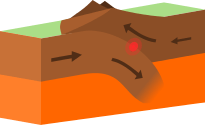
What type of plate boundary is this?
a)
Plate
b)
Divergent
c)
Convergent
d)
Transform
28.

What type of event will occur at this boundary?
a)
Earthquake
b)
Volcano Eruption
c)
Tornado
d)
Mountain Building
29.
A divergent boundary occurs when plates ....
a)
Pull apart
b)
Come together
c)
Slide past each other
d)
subducting
30.
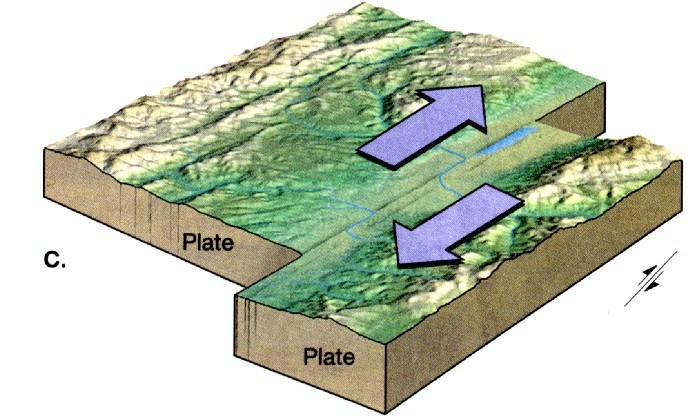
What type of plate boundary is this?
a)
Transform
b)
Convergent
c)
Divergent
d)
Plate
31.
The theory that says Earth's continents once made up an ancient supercontinent, and have been drifting apart ever since, is called the theory of...
a)
Pangea
b)
Plate Tectonics
c)
Natural Selection
d)
Gravity
32.
Oceanic Trenches are formed by _______ plate boundaries
a)
Convergent
b)
Transform
c)
Plate
d)
Divergent
33.
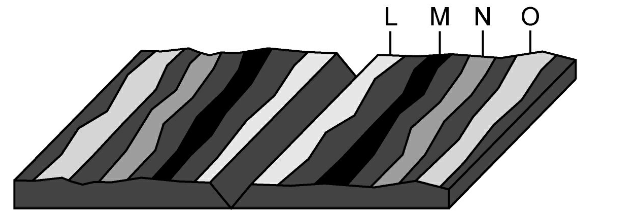
Where would the oldest rock be found?
a)
L
b)
M
c)
N
d)
O
34.
How is it possible for new crust to be formed without increasing the surface area of the Earth?
a)
Crust is destroyed at the same time it is created
b)
New crust is underwater where it sinks
c)
New crust breaks more easily than old crust
35.
Mountains are created when....
a)
Two continental plates collide
b)
Two oceanic plates pull apart
c)
An Oceanic plate subducts under a Continental Plate
d)
Two continental plates pull apart
36.
What type of plate boundary causes sea floor spreading?
a)
convergent
b)
divergent
c)
transform
d)
compression
37.
The stress caused by a transform plate boundary is
a)
compression
b)
tension
c)
shearing
d)
subduction
38.
What stress is associated with a convergent plate boundary?
a)
compression
b)
tension
c)
shearing
d)
sea floor spreading
39.

The super continent that existed millions of years ago is called
a)
Wegener
b)
Pangea
c)
Jurassic World
d)
Eurasia
40.
What is the outermost layer of earth?
a)
inner core
b)
outer core
c)
mantle
d)
crust
41.
Which layer is made of solid iron & nickel?
a)
inner core
b)
outer core
c)
mantle
d)
crust
42.
What is the outer core made of?
a)
solid rock
b)
solid metal
c)
melted rock
d)
melted metal
43.
Which layer has the coolest temperatures?
a)
outer core
b)
inner core
c)
mantle
d)
crust
44.
Which layer has the hottest temperatures?
a)
inner core
b)
outer core
c)
mantle
d)
crust
45.
Which layer is the least dense?
a)
inner core
b)
outer core
c)
mantle
d)
crust
46.
Which statement is true about oceanic crust?
a)
It is made of melted rock.
b)
It is the thinner than continental crust.
c)
It is thicker than continental crust.
d)
It is made of liquid metal.
47.
Which layer causes the earth's magnetic field?
a)
inner core
b)
outer core
c)
mantle
d)
crust
48.
What is the lithosphere made of?
a)
the upper mantle
b)
the crust & part of upper mantle
c)
the crust and mantle
d)
the crust
49.
What kind of crust do we live on?
a)
oceanic crust
b)
continental crust
50.

Which layer is represented by the yellow layer?
a)
inner core
b)
outer core
c)
mantle
d)
crust
51.
What happens to temperature as you move down through the layers?
a)
it remains the same
b)
it increases then decreases
c)
it increases
d)
it decreases
52.
Which statement is correct?
a)
As you move up through the layers, the pressure increases.
b)
As you move down through the layers pressure increases.
c)
As you move down through the layers, pressure decreases.
d)
As you move up down through the layers, pressure remains the same.
100 %

