
 Worksheets
Fingerprints (Quick Check)
Total questions: 22
Worksheet time: 14mins
William is learning about fingerprint patterns in his science class. His teacher shows him four different patterns and asks him to identify which one is not a general fingerprint pattern. Which should William choose?
Swirl
Whorl
Arch
Loop

Arjun is learning about fingerprint patterns in his science class. He looks at the fingerprint below, which is from his right hand. What pattern is this? (Hover over the picture)
Tented Arch
Plain Arch
Ulnar Loop
Plain Whorl

Identify the fingerprint pattern shown in the image. (Right Hand) (Hover over the picture)
Plain Whorl
Central Pocket Whorl
Double Loop Whorl
Accidental Whorl

What type of fingerprint is this? (Right hand) (Hover over the picture)
Central Pocket Whorl
Ulnar Loop
Accidental Whorl
Double Loop Whorl

What is the name of this minutiae?
Enclosure/Eye
Island
Dot
Bifurcation

What are the red triangles? (hover over the pic)
deltas
useless
forks
loops
What is a ridge count number?
The number of ridges from left to right
The number of ridges from top to bottom
The number of ridges between cores and deltas
The number of ridges connecting the center to the edge of a print
A criminal left a bloody fingerprint on a door handle. What type of print is this?
Patent
Latent
Plastic
Painted
What is the name of the print database maintained by the FBI to search both finger and palm prints?
AFIT: Automated Fingerprint Identification System (Upgraded to IAFIS)
PSC: Print Search Computer
APD: Automated Print Database
DPD: Digital Print Database
Which is NOT one of the three main distinguishing factors in fingerprint identification?
Width of the ridges
General patterns (Loops, Arches, Whorls)
Ridge Counts
Minutiae
Which is a possible outcome from a fingerprint analysis?
All of the choices
Positive Identification
Suspect exclusion
Match Inconclusive
The field of fingerprint analysis became quite popular during these years. Sir William Herschel began collecting fingerprints, Sir Francis Galton verified they didn't change with age, and Sir Edmund Henry established what became the modern day 10-card. What were the approximate years for this and for many fields of forensic science?
1850-1900
1900-1950
1800-1850
1750-1800
1700-1750
How and when are fingerprints created?
10-12 week fetus by volar pads
Inherited DNA instructions make special proteins during the ectoderm differentiation
Basal layer production during the 7th month of pregnancy
Fingertip biological printers around the 20th week of pregnancy
Why is removing your fingerprints from your fingers so difficult?
The patterns are present in the deep basal layer of skin
The patterns are present in the deep epidermal layer of skin
You need to remove your muscle tissue to remove your fingerprints
False. It is easy to remove your fingerprints by burning them.
Match the following fingerprint general patterns to the expected number of deltas.
Loops
1
Arches
0
Whorls
2 or 3
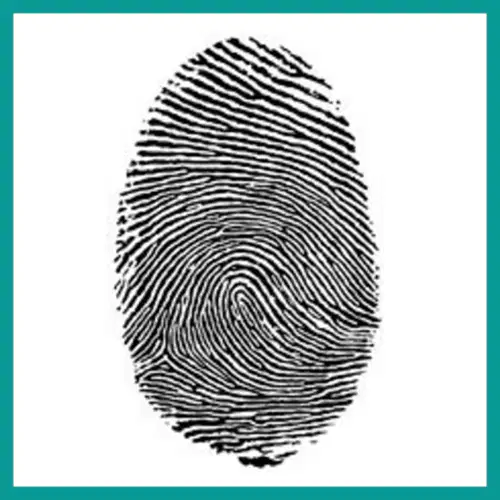
This print is from the right thumb. What is the specialized pattern?
Ulnar loop
Radial loop
Plain arch
Central Pocket loop whorl
Double loop whorl
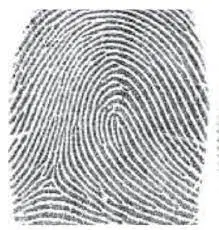
This print is from the left pointer finger. What is the specialized pattern?
Radial loop
Ulnar loop
Accidental whorl
Tented arch
How many cores should be present in loop fingerprints
1 each
2 each
2 or 3 each
None
Each successive level of fingerprint analysis reduces the suspect pool size. Of the three levels (specialized patterns, ridge count, minutiae), which provides the greatest individual evidence?
minutiae
specialized patterns
ridge counts
none, because fingerprinting only yields class evidence
Most fingerprints, palm prints, or toe prints are invisible to the eye until a contrasting powder attaches to the ridges (dusting for prints). What general type of evidence is this considered?
Latent
Patent
Plastic
Hidden
There are several substances that can help CSI agents find fingerprints because they undergo a chemical reaction with the fingerprint ridges. What are these substances reacting with in the fingerprints?
Oils, sugars and proteins
DNA
Skin
Oils only
Many places on the human body can leave a unique print at a crime scene that CSI agents can find. Which of the following is not typically one of those unique prints?
tongue prints
lip prints
palm prints
toe prints

