
 Worksheets
Reproduction, Development and Growth in Humans and Animals
Total questions: 50
Worksheet time: 38mins
What would happen to a species if every member could not reproduce?
The species will become endanger and can be extinct.
The fertilization is not needed because they will do asexual reproduction.
The species will arise as a dominant population on Earth.
The organism will adapt and prevent early death cases.
Which of the following are the female gonads?
Spermatozoa
Ova
Testes
Ovaries
Which of the following are the male gametes?
Ovaries
Testes
Spermatozoa
Ova
What is the scrotum?
A pouch of skin surrounding the testes
A fold of skin that protects the penis
An additional gland located at the end of the urethra
Where are spermatozoa stored while they are maturing?
In the prostate
In the epidymis
In the testes
In the seminal vesicle
Where is the genetic material (DNA) located in the spermatozoa?
In the head
In the tail
In the middle piece
Which part of the uterus is connected to the vagina?
The fallopian tubes
The cervix
The ovaries
Where does oogenesis take place?
Uterus
Fallopian tubes
Ovaries
Vagina
The FSH hormone is secreted by
the ovarian follicle
the pituitary gland
the corpus luteum
Which hormone stimulates follicle growth?
FSH
LH
Oestrogen
Without fertilisation, the corpus luteum
gets bigger
evolves
disintegrates
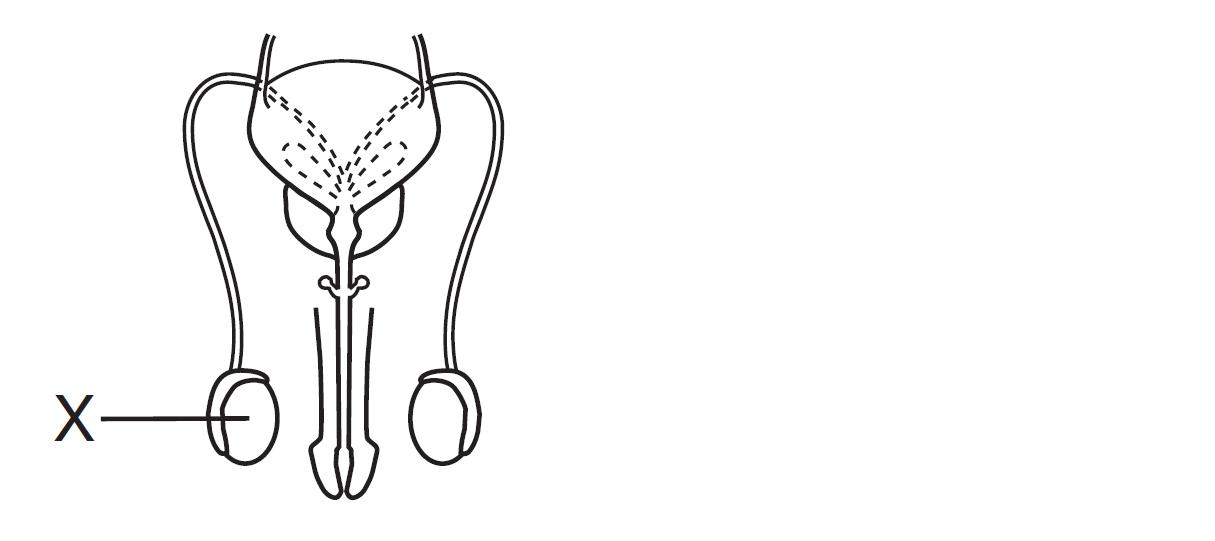
The diagram below represents a system in the human body. The function of structure X is to _____________
produce energy needed for sperm to move
provide food for the sperm to carry to the egg
produce and store urine
produce sperms and male sex hormones
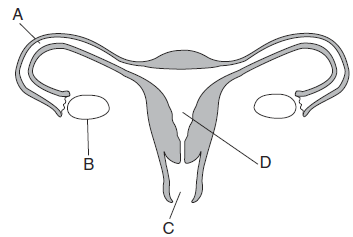
The human female reproductive system is represented below. Where will the embryo attach itself after fertilization?
A
B
C
D
What does IVF stand for?
In vitro fertilisation
Insert viable foetus
Internal variable fertilisation
Internal vitro fertilisation
The main function of the placenta is to :
allow direct exchange of blood between the mother and fetus for nutrition.
facilitate gas and nutrient exchange between the fetus and mother.
support the weight of the developing fetus in the uterus.
store gases and nutrients for later delivery to the fetus.
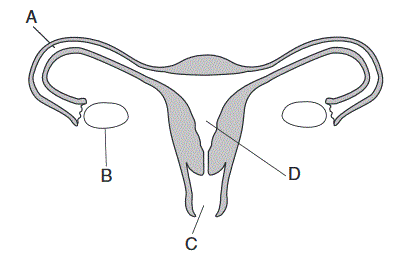
The diagram below represents structures found in the female reproductive system. If the areas labeled A were completely blocked on both sides, the most likely result would be that
egg production would stop
sperm production would stop
fertilization would not occur
an embryo would develop
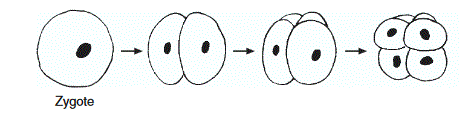
The diagram below represents some stages of early embryonic development. Which process is represented by the arrows in the diagram?
meiosis
Mitosis
Fertilization
Evolution


The process of spermatogenesis occurs in the
testes
ovaries
fallopian tubes
vas deferens
The process of spermatogenesis results in
one egg cell and three polar bodies
4 sperm cells
one sperm cell and three polar bodies
4 egg cells
The process of oogenesis results in
one egg cell and three polar bodies
4 sperm cells
one sperm cell and three polar bodies
4 egg cells
If a cell that has 46 chromosomes divides by meiosis, each cell produced at the end of this process will contain how many chromosomes?
23
46
69
92

An organized picture of an individual's chromosomes used to diagnose extra or missing chromosomes
amniocentesis
urine analysis
blood typing
karyotype
How many secondary spermatocytes are produced after the first round of meiosis?
1
2
4
A primary spermatocytes.....
A)divide by mitosis to produce two secondary spermatocytes
B)divide by meiosis to produce two secondary spermatocytes.
C)divides by meiosis to produce four spermatids
D)divides by meiosis to produce two spermatids.
E)divides by mitosis to produce two spermatids.
When does completion of meiosis occur in secondary oocyte
Stage 1
Stage 2
Fertilisation
Ovulation
In what structure does the secondary oocyte start Meoisis II?
Primary follicle
Primordial follicle
Eiffel Tower
Graafian follicle
Which one of the following is not diploid?
germinal epithelial cell
oogonia
primary oocyte
secondary oocyte
If fertilisation doesn't happen in what stage of meiosis II does the secondary oocyte reach?
Telophase
Prophase
Metaphase
Anaphase
When does oogenesis begin?
at birth
before birth
at the onset of adulthood
at the onset of puberty
What do you call the process in which the ovary releases a mature egg cell?
menstruation
oogenesis
ovulation
fertilisation
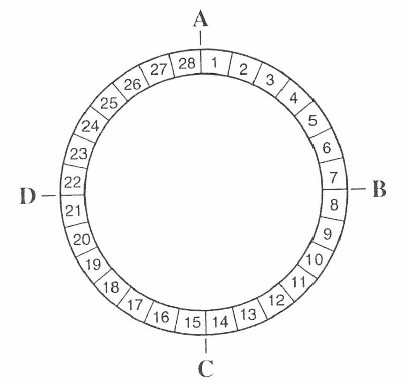
Which day that fertilization could occur if the sperm is present?
Day 1 - 5
Day 6 - 10
Day 11- 18
Day 19 - 28
What hormones are released by the Pituitary Gland?
FSH, Oestrogen, LH and Progesterone
FSH, Oestrogen, and Progesterone
FSH, LH and Progesterone
FSH and LH
What is Menstruation?
Discharge of blood and tissues of the uterus wall
Discharge of blood and tissues of the uterine lining
Discharge of egg from the ovary
Discharge of hormones from the ovary
On which date is a woman most likely to ovulate if the first day of menstrual loss was 1 February?
5 February
14 February
28 February
1 March

The graph shows the concentration in the blood of three of the four hormones FSH, LH, oestrogen and progesterone.
Which hormone is not shown?
FSH
LH
Oestrogen
Progesterone
Twins that are formed when two eggs are fertilized by two different sperm cells are called
Identical twins
Fratenal twins
Multple twins
Twins
Identical twins are formed when
the embryo splits into two and then stays stuck together
when 1 egg is fertilized by 1 sperm and then divides into 2
when two eggs are fertilized by one sperm
when one egg is fertilized by two sperm
Human growth is reversible.
True
False

The common pattern of growth displayed by insect is.....
Unlimited growth
Limited growth
Allometric growth
Intermittent growth
The exoskeleton is periodically shed in a process known as
ecdysis
chitin
instar
chaetae
the period between two ecdysis is known as
instar
moult
antagonistics
chitin
Select from the following graphs, the one that accurately shows the growth of an insect that does complete metamorphosis from the time it hatches till the time it becomes an adult


The diagram shows stages of oogenesis. What is stage W?
Mitosis
Meiosis I
Meiosis II
Differentiation

The figure shows the growth phases of an organism. Describe what happen during log phase?
Cells are still dividing but at a rate replacing the cells that have died
Growth slow down because limited by internal or external factors
The fastest organism growth
Organisms is trying to adapt to the new environment
undergo a few stages of ecdysis
complete metamorphosis
incomplete metamorphosis
molting

