
 Worksheets
Force and Motion Test
Total questions: 47
Worksheet time: 28mins
Newton's third law states that
An object at rest tends to stay at rest, and an object in motion tends to stay in motion, with the same direction and speed.
For every action, there is an equal and opposite reaction.
Force equals mass times acceleration
Newton's second law states that
An object at rest tends to stay at rest, and an object in motion tends to stay in motion, with the same direction and speed.
For every action, there is an equal and opposite reaction.
Force equals mass times acceleration
Newton's first law states that
An object at rest tends to stay at rest, and an object in motion tends to stay in motion, with the same direction and speed.
For every action, there is an equal and opposite reaction.
Force equals mass times acceleration

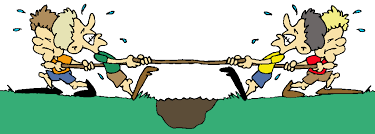
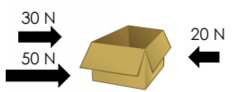
The image below shows two opposite forces acting during Tug-a-war, what can we say is true about the effect of the forces on the cart?
It cannot be determined without knowing which team is stronger.
The forces are unbalanced, and net force on the rope moves it to the left.
It cannot be determined because one team looks stronger than the other.
The forces are unbalanced, and net force on the rope moves it to the right.
What is velocity?
the speed of an object in a particular direction
a change in velocity
a push or pull
the location of an object in relation to another object
What is force?
a change in position
a push or pull
a change in velocity
how fast or slow something is moving
What is speed?
how hot or cold something is
how fast or slow something is moving
a force that acts to pull an object down to earth
how short or tall something is
What is acceleration?
a change in velocity
putting the pedal to the metal
a change in speed
a change in position
What is motion?
emotion-e
a change in position
a change in velocity
speed of an object in a particular direction
What is the unit for FORCE?
N (Newtons)
lbs (pounds)
g (grams)
m/s (meters per second)
If the net force is 0 the object will ...
CHANGE its motion
STAY the SAME, NOT Move

A bicycle rode 210 meters in 3 minutes. What was the speed of the bicycle?
630 m/min
70 m/min
7 m/min
7,000 m/min
Match the description to the graph:
"The car is stopped."


Match the description to the graph:
"The car is traveling at a constant speed."

Segment A-B The bus is _________________.
at rest
returning (to original position)
moving forward
What is the equation to calculate speed?
Speed = distance/time
Distance = time/speed
Speed = distance x velocity
Speed = distance x time

Which of the graphs show that a car is stopped?
E
F
G
H
Holding a marble at the top of a ramp
Potential
Kinetic
A slinky moving down a set of stairs
Potential Energy
Kinetic Energy
A boy standing on top of a slide
Potential Energy
Kinetic Energy
Kinetic Energy is
energy that matter has because of its position
energy that matter has because of its motion
What energy is stored and waiting to be used?
Kinetic Energy
Potential Energy
A lamp sitting on a table
balanced
unbalanced
A car accelerating around a mountain curve.
balanced
unbalanced
A book sitting on a shelf.
balanced
unbalanced
A skier skiing through flags in a race down the mountain.
balanced
unbalanced
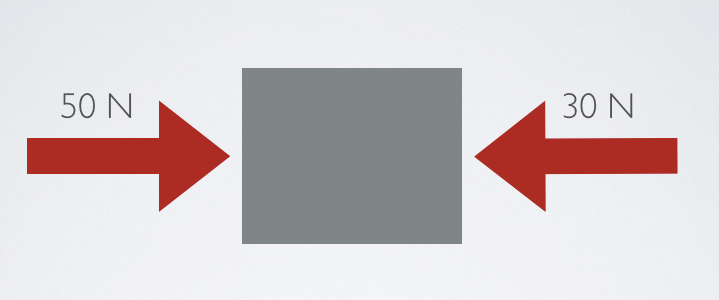


Which graph could represent a car moving at a constant speed in a forward direction?


Match the graph to the description:
"The car is stopped."
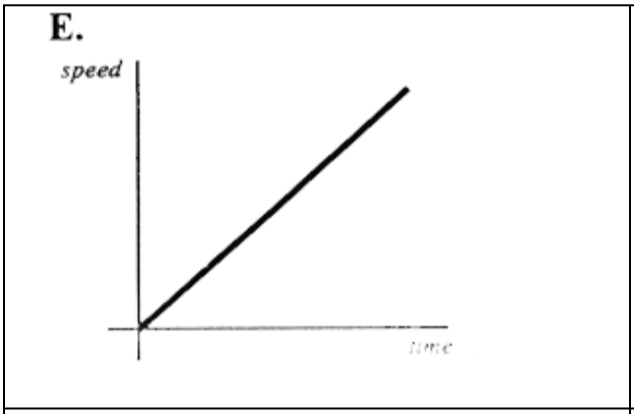
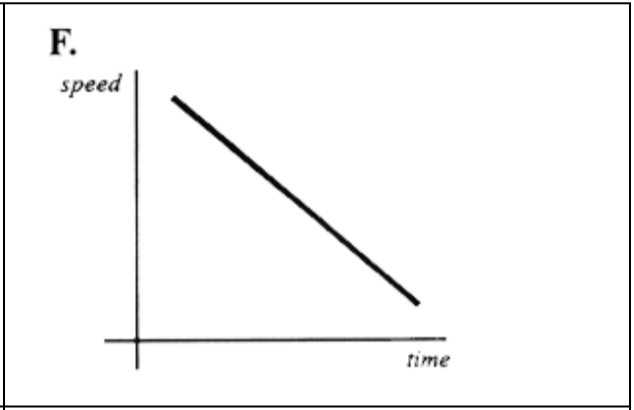
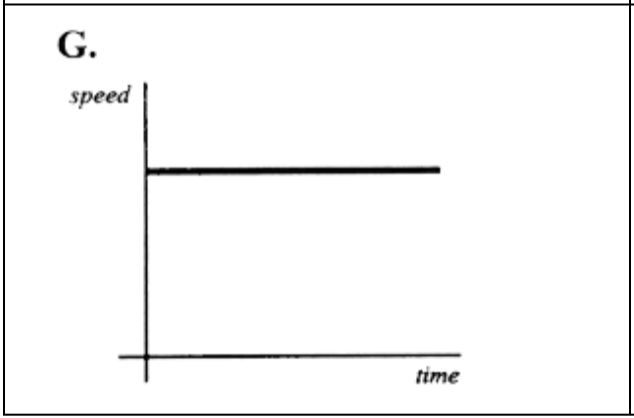
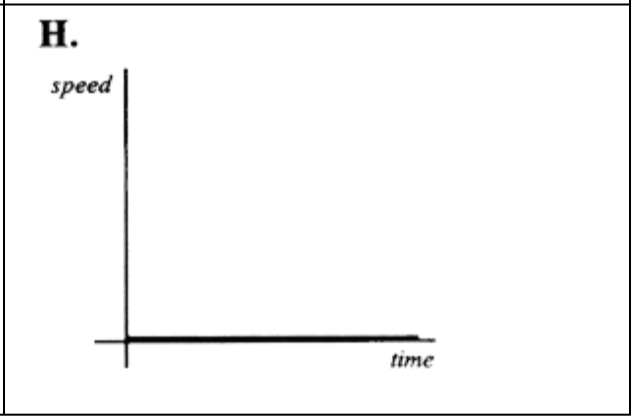
Match the graph to the description:
"The car is traveling at a constant speed."
Match the graph to the description:
"The car is accelerating speeding up (positive acceleration)."
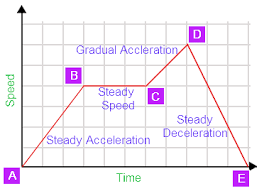
At what point is the speed the greatest?
C-D
B-C
A-B
D-E


Which answer choice best describes the movement of the object between the times of 0 and 6 seconds on the graph?
Moving at a constant speed
Accelerating
Moving toward the north
Stopped

Fido got out of his fenced yard and went wandering.What was the fastest segment of Fido's day outside the fence as he ran away?
A-B
B-C
C-D
D-F

What likely happened at points B-C?
He stopped
he ran quickly
he walked slowly
he ran back home

On a speed/time graph, what does a flat line mean?
Constant speed
stopping
increasing speed
decreasing speed

