
 Worksheets
Circulatory System: (parts and functions)
Total questions: 46
Worksheet time: 27mins
The human heart is _____________
made of muscle
pumps blood
had four chambers
all of the above
The blood is pumped to the lungs from the heart through the ______________
aorta
pulmonary veins
pulmonary arteries
ven cavas
The blood comes back to the heart from the body through two big veins called the ____________
pulmonary veins
vena cavas
aortas
right atria
The blood leaves the heart to the body through the ____________
aorta
pulmonary veins
pulmonary arteries
vena cavas
the first chamber of the heart the blood from the body enters is the __________
left atrium
right atrium
left ventricle
right ventricle
Which of the following is the liquid element of the blood?
platelets
plasma
Red blood cell
white blood cell
The blood vessels in the circulatory system where the exchange of gas takes place are the ____________
veins
arteries
aortas
capillaries
The correct sequence of heart chambers a red blood cell would pass through as it travels through the heart.
right atrium - left ventricle - left atrium - right ventricle
left atrium - left ventricle - right atrium - right ventricle
left atrium - right atrium - left ventricle - right ventricle
right atrium - right ventricle - left atrium - left ventricle
Which of the following is not part of the circulatory system?
heart
blood
blood vessels
lungs
What gives red blood cells their color?
hemoglobin
hemoglowbin
haemoglobin
heamowglobin
What is responsible for blood clotting?
Corpuscules
Protein
Hemoglobin
Plasma
What circulation carries oxygenated blood to the body?
coronary
systemic
pulmonary
portal
The valve between the right atrium and the right ventricle is called the ____________
bicuspid valve
tricuspid valve
mitral valve
heart valve
What color is oxygenated blood?
red
blue
white
purple
Component of blood that fights foreign bodies
plasma
white blood cells
red blood cells
platelets
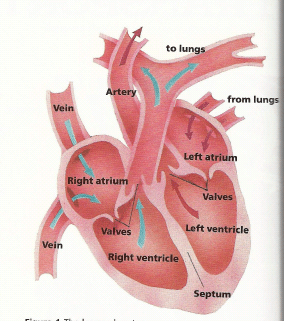
The _______________divides the heart into left and right sides.
septum
atria
ventricles
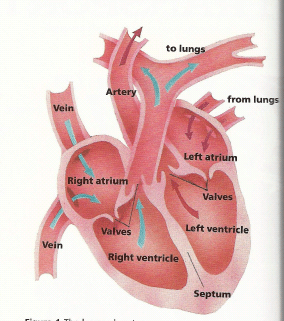
The upper chambers of the heart are called______________.
atria
ventricles
septum
The upper chambers of the heart are called______________.
atria
ventricles
septum
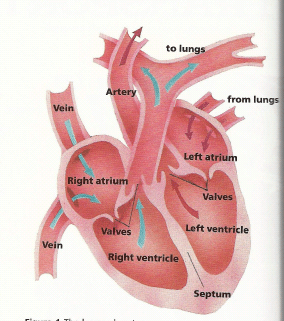
There are _____________chambers in the heart.
3
4
5
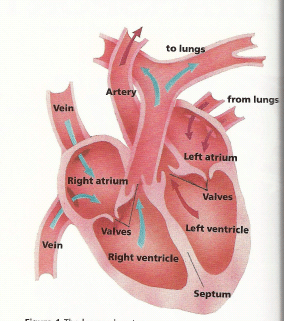
The ______________pump blood into the body.
septum
atria
ventricles
What keeps blood from flowing backwards in the heart?
atrium
valves
artery
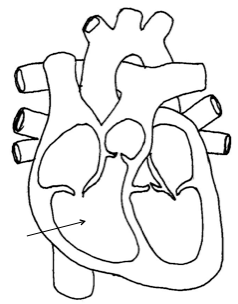
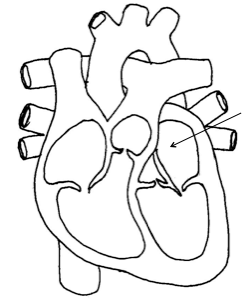
The movement of blood through the heart and body is called
circulation
locomotion
ventriculation
heart pump
The beating sound your heart makes comes from
blood going in the wrong direction
valves closing
the heart skipping beats
your ears playing tricks on you
With circulation, the heart provides your body with:
Oxygen
Nutrients
A way to get rid of waste
All of the above
The atria are the “upstairs” chambers of the heart and these parts are the “downstairs” chambers
Valves
Ventricles
Blood
Candy hearts

What the the functions of the Circulatory System? (Multiple answers)
Transports materials (gases, nutrients, waste products, molecules, hormones) to different
parts of the body
Removes waste products (cell waste and carbon dioxide)
helps your body move
Fights diseases
Which of the following statements is not a function of the lungs?
keeps oxygen in the body cells
keeps carbon dioxide in the body cells
exchanges oxygen and carbon dioxide between the body cells
exchanges gases between the body cells and external environment
Which is the correct pathway of oxygen?
nostril - pharynx - larynx - trachea - bronchi - bronchioles - alveoli
nostril - larynx - pharynx - trachea - bronchioles - bronchi - alveoli
nostril - pharynx - larynx - trachea - bronchi - bronchioles - alveoli
nostril - trachea - larynx - pharynx - bronchi - bronchioles - alveoli
What happens when we inhale?
the diaphragm relaxes, the volume of the lungs increases
the diaphragm relaxes, the volume of the lungs decreases
the diaphragm contracts, the volume of the lungs increases
the diaphragm contracts, the volume of the lungs decreases
Which of the following parts is responsible for gas exchange?
alveoli
bronchioles
larynx
nasal cavity
The following statements give the functions of the lungs, except
the lungs add oxygen to the blood
the lungs contract or relax during breathing
the lungs remove carbon dioxide from the body
the lungs control the respiratory system that helps make breathing possible
Which statement does not give the function of the circulatory system?
circulates blood
controls the functions of the heart
transports nutrients, gases and hormones
defends the body against pathogenic organisms
Which of the following is not part of the circulatory system?
blood
blood vessels
heart
lungs
What type of blood is being carried in the systemic circuit?
oxygenated blood only
deoxygenated blood only
both oxygenated and deoxygenated blood
neither oxygenated nor deoxygenated blood
Which blood vessels carry oxygen-poor blood?
arteries
arterioles
capillaries
veins
Which of the following pathway of blood flow is correct?
right atrium - right ventricle - pulmonary artery - lungs - pulmonary veins - left atrium - left ventricle - aorta
right atrium - pulmonary artery - right ventricle - lungs - pulmonary veins - left atrium - left ventricle - aorta
right ventricle - pulmonary artery - right atrium - lungs - pulmonary veins - left atrium - left ventricle – aorta
right ventricle - right atrium - lungs - pulmonary veins - pulmonary artery left atrium - left ventricle - aorta

