Wayground logo

Free Printable Worksheets

Font size

S
M
L
XL
Worksheets

Hazardous Environment

Total questions: 25

Worksheet time: 14mins

Name
Class
Date
1.

Once magma reaches the Earth's surface it is called.......

a)

Silica

b)

Lava

c)

Rock

d)

Molten

2.

TRUE or FALSE: A volcano that erupts quietly will produce a lot of cinders, ash, and bombs

a)

TRUE

b)

FALSE

3.
Which of the following terms are used to describe a volcano that may erupt at any time? 
a)
Dormant volcano
b)
Active volcano
c)
Extinct volcano
d)
Shield volcano
4.
Which of the following terms best describes a volcano that is dead and unlikely to erupt again? 
a)
Dormant volcano
b)
Extinct volcano
c)
Shield volcano
d)
Caldera
5.
Which of the following terms are used to describe a volcano that is has not recently erupted, but may in the future? (aka sleeping volcano)
a)
Composite volcano
b)
Active volcano
c)
Extinct volcano
d)
Dormant volcano
6.

As the country with the most active volcanoes, how do the government of Indonesia reacted to the eruption?

a)

alerting people living nearby

b)

monitoring the activity

c)

create an emergency evacuation if something happen

d)

don't bother to act

7.
What factor(s) determine(s) whether an eruption will be explosive?
a)
The amount of gases in the magma
b)
The amount of silica in the magma
c)
The amount of gas and silica in the magma
d)
None of these affect the explosiveness of the volcano
8.

What tool helps a volcanologist to monitor seismic activity?

a)

Radar

b)

GPS

c)

Thermometer

d)

Seismograph

9.
A mixture of hot gases, ash, cinders, and bombs that erupt explosively are called a(n)...
a)
pyroclastic flow
b)
lava flow
c)
volcanic cloud
d)
active mixtures
10.
What is an earthquake?
a)
When the earth causes an upward thrust in the epicenter.
b)
When the earth moves up and down along the ocean floor.
c)
When tectonic plates move against each other causing the earth to move. 
d)
None of the above
11.
Many earthquakes happen along the borders of...
a)
Countries
b)
Tetonic Plates
c)
Climate Zones
d)
None of the above.
12.
The epicenter of an earthquake is
a)
The point below the surface where rock begins to break and the first motion occurs
b)
The seismic station closest to the earthquake
c)
The place where the greatest damage occurs
d)
The point on the surface directly above the focus
13.
The Richter scale measures:
a)
the amount of radon gas released
b)
the movement of plates
c)
the strength of an earthquake
d)
the weight of tectonic plates
14.
Which is NOT a risk factor contributing to landslides
a)
Surrounding wildlife
b)
Slope Angle
c)
Gravity
d)
Amount of Water
15.

Why do avalanches happen?

a)

Tremors from far away earthquakes shake snow and ice loose

b)

Heavy rainfall weighs down on existing snow turning it to ice and it slides down

c)

Vibrations from loud sounds shatter old ice sheets causing them and the snow on them to fall

d)

Heavy snowfall lands on layers of old snow and ice causing them to become unstable

16.

When are avalanches most likely to happen?

a)

After a heavy snow storm drops at least 12 inches of new snow on top of old snow

b)

After an earthquake

c)

After a rain storm drops at least 12 inches of water on top of old snow

d)

After major celebrations that include fireworks

17.
Hurricanes lose power by
a)
traveling over the ocean
b)
travel over land
18.
What is the strongest category of hurricane?
a)
Category 5
b)
Category 10
c)
Category 1
19.
What measures the intensity of a tornado?
a)
Categories
b)
Tornado Scale
c)
Fujita Scale 
d)
Intense Scale
20.
What causes damage in a hurricane?
a)
Winds
b)
Flooding
c)
Storm Surge
d)
All of the above
21.

Hurricanes develop in ________ regions.

a)

Arctic

b)

Tropical

c)

Arid

d)

None of the above

22.
Where do most hurricanes develop?
a)
Middle of the United States
b)
Near the Equator
c)
Near Canada and Alaska
d)
Antarctica
23.
What is the name of a hurricane in Asia?
a)
Cyclone
b)
Typhoon
c)
Bob
d)
Dennis
24.
Where do tornadoes start?
a)
Over the ocean near the equator
b)
In the clouds that create blizzards
c)
In the clouds of severe thunderstorms
d)
Any time that it rains
25.
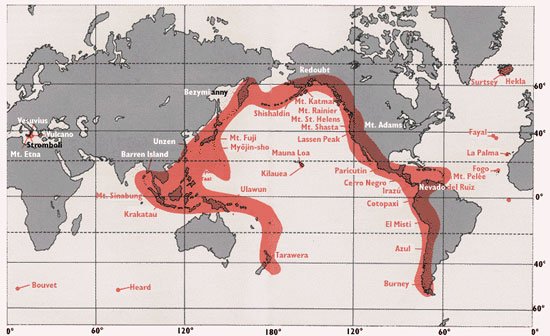
This is the name for the chain of volcanos around the edge of the Pacific Plate.
a)
Circle of Fire
b)
Ring of Lava
c)
Ring of Fire
d)
Circle of Magma