
 Worksheets
Chapter 10: Mechanical & sound waves
Total questions: 50
Worksheet time: 1hrs 21mins


∎ Progressive waves are travelling along the string in both directions.
∎ The standing wave is an example of superposition.
∎ The wavelength of the standing wave is d.

Standing waves are created by
Two identical waves reflecting off each other
Two identical waves being diffracted together
Two identical waves move through each other in opposite directions
Two identical waves are diffracted from two identical sources
In the diagram which letters represent the nodes
A B C
A C E
B D
B D E
A C D

What does a wave carry from place to place?
energy
matter
people
The highest point on a transverse wave is the
compression
crest
rest position
trough
The number of waves that pass somewhere in a second is:
amplitude
frequency
wavelength
What is the relation between Sound Intensity and Amplitude?
A. They are Inversely Proportional
B. They are Directly Proportional
C. They are Non – Linearly Proportional
D. None of these
Unit for measuring Sound Intensity
A. Joules
B. Lambda (λ)
C. Watts / Metre2 or Decibel
D. Hertz
In concert halls, soft materials and carpets are used to
(a) Increase sound waves
(b) Absorb sound waves
(c) Retract sound waves
(d) Refract sound waves.
The other name of wavelength is
λ
θ
β
γ
Intensity = ?
Power / Area
Power / Amplitude
Power / Frequency
Power / λ
(Hint: Think about our sound song.)





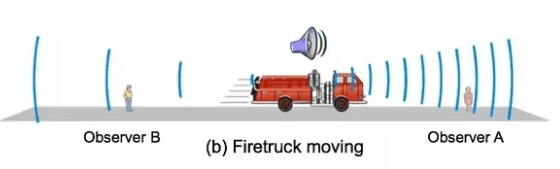
Look at the picture. Who is experiencing a higher pitched sound?
Observer A
Observer B
There's no difference
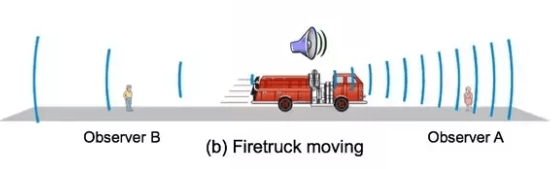
Look at the picture. Who is experiencing a lower pitched sound?
Observer A
Observer B
There is no difference
The first harmonic has
1 antinode
1 node
2 antinodes
no nodes
The second harmonic on a string fixed at both ends shows
A wavelength
Half a wavelength
Two wavelengths
The third harmonic on a string fixed at both ends shows
A wavelength and a half
Half a wavelength
Two wavelengths
A wavelength


How many antinodes does this standing wave have?
5
6
7
8

Standing waves created in strings, pipes and closed pipes have specific wavelengths that fit into the length of those instruments
True
False

Of the sound sources shown, that which is vibrating with its first harmonic is
the whistle.
the organ pipe.
the vibrating string.
the vibrating rod.
None of these.

Of the sound sources shown, that which is vibrating with its first harmonic is the
whistle.
organ pipe.
vibrating string.
vibrating rod.
vibrating spring.
What is the fist harmonic also called?
First harmonic
First Overtone
The fundamental
The resonant frequency
Even numbered harmonics do not form in a closed pipe because
the pipe “fits” only an odd number of quarter wavelengths
the pipe “fits” only an even number of quarter wavelengths
the pipe cannot put an anti-node at the open end
the pipe cannot get enough air to vibrate in the pipe at these lengths
Even numbered harmonics do not form in a closed pipe because
the pipe “fits” only an odd number of quarter wavelengths
the pipe “fits” only an even number of quarter wavelengths
the pipe cannot put an anti-node at the open end
the pipe cannot get enough air to vibrate in the pipe at these lengths
What number harmonic is shown in A
1
2
3
4

A pipe, opened at both ends (40 cm long) makes a tone travelling at 330 m/s. Calculate the frequency of the fundamental wave.
4.125 Hz
264 Hz
26400 Hz
412.5 Hz
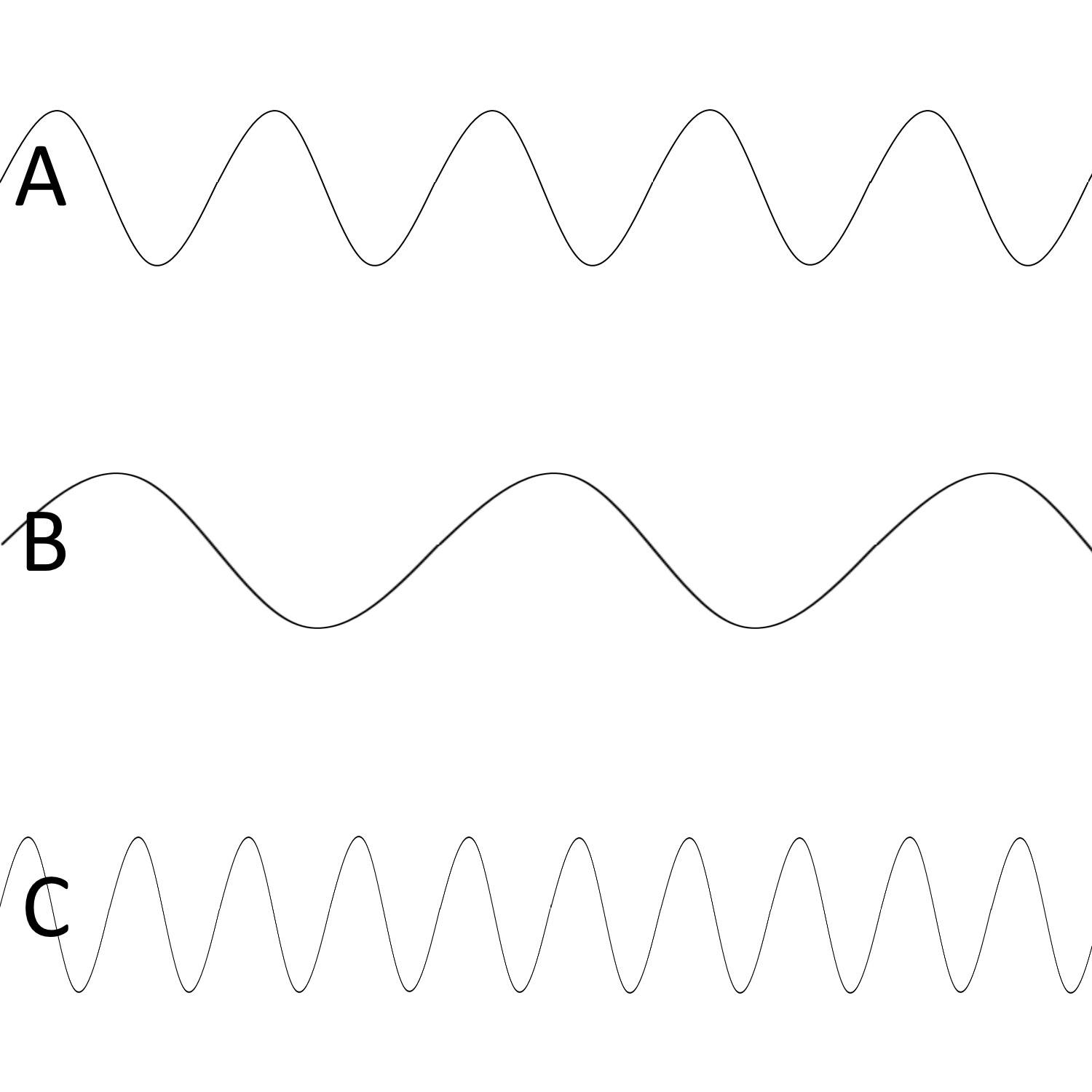


Which image represents a longitudinal wave?
A
B
Sound waves are which type of waves?
transverse
seismic
longitudinal
frequency

Which statement is correct about the wave shown in the diagram?
It is a transverse wave because the particles are moving perpendicular to the motion of the wave.
It is a transverse wave because the particles are moving parallel to the motion of the wave.
It is a longitudinal wave because the particles are moving perpendicular to the motion of the wave.
It is a longitudinal wave because the particles are moving parallel to the motion of the wave.

How many waves are represented here?
2
3
0
1

