wayground logo

Free Printable Worksheets

Font size

S
M
L
XL
Worksheets

Grade 6 EOY Exam Review

Total questions: 167

Worksheet time: 2hrs 15mins

Name
Class
Date
1.

What is your favorite animal? What genus/species does it belong to?

4 lines
2.
The steps of the scientific method, in order are:
a)
Observation, Research, Hypothesis, Plan, Collect Data, Conclusion
b)
Hypothesis, Plan, Collect Data, Conclusion, Observation, Research
c)
Observation, Research, Collect Data, Plan, Hypothesis, Conclusion
d)
Conclusion, Observation, Research, Collect Data, Plan, Hypothesis
3.

An educated guess about the results of an experiment is a (a)  

4.
A list of steps that tells how to complete an experiment
a)
Materials
b)
Procedure
c)
Conclusion
d)
Dependent Variable
5.
Important information observed using your 5 senses and written while doing an experiment is called
a)
Data
b)
Hypothesis
c)
Materials
d)
Conclusion
6.
The one thing you CHANGE in an experiment is the
a)
Dependent Variable
b)
Independent Variable
c)
Control
d)
Data
7.
An experiment has 10 plants growing in sunlight and 10 plants growing in red light.  The plant height is measured after one month.  What is a hypothesis for this experiment? 
a)
If the plant is grown in red light, then the plant will die. 
b)
The plants are dying
c)
Plants prefer sunlight
d)
Plants grow tall in red light
8.
An experiment has 10 plants growing in sunlight and 10 plants growing in red light.  The plant height is measured after one month. What is the INDEPENDENT variable in this experiment? 
a)
The plant height
b)
The plants
c)
The sunlight
d)
The red light
9.
After you complete your experiment, you look carefully at data.  When you do this you _____________ the data. 
a)
Analyze
b)
Conclude
c)
Procedure
d)
Hypothesis
10.

To carefully examine and study

a)

classify

b)

dichotomous key

c)

group

d)

observe

11.

any living thing

a)

organism

b)

kingdom

c)

vertebrate

d)

invertebrate

12.

put things into groups according to properties or features

a)

kingdoms

b)

classify

c)

observe

d)

dichotomous key

13.

Carolus Linneaus created a method to organize living things into groups from simplest to most complex

a)

classification system

b)

dichotmous key

c)

scientific name

d)

group

14.

highest or most general group of living things

a)

genus

b)

order

c)

phylum

d)

kingdom

15.

An animal with a backbone is called a

(a)  

16.

no backbone

a)

tricep

b)

femur

c)

vertebrate

d)

invertebrate

17.

tiny tubes that carry water and nutrients to all parts of a plant

a)

roots

b)

vascular

c)

straws

d)

stems

18.

correct order of classification

a)

Kingdom, phylum, class, order, family, genus, species

b)

species, kingdom, phylum, class, genus

c)

Kingdom, class, genus, species

19.

Why do we classify things?

a)

Grouping things helps us to understand them better

b)

all the cool people do it

c)

because we're better than every other organism

d)

why not?

20.

Which of these is NOT one of the 5 Kingdoms?

a)

Fungi

b)

Plantae

c)

Linnaeus

d)

Animal

e)

Monera

21.

The smallest of the classification groupings. Any group of organisms that share common genetic information. Members are capable of breeding and producing offspring that can also reproduce.

a)

order

b)

phylum

c)

species

d)

kingdom

22.

What is one way in which all living things on Earth are alike?

a)

All living things have hair.

b)

All living things are made of cells.

c)

The cells of all living things have chloroplast.

d)

All living things can move.

23.

When cells are damaged, new cells are created by cell division. How does the cell theory explain this fact?

a)

It states that all cells have a nucleus which divides.

b)

It states that all living things are made up of one or more cells.

c)

It states that cells come from previously existing cells.

d)

It states that the basic units of structure and function are cells.

24.

This organelle controls what goes in and out of plant and animal cells.

a)

Cell Wall

b)

Cell Membrane

c)

Chloroplasts

d)

Cytoplasm

25.
An organelle that captures energy from the sunlight in order to use it to produce food in plant cells is ______________.
a)
Chromatin
b)
Chloroplast
c)
Cytoplasm
d)
Cell Membrane
26.

The _____________ is a gel-like fluid that fills plant and animal cells. It holds the organelles in place and gives each cell its shape.

a)

Cytoplasm

b)

Cell Membrane

c)

Cell Wall

d)

Chloroplast

27.

When we exercise we use a lot more energy than when we are at rest. How to our cells help to maintain homeostasis during periods of exercise?

a)

The cells will die from using too much energy.

b)

The cells won't be able to keep up so they will multiply and create new cells.

c)

The cells will slowly die from using too much energy.

d)

The cells will create more mitochondria over time to produce more energy.

28.

What are the three parts of the cell theory?

a)

All cells come from pre-existing cells.

b)

Cells are the basic unit of structure and organization in all living things.

c)

Cells are the basic unit of structure and organization in all matter.

d)

All organisms are made of one or more cell.s

29.

What part of the cell is this one?

(a)  

30.
This organelle is stores food, water and waste.
a)
Ribosome
b)
Cytoplasm
c)
Vacuole
d)
Mitochondria
31.
Rocks are not living because
a)
they never move
b)
they aren't needed for humans
c)
they are not made of cells
d)
they don't break down
32.

A physical appearance is

a)

genotype

b)

heterozygous

c)

phenotype

d)

codominance

33.

A mutation is harmful to an organism if it

a)

changes the phenotype of an organism

b)

changes the DNA segment

c)

reduces the organism's chance of survival

d)

makes the organism better able to avoid predators

34.

Who studied different characteristics of pea plants by cross-pollinating plants?

a)

Gregor Mendel

b)

Albert Punnett

c)

Sir Isaac Newton

d)

David Kuster

35.

What does a Punnett Square determine?

a)

all of Mendel's discoveries about genetic crosses

b)

all the outcomes of a genetic cross

c)

only the recessive allele combinations

d)

only the dominant allele combinations

36.

Genotype is

a)

stem height

b)

feather color

c)

physical appearance

d)

genetic makeup

37.

If a homozygous black cat (BB) is crossed with a homozygous white cat (bb), what is the probability of having a cat with white fur?

a)

100%

b)

0%

c)

75%

d)

25%

38.

A mother gives birth to a son, she then gives birth to a daughter. What is the likely hood that she will have another son?

a)

75%

b)

25%

c)

50%

d)

100%

39.
having two of the same genes for the trait (sometimes called purebred).
a)
homozygous
b)
hetrozygous
c)
protein
d)
chromosome
40.
The living and non living things in an area make up an
a)
population
b)
community
c)
ecosystem
d)
biotic factors
41.

Water is an example of a(n)___________ factor

a)

biotic

b)

abiotic

c)

blank

d)

control variable

42.
A drought reduced the number of plants growing in an area. The number of deer in the area would decrease because of the lack of plants. What would happen to the population of coyotes that feed on the deer?
a)
The number of coyotes would increase
b)
The coyotes would not be affected because they do not eat plants.
c)
The number of coyotes would decrease
43.

Tiny organisms called, (a)   in the soil, "fix" nitrogen in order for plants to be able to use it.

44.
__________ help an organism survive and reproduce
a)
Defense
b)
adaptations
c)
skills
d)
niche
45.
A food web consists of?
a)
Many overlapping food chains in an ecosystem.
b)
A series of events in which one organism eats another and obtains energy.
c)
Amount of energy that moves from one feeding level to another.
d)
Many types of insects that are stuck.
46.
In the food web shown, the snail would be considered...
a)
primary consumer
b)
secondary consumer
c)
tertiary consumer
d)
producer
47.

Which ecosystem is formed when the salty ocean water meets freshwater? FYI: this type of water is called brackish water.

a)

Ocean

b)

Pond

c)

Tropical Rainforest

d)

Estuary

48.

This biome has:

• 100 - 175 inches of rain

• Temperatures can vary depending on location

• High biodiversity

• trees, flowers, plants, carnivorous plants

• monkeys, large predatory cats, capybaras

• large snakes

• poisonous dart frogs

What is it called?

(a)  

49.
What is the order of succession shown in this figure?
a)
A, B, C, D
b)
B, A, D, C
c)
C, D, A, B
d)
D, A, B, C
50.
the 2nd layer of the earth; thickest layer
a)
outer core
b)
mantle
c)
inner core
d)
earthquake
51.

3% of the water on the Earth is

a)

saltwater

b)

freshwater

52.

Most of the fresh water on Earth is located in

a)

ice

b)

rivers

c)

the air

d)

oceans

53.
What are the world's highest Landforms
a)
Mountains
b)
Hills
c)
Valleys
d)
Skyscrapers
54.

Why would a mountain climber need a map?

a)

To show cliffs, canyons, and ice fields.

b)

Just in case he can't get his cell phone to work.

c)

He'd also need a good body guard.

d)

Just in case he runs out of toilet paper.

55.
Rocks in India show scratches and scars that formed when glaciers ground over their surfaces. What does this mean?
a)
India is currently near the north pole now
b)
The glaciers traveled from the north pole to india a long time ago
c)
India was covered in ice a long time ago
d)
Glaciers formed on India during the ice age 
56.

What type of event will occur at this boundary?

(a)  

57.

the measurement of an earthquake’s strength.

a)

Intensity

b)

Richter Scale

c)

Magnitude

d)

Aftershock

58.

What do we use to measure earthquakes?

a)

Richter scale and mercalli scale

b)

ruler and digital scale

c)

book and a wave machine

d)

Magnitude and longitude

59.
What is erosion?
a)
When Earth materials, like rock, sand, and soil are being carried away from their original location
b)
When Earth materials are broke down into smaller pieces
c)
When Earth materials, like rock, sand, and soil, are dropped or deposited into a new location
d)
When the Earth changes quickly and it looks different from before
60.
This rock arch is a result of
a)
deposition of minerals
b)
wind erosion
c)
water erosion
d)
ice wedging
61.
How does freezing water cause the weathering of rocks?  The freezing water—
a)
keeps the rocks in place
b)
makes the rocks last longer
c)
expands cracks and breaks rocks
d)
causes rocks to fall in landslides
62.

Rosa's neighborhood is only allowed to water their lawns on Tuesdays and Thursdays. What is the most likely explanation for why Rosa's neighborhood can only water their lawns two days a week?

a)

Water is a renewable resource that needs to be conserved.

b)

Water is a nonrenewable resource that needs to be conserved.

c)

Water erodes the soil, and soil is a renewable resource that needs to be conserved.

d)

Water corrodes the soil, and soil is a nonrenewable resource that needs to be conserved.

63.

After he finishes his lunch, Edwin needs to get rid of his trash. He has the empty paper bag that he brought his lunch in, an empty soda can, a pizza crust that he didn't finish, and a dirty napkin.


Match the item to the action Edwin could do to practice saving resources: Paper Bag

a)

Recycle

b)

Throw Away

64.

Clothes are often made from cotton, which is grown from a plant. What kind of resource is cotton?

a)

renewable

b)

nonrenewable

c)

mineral

d)

chemical

65.

Which of the following is a nonrenewable resource?

a)
b)
c)
d)
66.

How is the atmosphere involved in the greenhouse effect?

a)

It transforms light energy from the Sun into thermal energy that warms the surface of Earth.

b)

Gases in the atmosphere trap and redirect heat reflected from the surface of Earth.

c)

Gases magnify the heat of the Sun as it passes down through Earth's atmosphere.

d)

Heat from the surface of Earth is absorbed by gases and radiated into space.

67.
How can farmers prevent/slow down soil erosion?
a)
Cover their crops with a tarp 
b)
Water the soil everyday in order to weigh it down 
c)
Plant crops, plants, etc. to hold the soil in place
d)
Cut down all of the trees and crops. 
68.
What soil conservation technique is this?
a)
Crop Rotation
b)
Wind Breaks
c)
Contour Plowing
d)
No-Till Farming
69.

A measure of the ability of a mineral to resist scratching

(a)  

70.

The color of the powder of a mineral

a)

hardness

b)

streak

c)

luster

71.
Deposits of minerals from which metals and nonmetals can be removed profitably.
a)
Ore
b)
Conduction
c)
Placer Deposits
d)
Wire
72.

What are some of the negative effects of littering? (eg throwing unwanted plastic into the sea)

a)

It chokes up the drainage system

b)

It become a decoration in the sea

c)

It could entangle and poison aquatic organism

d)

It create more job opportunities so that people can be hired to clean the sea

73.

Which of the following shows how water can be polluted?

a)

Releasing harmful substances into drains

b)

Releasing human waste into swimming pool

c)

Washing clothes by the river

d)

Have more boats on the sea

74.

When conserving water, the 3Rs we need to remember are:

a)

Remove, Reuse, Recycle

b)

Report, Remove, Reduce

c)

Reduce, Reuse, Recycle

d)

Reduce, Reuse, Rethink

75.

Which layer of the atmosphere contains the ozone?

a)

Troposphere

b)

Mesosphere

c)

Stratosphere

d)

Exosphere

76.

The _____ protects us from Earth's harmful UV rays.

a)

Ozone

b)

Troposphere

c)

Clouds

d)

Exosphere

77.

Where do satellites orbit?

a)

Thermosphere

b)

Stratosphere

c)

Exosphere

d)

Mesosphere

78.

The layer of earths atmosphere with most of Earth's water vapor?

a)

Exosphere

b)

Thermosphere

c)

Mesosphere

d)

Troposphere

79.

What is the correct order of layers for the atmosphere?

a)

Thermosphere

Stratosphere

Mesosphere

Troposphere

Exosphere

b)

Thermosphere

Exosphere

Troposphere

Mesosphere

Stratosphere

c)

Troposphere

Stratosphere

Mesosphere

Thermosphere

Exosphere

d)

Troposphere

Stratosphere

Exosphere

Thermosphere

Mesosphere

80.

What is the transfer of energy by electromagnetic waves?

(a)  

81.
What is the transfer of thermal energy by the collision between particles of matter?
a)
radiation
b)
conduction
c)
convection
d)
latent
82.
When air molecules are heated at the surface they spread apart and become less dense, rising into the atmosphere.  Then they transfer the thermal energy to the higher altitudes.  As the air molecules cool at the higher altitudes they then become more dense and fall back done toward Earth.  This is an example of which type of thermal energy transfer?
a)
radiation
b)
conduction
c)
convection
d)
none of these
83.
What is the natural process by which water continually moves among the oceans, land, and atmosphere?
a)
rock cycle
b)
water cycle
c)
life cycle
d)
none of these
84.
What is the force that a column of air applies on the air or surface below it?
a)
temperature
b)
pressure
c)
wind
d)
relative humidity
85.
What is air that moves from areas of high pressure to areas of low pressure?
a)
pressure
b)
wind
c)
relative humidity
d)
dew point
86.
These types of clouds are fluffy, heaped, and piled up clouds that are between altitudes 2,000 meters - 6,000 meters.
a)
stratus
b)
cumulus
c)
cirrus
87.
These types of clouds are flat, white, and layered clouds that are at altitudes up to 2,000 meters.
a)
stratus
b)
cumulus
c)
cirrus
88.
 A fast moving cold air mass overtakes a warm air mass is called a _________________
a)
warm front
b)
cold front
c)
stationary front
d)
occluded front
89.
A huge body of air that has similar temperature and humidity at any given height is called an __________________________.
a)
front
b)
jet stream
c)
air mass
d)
cyclone
90.
When air pressure is high, what type of weather do we experience?
a)
sunny and clear
b)
rainy and cloudy
91.

How many planets are in the solar system?

(a)  

92.
Which planets are the gaseous planets?
a)
Mercury, Mars, Neptune, and Uranus
b)
Earth, Venus, Jupiter, and Neptune
c)
Neptune, Saturn, Jupiter, and Earth
d)
Jupiter, Saturn, Uranus, and Neptune
93.
What causes day and night on Earth?
a)
One Earth rotation
b)
One revolution around the sun
94.
What causes years on Earth?
a)
One Earth rotation
b)
One revolution around the sun
95.
What does this diagram represent?
a)
Solar eclipse
b)
Lunar eclipse
96.

astronomy

a)

the time required for the moon to orbit once around the Earth

b)

the time required for the Earth to rotate once on its axis

c)

the time required for Earth to orbit once around the sun

d)

the study of the universe

97.

light-year

a)

the distance that light travels in one year

b)

a large, reddish star late in its life cycle

c)

a small, hot, dim star that is the leftover center of an old star

d)

a gigantic explosion in which a massive star collapses and throws its outer layers into space

98.

supernova

a)

the distance that light travels in one year

b)

a large, reddish star late in its life cycle

c)

a small, hot, dim star that is the leftover center of an old star

d)

a gigantic explosion in which a massive star collapses and throws its outer layers into space

99.

How does the sun produce energy?

a)

Fusion of hydrogen into helium.

b)

Burning of hydrogen

c)

Fission of helium into hydrogen

d)

Fusion of helium into hydrogen

100.

List the planets in order starting from the sun.

a)

Mercury, Venus, Earth, Mars, Jupiter, Saturn, Uranus, Neptune

b)

Mercury, Venus, Earth, Mars, Jupiter, Saturn, Neptune, Uranus

c)

Mars, Venus, Earth, Mercury, Jupiter, Saturn, Uranus, Neptune

d)

Mercury, Venus, Earth, Mars, Saturn, Jupiter, Uranus, Neptune

101.

What characteristics are used to classify stars? (Select all that apply)

a)

Size

b)

Brightness

c)

Temperature

d)

Distance from sun

102.

Rank the colors of stars from hottest to coolest.

a)

Blue, white, yellow, orange/red, red

b)

Blue, yellow, white, orange/red, red

c)

Red, orange/red, white, yellow, blue

d)

Red, orange/red, yellow, white, blue

103.

What kind of galaxy is this?

(a)  

104.

The most common galaxy; 60% of galaxies.

a)

Irregular Galaxy

b)

Spiral Galaxy

c)

Elliptical Galaxy

d)

All of the above

105.
Place these objects in order from smallest to largest.
a)
Planets, solar system, universe, galaxy
b)
Solar system, planets, galaxy, universe
c)
Planets, solar system, galaxy, universe
d)
Galaxy, solar system, planets, universe
106.
What are the three states of matter?
a)
solid, volume, mass
b)
density, volume, mass
c)
solid, liquid, gas
d)
density, gas, volume
107.
Something that takes up space and has mass.
a)
volume
b)
matter
c)
mass
d)
density
108.
The amount of space something takes up
a)
density
b)
volume
c)
mass
d)
matter
109.
A watermelon has more matter than a grape, so it has more
a)
mass
b)
eat
c)
solid
d)
greater
110.
You can measure ______ with grams.
a)
mass
b)
volume
c)
conductivity
d)
melting point
111.
The measurement system used by scientist around the world.
a)
metric system
b)
customary systerm
c)
calorie system
d)
science system
112.
Volume is ______________.
a)
length X width
b)
height X length
c)
length X width X height
d)
width X height
113.

Which example is a compound?

a)

N2

b)

O2

c)

Cu

d)

H2O2

114.
A combination of substances that are not chemically combined is called a(n)____________. 
a)
mixture
b)
compound
c)
physical
115.
When two or more different types of atoms chemically combine they form a ... 
a)
Compound
b)
Heterogeneous Mixture
c)
Molecule
d)
Homogeneous Mixture
116.
Iron is an example of one of the ______.
a)
90 man made elements
b)
200 naturally occurring elements
c)
90 naturally occurring elements
d)
200 man made elements
117.
The picture is an example of what type of substance?
a)
A Mixture of Two Elements
b)
A Molecule
c)
An Element
d)
A Compound
118.

Trevor brought in two gold coins. One is large and one is small. Jayla says that the gold coins are made of different sized atoms because one coin is bigger than the other. Which statement below is correct?

a)

Jayla is wrong because bigger coins mean bigger atoms.

b)

Jayla is wrong because they are both gold so they have the same atoms it is just that the bigger coin has more gold atoms.

c)

Jayla is wrong because all atoms are the exact same size regardless of what type of element they are talking about.

d)

Jayla is right because gold atoms are bigger than all other atoms.
119.
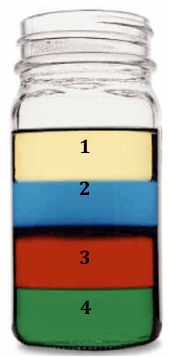
Put the liquids in order from most dense to least dense?
a)
4, 3, 2, 1
b)
1, 2, 3, 4
c)
3, 4, 2, 1, 
d)
4, 3, 1, 2
120.
What is the difference between a conductor and an insulator?
a)
An insulator allows electricity to flow through it easily and a conductor does not
b)
A conductor allows electricity to flow through it easily and an insulator does not.
c)
An insulator is magnetic and a conductor is not
d)
A conductor is magnetic and an insulator is not
121.
What is an element?
a)
An element is an atom and two atoms
b)
An element is one or more atoms of the same kind.
c)
An element is more than one of different kinds
122.
How many atoms of Nitrogen are in this molecule?
a)
3
b)
2
c)
0
d)
1
123.
A solid piece of chocolate is melted and changed to liquid form. Which property of the piece of chocolate will remain the same?
a)
Texture
b)
Temperature
c)
Shape
d)
 Mass
124.
Fizzing, foaming, and burning are all examples of
a)
Chemical change
b)
Physical change
125.

What is the substance present at the END of a reaction called?

a)

Product

b)

Exponent

c)

Integer

d)

Reactant

126.

How do you know baking a cake is a chemical reaction?

a)

It tastes yummy.

b)

A new substance is formed.

c)

You mixed it together.

d)

It has ingredients.

127.
Flammability (burns): Chemical or Physical Property
a)
Chemical Property
b)
Physical Property
128.

the temperature at which a solid changes to a liquid

a)

solubility

b)

boiling point

c)

melting point

d)

state of matter

129.

Acid is?

a)

A substance that reacts to metals and carbonates, and has a Ph of below 7.

b)

Often used in drain cleaner.

c)

Something that can only be found in a lab

d)

A bitter tasting substance

130.

A base is

a)

A substance that feels slippery, has a higher Ph than 7, and is often used in drain cleaner.

b)

Has a Ph of below 7 and can react to metal and carbonates

c)

Is only found in a lab

d)

Something water can never be

131.
Organic compounds are in all?
a)
dead organisms
b)
people and plants
c)
living organisms
d)
cats
132.
All organic compounds contain the element
a)
carbon
b)
nitrogen
c)
phosphorus
d)
sulfur
133.
What is Half-life?
a)
The amount of time it takes for some of the nuclei in a sample of the isotope to decay
b)
The amount of time it takes for half the electrons in a sample of the isotope to decay
c)
The amount of time it takes for half the nuclei in a sample of the isotope to decay
d)
the amount of time it takes to double the nuclei in a sample of the isotope to decay
134.
The three types of nuclear radiation in increasing order of penetrating power are ____.  
a)
  alpha, beta, gamma 
b)
X ray, beta, gamma
c)
alpha, gamma, beta 
d)
X ray, gamma, beta 
135.

What is radioactivity?

a)

A term that describes the forces that hold atomic nuclei together

b)

The movement of electrons around an atomic nucleus

c)

The application of heat energy to an atomic nucleus

d)

The emission of high-energy particles or waves from atoms

136.

Imagine you have 50,000 atoms of uranium-238. If U-238 has a half-life of 4.5 billion years, how many U-238 atoms will be left after 4.5 billion years?

a)

25,000

b)

50,000

c)

12,500

d)

0

137.
Which graph best represents a graph of a car travelling down a freeway at a CONSTANT speed?
a)
A
b)
B
c)
C
d)
D
138.
a change in position is defined as
a)
force
b)
motion
c)
speed
d)
acceleration
139.
A student slides a book across a desk by giving it an initial push. Which of the following is the MOST important reason that the book eventually comes to a stop instead of continuing to slide?
a)
The initial force was too weak to keep the book in motion.
b)
The mass of the book was not enough to keep the book in motion.
c)
The force that occurs when the book rubs against the desk stops the book.
d)
The magnetic force from the Earth stops the book.
140.

In a game of tug-of-war, there is a force pulling to right with 70N and a force pulling to the left with 68N. What will be the resulting motion?

a)

to the right

b)

to the left

c)

no motion

d)

everyone will move in the direction they are pulling

141.

The unit of measurement for force

a)

reference frame

b)

Newton

c)

net force

d)

acceleration

142.

An object in motion stays in motion and an object at rest stays at rest UNLESS

a)

acted on by a balanced force.

b)

acted on by an unbalanced force.

143.
Which statement best explains Newton's Third Law of Motion?
a)
An object at rest tends to stay at rest.
b)
For every action there is an equal and opposite reaction.
c)
The acceleration of an object is based on the force applied.
d)
An object continues its motion until an unbalanced force is applied.
144.
Which statement BEST describes the relationship between visible light and the electromagnetic spectrum?
a)
Visible light and the electromagnetic spectrum are different names for the same phenomenon.
b)
Visible light occupies about half of the electromagnetic spectrum.
c)
Visible light is a narrow band in the electromagnetic spectrum.
d)
Visible light and the electromagnetic spectrum have a small area of overlap.
145.
Light waves are arranged in the electromagnetic spectrum by
a)
wavelength and brightness.
b)
speed and color.
c)
brightness and color.
d)
wavelength and frequency.
146.
Which of these illustrates that sound waves can travel through a liquid?
a)
Voices can be heard as people speak to one another.
b)
Whales and porpoises signal each other by making sounds.
c)
Astronauts can’t hear each other in space unless they use a radio.
d)
Footsteps can be heard through the ceiling as someone walks on the roof.
147.
An echo is a sound wave that has been
a)
absorbed.
b)
refracted.
c)
scattered.
d)
reflected
148.
A fifth-grade student fastened a piece of cardboard to his bicycle wheel so that the spokes would cause the card to vibrate. When the student rode the bike fast, the student heard a high pitch. When the student rode the bike slowly, the student heard a low pitch. Which BEST explains why the student heard both high and low pitches from the cardboard?
a)
The vibrations were faster when the student rode slowly.
b)
The vibrations were slower when the student rode faster.
c)
The cardboard vibrated at the same speed.
d)
The cardboard vibrated at different speeds.
149.
Which is a source of sound?
a)
thermal energy
b)
potential energy
c)
a vibration
d)
a medium
150.
What shape does light travel in?
a)
Waves
b)
Circles
c)
Squares
d)
Diamonds
151.
Light is predictable because it will always travel in a _________ line.
a)
Curvy
b)
Straight
c)
Backwards
d)
Crazy
152.
What types of matter can light travel through?
a)
Some solids, liquids, gases and all empty space (vacuum)
b)
All solids, liquids, gases, and empty space (vacuum)
c)
Some solids, liquids, and gases
d)
Only empty space (vacuum)
153.
If someone is wearing a black shirt in the sunshine, what will the black do to the light?
a)
Reflect it
b)
Absorb it
c)
Refract it
d)
Diffuse it
154.
Why does a spoon look bigger in the water than it does on the top?
a)
The light refracts as it moves from air to water
b)
The light reflects as it moves from air to water
c)
The light absorbs as it moves from air to water
d)
The light is diffused as it moves from air to water
155.

only allows SOME light to pass through

a)

transparent

b)

translucent

c)

opaque

d)

clear

156.

Shorter Waves have ____Energy,Longer Waves___Energy?

a)

Lower,Higher

b)

Higher,Lower

157.

Order Of the Electromagnetic System?

a)

Radio Waves,Microwaves,Infrared,Visible Light,X-rays,Ultra Violet,Gamma.

b)

Radio Waves,Microwaves,Infrared,Visible Light,Ultra Violet,X-rays,Gamma.

158.
What type of heat transfer happens in liquids and gases?
a)
Conduction
b)
Convection
c)
Radiation
159.
Hot air ______ while cool air ____
a)
Sinks, Rises
b)
Rises, Rises
c)
Rises, Sinks
d)
Convection, Radiation 
160.
Boiling water is an example of what two types of heat transfer
a)
Conduction and Radiation
b)
Conduction and Convection
c)
Radiation and Convection
161.
When you touch a cold window, how is energy being transferred?
a)
The window transfers heat to you 
b)
You transfer heat to the window
c)
The sun transfers heat to you
d)
None of the above
162.

Walking converts what type of energy into mechanical energy?

a)

chemical

b)

electromagnetic

c)

nuclear

d)

thermal

163.

Walking converts what type of energy into mechanical energy?

a)

chemical

b)

electromagnetic

c)

nuclear

d)

thermal

164.

A calorie is the _____ needed to raise the temperature of a kilogram of water one degree _______

a)

fire, fairenheit

b)

vitamin,higher

c)

heat, Celsius

d)

food, lower

165.

This force occurs when there is an attractive and repulsive force between two poles.

a)

Magnetic

b)

Electric

c)

Electromagnetism

166.
If you wrap more coils around an electromagnet, it will become...
a)
brighter
b)
stronger
c)
weaker
d)
invisible
167.
The path along which electricity travels.
a)
Fuse
b)
Electric circuit
c)
Electric Discharge
d)
Insulator