
 Worksheets
STAAR - 7TH GRADE REVIEW
Total questions: 172
Worksheet time: 2hrs 16mins




Which of the following examples represents a physical change?


Which of the following is evidence of a physical change?
new substance
shape change
light produced
gas released
A teacher is demonstrating physical and chemical changes to her class. Which action should they use to demonstrate a chemical change?
Cutting a piece of paper with scissors.
Folding a piece of paper into an airplane.
Ripping a piece of paper with their hands.
Burning a piece of paper with a match.
A physical change is
a change where the characteristics do not change the substance
a change where the characteristics do change the substance
a change where the chemistry changes
What is the definition of chemical change?
any change that results in the formation of one (or more) new chemical substance(s)
changing of only the appearance of the object
matter cannot be created or destroyed, only change form
changes affecting the form of a chemical substance, but not its chemical composition
Which example best illustrates a physical change?
iron rusting
charcoal burning
an ice cube melting
a marshmallow burning
A glass bottle that is shattered is a
Chemical Change
Physical Change
Baking soda and vinegar combining to make carbon dioxide is a
Chemical Change
Physical Change
Which of the following are examples of chemical changes? Select all that apply!
Iron Rusting
Gas Burning
Breaking a Glass
Boiling Water
Burning Wood
Sugar dissolving in water is a
Chemical Change
Physical Change

Identify the change shown in the picture.
Irreversible physical change
Irreversible chemical change
reversible physical change
reversible chemical change
Which one describes a physical change?
A change where the chemical makeup of an object changes.
A change where the characteristics do not change the substance.
A change where the substance turns into something new.
The composition of the object changes.
Which of the following is NOT an indicator of chemical changes?
Unexpected color change
Dissolving
Light production
Gas formation
Select ALL the characteristics of a physical change.
changes in appearance only
a new substance is not created
changes the pH level
chemical bonds are not created or broken
burning and fire

All bodies of fresh water, salt water, ice, and snow that are found above ground
Groundwater
Surface water
Runoff
Swimming pool


Which biome is more biodiverse?
Desert
Grassland
Tundra
Rainforest


Image "B" shows more biodiversity than image "A". Why?
Because "B" shows more different species than image "A"
Because image "B" has less different species than "A"
"A" has a greater number of same species plants so this statement is wrong.
Both images show the same biodiversity

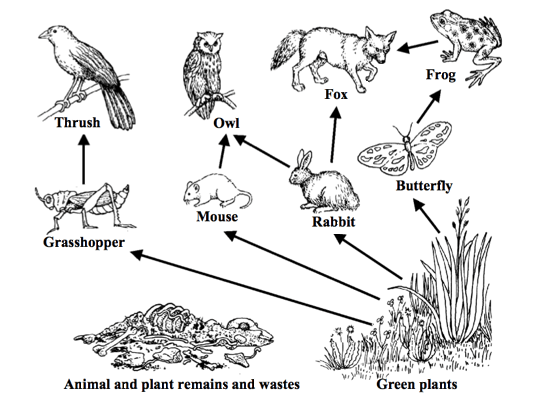
Food Web B is an example of...
Low biodiversity and low sustainability. If the producer dies then all the food web will suffer.
High biodiversity and high sustainability. If an organism is removed the food web will continue with no effect.

Biodiversity is important to keep an area (biome) healthy. In this example "Food Web A" is sustainable. Why is sustainability important for an ecosystem in "Food Web A".
If one organism is removed the food web can still operate (work) with little or no negative effect.
If an organism is removed the food web will collapse and will affect the environment.


High biodiversity makes the food web more complex and better able to support the most species, even if some populations decrease.
True
False
High biodiversity makes it more likely that the ecosystem will be able to keep functioning after a disturbance, such as disease or natural disaster.
True
False
High biodiversity is a sign of a healthy ecosystem.
True
False

What are some ways we can help in maintaining biodiversity?
Get involved with ecological restoration in your area.
Prevent invasive species from overpopulating.
Don't use chemical pesticides on crops.
All of the above

The diagram below shows changes occurring in an ecosystem over time.
What is happening in the diagram?
Plants are growing larger over time.
Soil is being removed from an ecosystem over time.
An ecosystem is slowly being eliminated from a region.
Biological communities are gradually being replaced by other communities.

The diagram shows changes to a pond ecosystem over time.
Through which of the following processes are plant communities taking over the ecosystem?
biodiversity
primary succession
climate disturbance
secondary succession

The diagram below shows an example of ecological succession.
What does the presence of soil indicate about this process?
It is unchanging.
It is an example of primary succession.
It is an example of secondary succession.
It is an example of catastrophic change.
Primary succession occurs when pioneer species move into an area that has no plants. Which organisms are common pioneer species?
Conifer trees and tall grasses with roots that loosen the soil.
Mosses and lichens that can grow on rocky surfaces.
Grasses and weeds that arrive as seeds carried by the wind and then germinate in rich soil.
Vines and shrubs that help prevent the erosion of shallow soil.
Both primary and secondary succession begin with pioneer species that —
change the area and make it safer from predatory organisms.
invade the area so that new organisms cannot be established.
modify the area and allow larger and more complex organisms to appear.
use up all the existing resources and prevent establishment of non-native organisms.
How is the number of species in an ecosystem related to the stage of ecological succession?
The number of species increases as succession proceeds.
The number of species decreases as an ecosystem becomes mature.
The number of species present when succession begins remains the same.
The number of species increases and then decreases as succession proceeds.
How do pioneer species make ecological succession possible on an island following a volcanic eruption?
They use chemicals to produce food.
They establish homes in which animals can live.
They break down rock into soil in which plants can grow.
They adjust the climate by altering the average temperature in a region.
How is secondary succession different from primary succession?
Secondary succession occurs after a disturbance in an area that was previously uninhabited.
Secondary succession occurs after a disturbance in an area in which the soil has remained intact.
Secondary succession occurs over a longer period of time than primary succession.
Secondary succession occurs when animals are introduced to an area that had only plants.
An ecosystem experiences a volcanic eruption that covers the area with lava. Which of the following organisms is most likely to be a pioneer species in this ecosystem?
a tall tree
a shrub
moss
a mouse
Some students take care of a vegetable garden. When it is time to plant in the spring, the students leave part of the garden empty in order to observe ecological succession. Which of these will most likely occur first?
development of topsoil
growth of weeds and grasses
growth of trees and shrubs
development of a stream


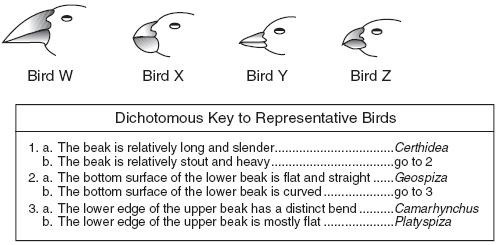
What is the name of bird X?
Certhidea
Geospiza
Camarhynchus
Platyspiza
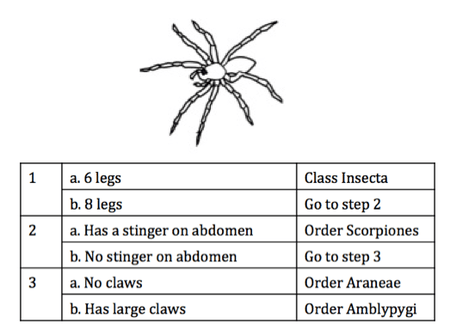


Leaf S
Eastern white pine
balsam poplar
sweet gum
ginko

Which characteristics are used to identify the American Robin?
Head color, Beak shape, and Beak Color
Head color and Beak Color
Beak Shape and Beak Color
Beak Color

Genetic material (DNA) can be found in the...
nucleus
mitochondria
chloroplast
cell wall
What is the correct order of organization for genetic information?
Gene, DNA, chromosomes, nucleus, cell
Cell, nucleus, DNA, chromosome, gene
Nucleus, cell, chromosome, gene, DNA
Cell, nucleus, chromosome, DNA, gene
What is heredity?
The passing of traditions from one generation to the next.
The passing of genetic information from one generation to the next.
Genetic information found in the nucleus.
The study of genes.
How many chromosomes are found in a "normal" human being?
44
46
48
50
Dominant traits...
Covers other traits
Represented by capital letters in genotypes
Represented by little letters in genotypes
The hidden trait
Recessive traits are...
Represented by capital letters
Covers other traits
Represented by little letters
Hidden traits ONLY visible when dominant allele is NOT there
Heredity involves which main body system?
Reproduction System
Respiratory System
Digestive System
Skeletal System
Which choice is NOT true about genes?
They are found in the nucleus.
They are located on chromosomes.
They provide energy to the cell.
They provide genetic information for traits.

Which piece of genetic information looks like a long twisted/coiled ladder?
Chromosome
DNA
ATP
Nucleus

Which structure looks like a skinny X?
Chromosome
DNA
Gene
Nucleus
The inherited traits of an organism is governed by...
Mitochondria
Genes
Enzymes
Cytoplasm
Genetic instructions are passed from both parents to their...
offspring
organism
organelle
parents
Which is NOT an inherited trait?
shape of eyes
male or female
widow's peak hairline
favorite color
Which genotype is hetrozygous?
Bb
BB
DD
dd
Which genotype is homozygous dominant?
Bb
bb
BB
Dd
Which is NOT an example of a phenotype?
black fur
blue eyes
brown hair
bb
Which genotype is homozygous recessive?
Bb
BB
bb
brown eyes
What is the main purpose of chromosomes?
To store genetic instructions (DNA)
To release energy
To control what enters and leaves cell
To store materials inside the cell
Protects the body, regulates body temperature
Integumentary
Nervous
Skeletal
Muscular
Carries oxygen and nutrients to all parts of the body.
Integumentary
Nervous
Circulatory
Respiratory
Allows movement in the body
Integumentary
Nervous
Skeletal
Muscular
Receives stimuli and transports impulses, coordinates actions and reactions in the body
Integumentary
Nervous
Circulatory
Respiratory
Supports and provides structure for the body
Skeletal
Muscular
Circulatory
Respiratory
Supplies blood with oxygen and rids the body of carbon dioxide
Integumentary
Nervous
Circulatory
Respiratory
Main Organs: Skin
Integumentary
Nervous
Skeletal
Muscular
Main Organs: Heart and blood vessels
Integumentary
Nervous
Circulatory
Respiratory
Main Organs: Muscles
Integumentary
Nervous
Skeletal
Muscular
Main Organs: Brains, spinal cord, nerves
Integumentary
Nervous
Circulatory
Respiratory
Main Organs: Bones and joints
Skeletal
Muscular
Circulatory
Respiratory
Main Organs: Lungs
Integumentary
Nervous
Circulatory
Respiratory

Integumentary
Nervous
Skeletal
Muscular

Integumentary
Nervous
Circulatory
Respiratory

Integumentary
Nervous
Skeletal
Muscular

Integumentary
Nervous
Circulatory
Respiratory

Skeletal
Muscular
Circulatory
Respiratory

Integumentary
Nervous
Circulatory
Respiratory

The structure labeled "D" has the function of
Controls all activity in the cell (the brain) and stores DNA.
Fluid that fills the cell and keeps the organelles in place.
Stores water and nutrients for the cell to survive.
Breakdown and detoxify waste material within the cell.

The structure labeled "A" has the function of
A rigid exterior which protects and supports the cell.
Outer lining the cells. Controls what goes in and out.
Power plant of the cell. They create energy called ATP
Fluid that fills the cell and keeps the organelles in place.

The structure labeled "H" has the function of
Power plant of the cell. They create energy called ATP.
Converts sunlight, water, and carbon dioxide into glucose and oxygen in a process called photosynthesis.
Breakdown and detoxify waste material within the cell.
Controls all activity in the cell (the brain) and stores DNA.

The structure labeled "I" has the function of
Packaging plant. They group items together and pack them into vesicles.
Breakdown and detoxify waste material within the cell.
Prepares the proteins for transfer to the Golgi Bodies.
Power plant of the cell. They create energy called ATP.

The structure labeled "B" has the function of
A rigid exterior which protects and supports the cell.
Outer lining the cells. Controls what goes in and out.
Fluid that fills the cell and keeps the organelles in place.
Stores water and nutrients for the cell to survive.

The structure labeled "C" has the function of
Controls all activity in the cell and stores DNA.
Stores water and nutrients for the cell to survive.
Fluid that fills the cell and keeps the organelles in place.
Prepares the proteins for transfer to the Golgi Bodies.

The structure labeled "E" has the function of
Power plant of the cell. They create energy called ATP.
Stores water and nutrients for the cell to survive.
Prepares the proteins for transfer to the Golgi Bodies.
Controls all activity in the cell (the brain) and stores DNA.

The structure labeled "F" has the function of
Power plant of the cell. They create energy called ATP.
Converts sunlight, water, and carbon dioxide into glucose and oxygen in a process called photosynthesis.
Follows the instructions of the nucleus and creates proteins.
Breakdown and detoxify waste material within the cell.

The structure labeled "J" has the function of
Prepares the proteins for transfer to the Golgi Bodies.
Power plant of the cell. They create energy called ATP.
Packaging, they group items together and pack them into packets.
Breakdown and detoxify waste material within the cell.
What is the outer lining of the cells. Controls what goes in and out.
Endoplasmic Reticulum
Cell Membrane
Cell Wall
Cytoplasm
A rigid exterior which protects and supports the cell.
Cell Membrane
Cell Wall
Cytoplasm
Vacuole
Controls all activity in the cell (the brain) and stores DNA
Mitochondria
Chloroplasts
Nucleus
Lysosomes
Fluid that fills the cell and keeps the organelles in place.
Cell Membrane
Cell Wall
Vacuole
Cytoplasm
Power plant of the cell. They create energy called ATP.
Nucleus
Chloroplasts
Mitochondria
Vacuole
Converts sunlight, water, and carbon dioxide into glucose and oxygen in a process called photosynthesis.
Mitochondria
Chloroplast
Nucleus
Lysosomes
Stores water and nutrients for the cell to survive
Vacuole
Lysosomes
Cell Membrane
Ctyoplasm
Follows the instructions of the nucleus and creates proteins
Endoplasmic reticulum
Golgi Bodies
Ribosomes
Nucleus
Packaging plant. They group items together and pack them into packets.
Endoplasmic Reticulum
Lysosomes
Mitochondria
Golgi Bodies
Breakdown and detoxify waste material within the cell.
Mitochondria
Vacuole
Lysosomes
Ribosomes
Prepares the proteins for transfer to the Golgi Bodies.
Endoplasmic Reticulum
Golgi Bodies
Vacuole
Cytoplasm


Robert Hooke named the small compartments that made up the cork __________after the rooms monks lived in.
organelles
membranes
mocroscopes
cells
Cell theory states that...
cells are the basic building block of life
cells are cool
cells are microscopic
cells cannot be destroyed
How does the DNA of the offspring formed from asexual reproduction compare to the parent?
none of the DNA is transferred to the offspring
half of the DNA is transferred to the offspring
the DNA of the offspring is identical to the DNA of the parent
none of these are correct
Which of these is NOT an advantage of asexual reproduction.
Enables organisms to reproduce without a mate
Requires less time and energy
Results in little genetic variation
Enables organisms to produce large amounts of offspring
Enables plants to spread and colonize an area in a short period of time
What is one advantage of sexual reproduction?
The offspring are identical to the parents.
The offspring are resistant to viruses.
The offspring are born live, rather than from eggs.
The offspring inherit a wider variety of genetic information.
How many parents does sexual reproduction require?
1
3
4
2
If two organisms reproduce sexually, then their offspring will exhibit a genetic makeup that is
identical to only one parent
identical to all of its siblings
a unique combination of traits
the recessive traits of each parent
When comparing the offspring of sexually and asexually reproducing organisms, we would expect the genetic material (DNA) of the sexually reproducing organism to
contain fewer mutations
be lesser in quantity
be simpler overall
show more variation


How an organism responds or acts
Behavior
Environment
Heredity
Inherited

Characteristic passed from parents to their young.
Behavior
Environment
Heredity
Inherited



