
 Worksheets
Y10 IGCSE Chem - Reactivity, Extraction and Electrolysis Metals
Total questions: 174
Worksheet time: 3hrs 16mins
sodium + oxygen --> (a)
calcium + steam -->
(a)
potassium + water -->
(a)
potassium + water -->
magnesium + hydrochloric acid -->
What is the chemical formulae for magnesium sulfate?
What is the chemical formula for calcium chloride?
What is the chemical formula for aluminum nitrate?
What is the chemical formula for iron (III) oxide?
What is the chemical formula for zinc chloride?
What is the chemical formula for aluminum hydroxide?
What is the chemical formula for aluminium oxide?
What is needed for rusting to occur?
What type of reaction occurs when iron rusts?
(a)
Which of the following is an example of the barrier method to protect iron from rusting?
coating iron in oil
placing a chunk of zinc next to iron
Painting iron
What word describes coating iron with a layer of zinc? (use the british spelling)
(a)
What is galvanisation?
How does covering bicycle chains in oil prevent rust?
How does placing a chunk of aluminum or zinc on ship hulls protect it from rusting?
forms a layer around the iron to protect it
sacrifices itself first so iron doesn't react
What is an example of sacrificial protection for rusting?
using large chunks of zinc on ship hulls
using large chunks of copper on ship hulls
Copper coating ship hulls
coating pots and pans in stainless steel
What happens in a displacement reaction?
What is an oxidising agent? Select 2.
A substance that can accept electrons from another substance.
A substance that causes the other substance to be oxidized.
What is a reducing agent? Select 2
donates electrons to another substance in a chemical reaction.
speeds up a reaction by lowering the activation energy.
causes the other substance to go through oxidation
accepts electrons in a chemical reaction.
causes the other substance to go through reduction
In a reaction, copper is reduced; its number of electrons has:
Increased
Decreased
Remained Constant
Varies Randomly
Mg → Mg2+ + 2e–
In a redox reaction, the species reduced
gains electrons and is the oxidizing agent
loses electrons and is the oxidizing agent
loses electrons and is the reducing agent
gains electrons and is the reducing agent
Gaining oxygen is an example of...
oxidation
reduction
Identify the substance that is reduced in the reaction between copper(II) ion and magnesium.
Cu2+ + Mg → Cu + Mg2+
Cu2+
Mg
Cu
Mg2+
Oxidation involves
gaining electrons; gaining oxygen
losing electrons; losing oxygen
gaining electrons; losing oxygen
losing electrons; gaining oxygen
Reduction is....
Gain of electrons
Loss of electrons
Both the loss and gain of electrons
None of these
Oxidation is....
Gain of electrons
Loss of electrons
Both the loss and gain of electrons
None of these
Identify the species reduced in the following reaction.
Fe(s) + 2 Ag+(aq) → Fe2+(aq) + 2 Ag(s)
Fe
Ag
none of these
None of the above
During the process of reduction, _________________
protons are lost.
protons are gained.
electrons are lost.
electrons are gained
neutrons are lost.
Substances that lose electrons easily and are oxidized in a chemical reaction are ____________.
reducing agents
coloring agents
oxidizing agents
neutralizing agents
analytical agents
4Fe + 3O2 --> 2Fe2O3
which element, if any, is oxidized?
Identify the species oxidized in the following reaction.
2 Al(s) + 3 Cu2+(aq) → 2 Al3+(aq) + 3 Cu(s)
Al
Al3+
Cu
Cu2+
Mg → Mg2+ + 2e–
Cl2 + 2e- --> 2Cl - is an example of:
a chemical reaction
redox
oxidation
reduction
2Ca(s) + O2(g) --> 2CaO(s), calcium is __________


Which of the following is MOST reactive?
Magnesium
Lead
Tin
Copper
Zinc
Which metal is more reactive than calcium?
magnesium
potassium
silver
aluminum
Choose the least reactive metal
calcium
magnesium
iron
copper
Use the following observations to select the correct reactivity series (highest to lowest).
calcium + water: slow
sodium + water: fast
calcium + dilute acid: very fast
gold + dilute acid: no reaction
aluminium + dilute acid: fast
calcium, sodium, aluminium, gold
sodium, calcium, aluminium, gold
sodium, aluminium, calcium, gold
gold, aluminium, calcium, sodium
What prevents rusting?
Painting
Washing
Dusting
Sanding
What are the two non-metals that are include in the reactivity series of metals?
Hydrogen and iron
Oxygen and lead
Tin and carbon
Carbon and hydrogen

Read the underlined words carefully. Rank the metals according to decreasing reactivity (most reactive to least reactive).
Metal A, B, C, D
Metal A, C, B, D
Metal B, C, D, A
Metal D, B, C, A
Metal oxides that more reactive than carbon can be extracted through ......
Electrolysis
Fractional distillation
Evaporation
Photosynthesis

Displacement reactions are used to find the order of reactivity of metals.
In an experiment, a piece of zinc metal is placed in a beaker containing copper(II) sulfate solution.
What do you observe when zinc is added to copper (ii) sulfate?
The solution turns from blue colourless
A pink/brown substance is formed
Bubbles form
Hydrogen gas is produced
Mg(s) + Zn2+(aq) -> Mg2+(aq) + Zn(s)
In the following reaction is Mg(s) oxidised or reduced?
oxidised
reduced
Zn(s) + CuO(s) -> ZnO(s) + Cu(s)
The reaction above is Zn oxidised or reduced?
oxidised
reduced

Magnesium was added to dilute acid. It reacted vigorously. Bubbles of (a) gas were produced.


Some chemical properties of three metals W, X and Y and their oxides are shown.
What is the order of reactivity of these metals, with most reactive first?
W → Y → X
X → Y → W
Y → W → X
Y → X → W

The diagrams show what happens when three different metals are added to water.
What are X, Y and Z?
X = calcium; Y = copper; Z = potassium
X = copper ; Y = calcium; Z = potassium
X = potassium; Y = calcium; Z = copper
X = potassium; Y = copper; Z = calcium

Samples of five different metals, E, F, G, H and J were reacted with dilute sulfuric acid using the apparatus shown.
The volume of hydrogen gas collected after one minute was measured.
The results are shown on the bar chart.
What is the order of reactivity of the metals (most reactive first)?
E, F, G, H, J
G, E, H, F, J
J, F, H, E, G
J, H, G, F, E
Metal X lies between zinc and iron in the reactivity series.
Which statements about metal X are correct?
1 It reacts with steam to produce hydrogen gas.
2 It does not react with steam but will produce hydrogen with dilute acid.
3 The metal can be obtained from its oxide by heating strongly with charcoal.
4 The metal oxide cannot be reduced using carbon.
1 and 3
1 and 4
2 and 3
2 and 4
Which statement about the uses of metals is correct?
Aluminium is used in the manufacture of aircraft because of its strength and high density.
Copper is used in electrical wiring because of its strength and high density.
Mild steel is used in the manufacture of car bodies because of its strength and resistance to corrosion.
Stainless steel is used in the construction of chemical plant because of its strength and resistance to corrosion.
Which property is not correct for copper?
good conductor of heat
insoluble in water
low melting point
malleable (can be hammered into shape)
Which metal would be suitable for all of the following uses?
• making aircraft bodies
• making food containers
• making overhead power cables
aluminium
brass
mild steel
pure iron
Which two elements make up mild steel?
aluminium and magnesium
copper and zinc
iron and carbon
tin and lead
What is a major use of aluminium?
making brass
making cutlery
making electrical wiring
making food containers
Which statement is not correct?
Aluminium is used in food containers because of its resistance to corrosion.
Aluminium is used in the manufacture of aircraft because of its strength and low density.
Mild steel is used in car bodies because of its strength and low density.
Stainless steel is used in chemical plant because of its strength and resistance to corrosion.
What is Electrolysis ?
Chemical decomposition due to passage of light through solutions of ionic compounds.
Chemical decomposition due to passage of electricity through solution of ionic compounds.
Chemical decomposition due to passage of heat through solution of ionic compounds.
All of the above
Polls of Graphite or Platinum through which an electric current enters the electrolyte are collectively called what ?
Electrodes
Anode
Cathode
Cation
The name given to the positive electrode is called ?
Cathode
Anode
Anion
Cation
The name given to the negative charged electrode is called ?
Anode
Cathode
Anion
Cation
A negatively charged ion is refers to as ?
Anion
Anode
Cation
Cathode
A positively charged ion is called ?
Cathode
Cation
Anode
Anion
During the electrolysis, which of the following Electrodes will Sodium Ions ( Na+) got attracted to ?
Anode
Cathode
All of the anove
Non of the above
During electrolysis, Which of the following electrodes will Bromide ions ( Br-) got attracted to?
Anode
Cathode
All of the above
Non of the above.
In electrolysis, Oxidation occurs in which of the following electrodes?
Cathode
Anode
Both cathode and Anode
Non of the above
In electrolysis, reduction takes place in which of the following electrodes?
Cathode
Anode
Both cathode and anode
Non of the above
Which particles are responsible for conduction of electricity in electrolyte ?
Free moving electrons
Free moving ions
Free moving proton
Excess neutron

What particle carries the charge in the wire?
electron
proton
ion
atom

What are the electrode products when molten silver iodide is electrolysed between inert electrodes?
A
B
C
D

Copper and hydrogen can each be formed by electrolysis.
At which electrodes are these elements formed?
A
B
C
D
Which substance does NOT produce a gas at both electrodes during electrolysis?
concentrated aqueous sodium chloride
concentrated hydrochloric acid
dilute sulfuric acid
molten lead(II) bromide

The apparatus used for electrolysis is shown.
Which statement is correct?
Copper forms at the anode in some electrolysis reactions.
Hydrogen forms at the cathode in some electrolysis reactions.
Oxygen forms at the cathode in some electrolysis reactions.
The negative electrode is called the anode.

Pure metals are malleable as atoms are arranged
in regular layers
in irregular layers
in molecules
in independent small domains
Which substance will not conduct electricity?
aluminium
copper
plastic
Steel
Which statement about rusting is not correct?
Only oxygen is needed for rusting
Painting can stop iron gates from rusting
Rust in hydrated iron (III) oxide
Salt can speed up the rate of rusting.
Which equation shows reduction
Fe2+ + e- → Fe3+
Fe2+ → Fe3+ + e-
Fe3+ + e- → Fe2+
Fe3+ → Fe2+ + e-

A student investigated the reaction of four metals R, S,T and U with solutions of their salts.
What is the order of reactivity?
R → S → U → T
R → T → U → S
S → U → T → R
U → R → T → S
An example of a redox reaction is shown.
Zn + Cu2+ → Zn2+ + Cu
Zn in the oxidising agent and oxidises Cu2+
Zn in the oxidising agent and reduces Cu2+
Zn in the reducing agent and oxidises Cu2+
Zn in the reducing agent and reduces Cu2+
A steel bicycle which has been left outdoors for several months is starting to rust. What would not reduce the rate of corrosion?
Remove the rust and paint the bike
Remove the rust and store the bicycle in a dry shed
Remove the rust and wipe the bicycle with a clean, damp cloth
Remove the rust and wipe the bicycle with an oily cloth
which alloy is used to knives and swords?
Cast iron
low carbon steel
high carbon steel
stainless steel
Iron is extracted in a (a) furnace
Which of these metals could be described as lightweight or low density?
copper
Aluminium
Gold
Iron
Which of the following would react with iron nitrate solution?
copper
silver
zinc
gold
Metals that are less reactive than (a) do not react with acids, water or steam.
Metals that are more reactive than (a) are extracted using electrolysis.
Unreactive metals found as the uncombined element are described as (a)
Steel is an alloy of iron and (a)
Alloys are harder than pure metals because the atoms are different sizes which (a) the layers of atoms in a metal
An alloy is a (a) of metals and one or more elements usually other metals or carbon
Many metals are extracted from their ores by heating them with carbon in huge furnaces. Which metal(s) cannot be extracted using this method?
Aluminum
Calcium
Zinc
Copper
Which of these metals requires the least energy to be separated from its ore?
copper
lead
potassium
aluminium
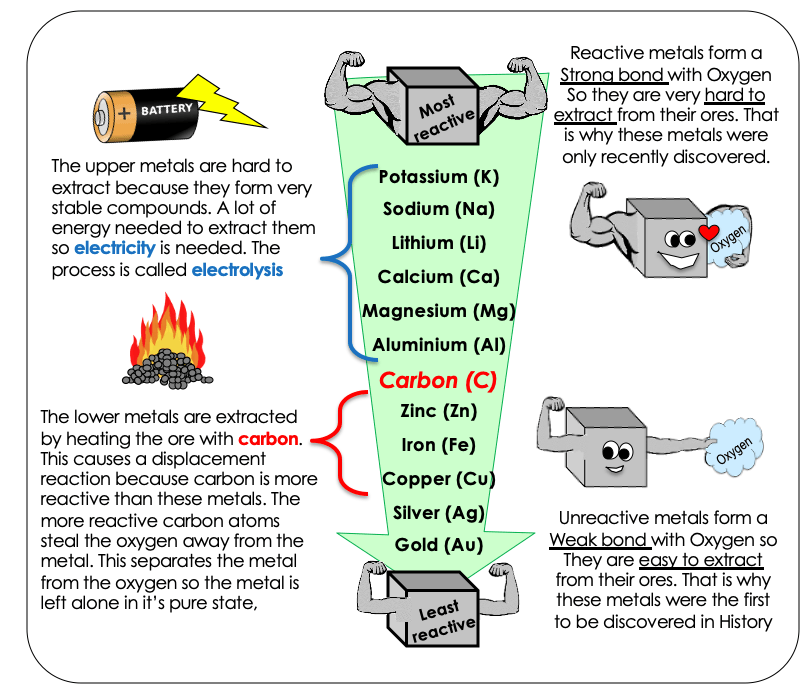
Which element cannot be extracted from its ore by reduction with carbon?
iron
aluminium
copper
zinc
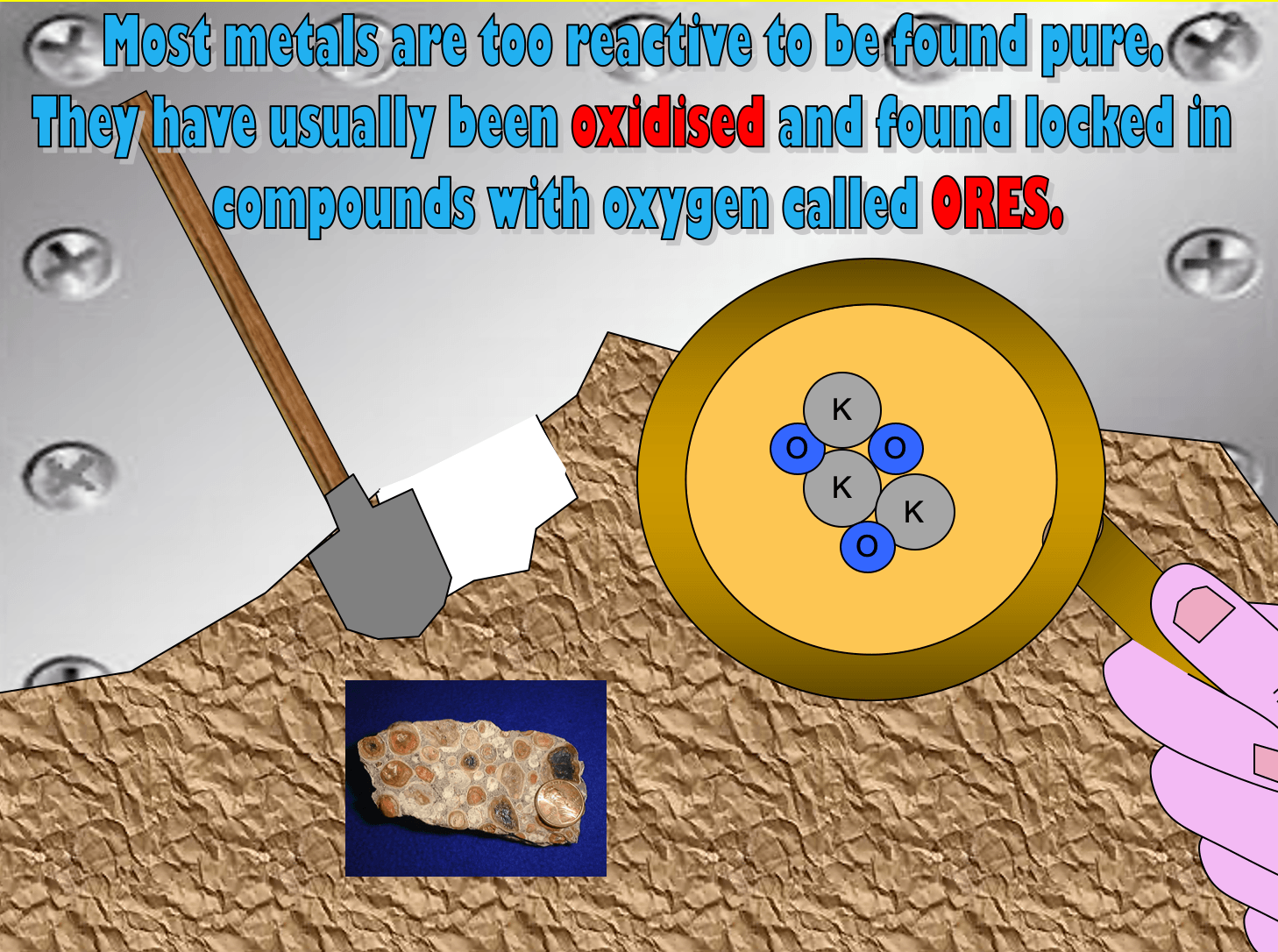
Which of these metals is most likely to be found locked in an ore?
silver
gold
potassium
platinum
Steel generally speaking is made of
iron and carbon
copper and iron
tin and carbon
aluminum and nickel

Which diagram represents an alloy?
A
B
C
D

The diagrams show an investigation into the conditions needed for rusting of iron nails. The nails in tubes 1 and 2 rust within a few days.
Which conditions are required for rusting?
Air alone
Air and water
Salt and water
Water alone
C + O2 → CO2
CO + Fe2O3 → CO2 + Fe
An industrial product is made by adding chromium and carbon to iron. The product produced is
I. more malleable than iron
II. more resistant to corrosion than iron
III. is shinier than iron
IV. is harder than iron
II and IV
I, II and III
II, III and IV
I, II, II and IV
‘Bronze is harder than copper’. Which of the following is the best to explain the statement?
Atoms in bronze are arranged closely packed and less empty spaces.
Layers of atoms in bronze are not easily slide over each other.
Atomic size of copper and tin is different.
Bronze is a mixture of copper and tin
Alloying can harden the metals because
the foreign atoms can prevent layers of atoms from sliding over each other
the foreign atoms produce stronger attractive forces between the metal atoms
the foreign atoms are stronger and harder
the foreign atoms increase the energy of the metal atoms
Which of the following properties does not belong to an alloy as compared to its pure metal?
Stronger
More corrosion resistant
Harder
More malleable
Which of the following statements below is true?
Copper is more ductile than brass
Brass is more malleable than copper
Iron is shinier than stainless steel
Iron is more resistant to corrosion than steel
Steel can become stainless when alloyed with _____.
chromium and nickel
copper and zinc
tin and lead
iron aand carbon
Which of the following are alloys? (choose 3)
Lead
Bronze
Brass
Aluminium
Stainless Steel
The most common element added to iron to create steel alloy is ...
tungsten
vanadium
chromium
carbon
Why is steel alloyed with other metals?
To make It stronger
To make it lighter
To make it more resistant to corrosion
All of the above
Which of these pictures shows the particles in a solid, pure metal?


What is an alloy?
A substance made by mixing two or more metals to create a material with improved properties
A substance made by mixing two or more non-metals to create a material with improved properties
A substance made by mixing a metal and a non-metal to create a material with improved properties
A substance made by mixing two or more elements, at least one of which is a metal, to create a material with improved properties
Why do jewelers not create jewelry with pure gold, silver, or copper?
It is a soft metal, so it will rub or scratch away over time.
It will not be shiny.
It is impossible to find a pure form of these metals.
It is too hard to shape into a design.


Choose the half-equation that shows the discharge of aluminium ion.
Al3+ - 3e- --> Al
Al2+ + 3e- --> Al
Al3+ + 3e- --> Al
Al3+ --> Al + 3e-
What is the half-equation for the discharge of hydroxide ions?
2O2- --> O2 + 4e-
OH- --> OH + e
4OH- --> 2H2O + O2 + 4e-
2H2O + O2 + 4e- --> 4OH-
Anions get discharged by ________ electrons at the ___________
gaining, cathode
losing, anode
gaining, anode
losing, cathode
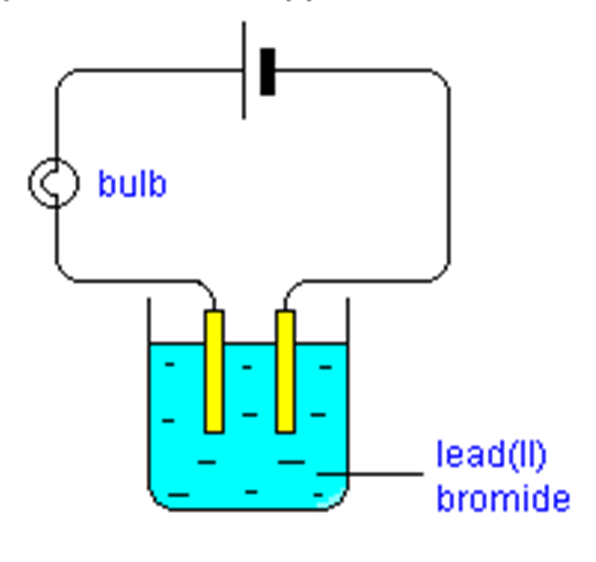

When substance X is electrolysed, the amount of gases P and Q formed is shown.
What is substance X?
concentrated aqueous sodium chloride
concentrated hydrochloric acid
dilute sulfuric acid
molten lead(II) bromide

What are the products at the electrodes when dilute sulfuric acid is electrolysed using inert electrodes?
A
B
C
D

Which row describes the electrolysis of molten potassium bromide?
A
B
C
D

The diagram shows the electrolysis of concentrated hydrochloric acid and concentrated aqueous
sodium chloride using carbon electrodes.
At which electrode(s) is hydrogen produced?
electrode 1 only
electrodes 1 and 3
electrode 2 only
electrodes 2 and 4
What are the electrode products when molten silver iodide is electrolysed between inert electrodes?
A
B
C
D
Copper and hydrogen can each be formed by electrolysis.
At which electrodes are these elements formed?
A
B
C
D
The apparatus used for electrolysis is shown.
Which statement is correct?
Copper forms at the anode in some electrolysis reactions.
Hydrogen forms at the cathode in some electrolysis reactions.
Oxygen forms at the cathode in some electrolysis reactions.
The negative electrode is called the anode.
What ions are present in molten aluminium oxide?
Al3+, O2-, H+, OH-
Al3+, O2-
Al3+, OH-
In the electrolysis of a solution, which two ions are present from the water molecules themselves?
H+
H-
H2O-
OH-
In the electrolysis of aqueous sodium chloride, NaCl (aq), which of the four ions will be oxidised at the anode (positive electrode)?
Sodium ions (Na+)
Chloride ions (Cl-)
Hydrogen ions (H+)
Hydroxide ions (OH-)
In the electrolysis of aqueous sodium chloride, NaCl (aq), which of the four ions will be reduced at the cathode (negative electrode)?
Sodium ions (Na+)
Chloride ions (Cl-)
Hydrogen ions (H+)
Hydroxide ions (OH-)

Choose the correct option.
A
B
C
D

Choose the correct option.
A
B
C
D

Choose the correct option.
A
B
C
D

Choose the correct option.
A
B
C
D

Choose the correct option.
A
B
C
D

Choose the correct option.
A
B
C
D

Choose the correct option.
A
B
C
D

Which statement is correct?
Copper metal is deposited at the positive electrode
In the external circuit electrons move from negative to positive
In the solution electrons move from positive to negative
Oxygen gas is produced at the positive electrode
Concentrated aqueous sodium chloride can be electrolysed. Which statement is correct?
Hydrogen gas is formed at the anode, and chlorine gas is formed at the cathode.
Hydrogen gas is formed at the cathode, and chlorine gas is formed at the anode.
Sodium metal is formed at the anode, and chlorine gas is formed at the cathode.
Sodium metal is formed at the cathode, and chlorine gas is formed at the anode.

