
 Worksheets
Unit 3 Chemistry Part 2 Review Wayground Gregg
Total questions: 176
Worksheet time: 4hrs 14mins
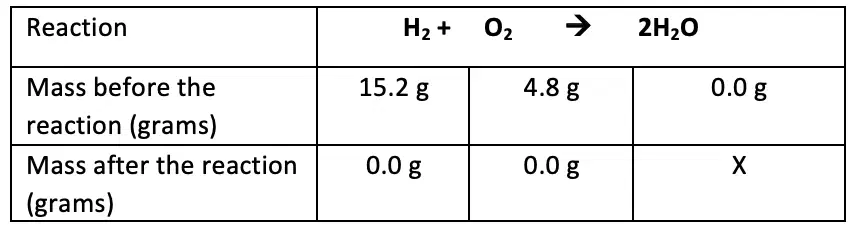
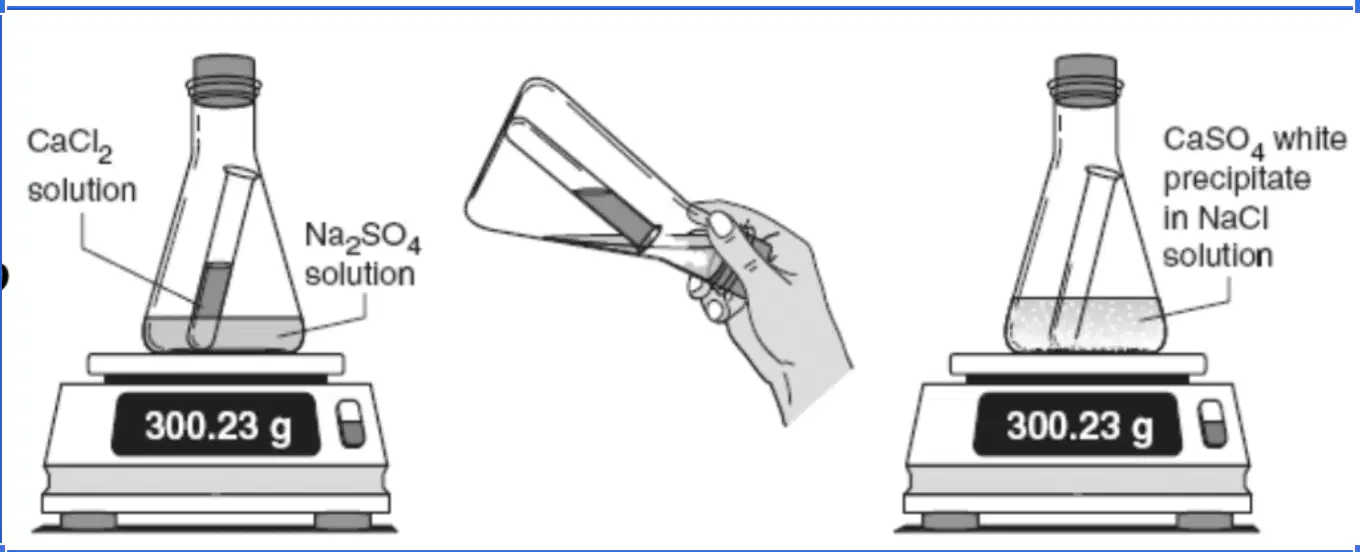


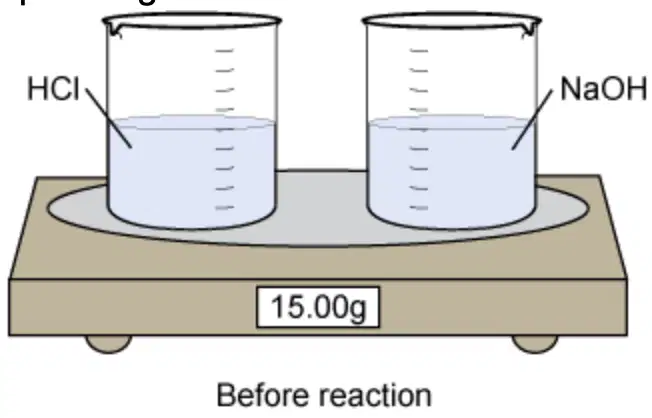




Which of the following best demonstrates the law of conservation of mass during a chemical reaction?
The total mass of the products is greater than the total mass of the reactants.
The total mass of the products is double the mass of the reactants.
The total mass of the products is equal to the total mass of the reactants.
The total mass of the products is less than the total mass of the reactants.
A student mixes two clear solutions in a sealed container and observes the formation of a solid and a gas. After the reaction, the mass of the sealed container and its contents is measured. What should the student expect?
The mass will decrease because a gas was produced.
The mass will increase because a solid was formed.
The mass will remain the same as before the reaction.
The mass will double due to the reaction.
Why is it important to conduct experiments in a closed system when investigating the law of conservation of mass?
To prevent the loss of mass as gases or vapors.
To increase the rate of the chemical reaction.
To ensure the reactants mix more thoroughly.
To change the color of the products.

When a liquid reaches the temperatures of its ___, it can become a gas.

When a solid reaches the temperatures of its ___, it can become a liquid.
melting point
freezing point
boiling point
density

When a liquid reaches the temperatures of its ___, it can become a solid.
melting point
freezing point
boiling point
density
Which of the following objects is not an electrical conductor?
Paper clip
Coin
Eraser
Iron nail
Select specific properties that are observed by your senses
Smell
Density
Texture
Color

A glass marble and a piece of cork of the same shape and size are dropped in water. Which of the following explains correctly why the glass marble sinks while the cork piece floats on water?
The glass marble is denser than water while the cork is less dense than water.
The glass marble is less dense than water while the cork is denser than water.
The glass marble and the cork are both denser than water.
The glass marble and the cork are both less dense than water.
Which is a size-dependent (Non-characteristic) property?
Weight
conductivity
solubility
melting/boiling point
Which is a size-independent (characteristic) property?
Mass
Color
volume
Density

A characteristic of matter that can be observed without changing the identity of the matter is a physical property.
True
False
Weight is the amount of matter in an object.
True
False

The ability to conduct electric current is referred to as...
density
solubility
malleability
electrical conductivity
would you use to separate salt from a
saltwater solution?
(a) is soluble in water.
Which are examples of thermal conductors?
cotton and polyester
copper, aluminum and iron
wood and rubber
glass and plastic
If you travel to the moon will your mass be greater than, less than, or the same as on Earth?
The ability to burn is known as---
Flammability
Combustion
Density
Exploding
Mass divided by volume is the formula for calculating----
Mass
Volume
Density
Matter
Reactivity (bubbling, fizzing) is a --- property.
Chemical
Physical


The melting point in degrees Celsius is---
100
32
0
212

H2 + O → H2O
H2 + O → H2O
What is the Law of Conservation of Mass?
It states that matter cannot be created or destroyed.
It states that energy cannot be created or destroyed.
It states that matter can be created or destroyed.
It states that sound can be created or destroyed.
Example: H2
N2+O2--> _NO
Mg + __HCl ---> MgCl2 + H2
Al + O2 → 2Al2O3
What chemical property describes a substance's ability to burn?
Flammability
Reactivity
pH
What chemical property describes a substance's ability to combine and form one or more new substances?
Flammability
Reactivity
pH
Alka Seltzer tablets fizz and bubble when placed in water. This is an example of what chemical property?
Flammability
Reactivity
pH
Rusting demonstrates what chemical property?
Flammability
Reactivity
pH
Putting ketchup on a penny demonstrates what chemical property?
Flammability
Reactivity
pH
True or False.
Cooking is always a chemical change.
True
False
Frying an egg is a chemical change. Which of the following sign(s) indicate that a chemical change occurred?
An unexpected change in color
Change in odor
Production of heat and/or smoke
Fizzing, bubbling, and/or foaming
Sound and/or light being given off
Mixing baking soda and vinegar is a chemical change. Which of the following sign(s) indicate that a chemical change occurred?
An unexpected change in color
Change in odor
Production of heat and/or smoke
Fizzing, bubbling, and/or foaming
Sound and/or light being given off
Burning paper is a chemical change. Which of the following sign(s) indicate that a chemical change occurred?
An unexpected change in color
Change in odor
Production of heat and/or smoke
Fizzing, bubbling, and/or foaming
Sound and/or light being given off
What are the six signs that a chemical change is occurring? Provide an example of a different reaction for each of the indicators you describe.

Describe THREE physical properties of the car pictured above. What has happened to the car? Why? Is this an example of a physical change or a chemical change? Explain.
A class observes a tree being cut with a chain saw. A student concluded that since it is impossible to put the tiny wood chips back together and the process cannot be reversed, that cutting trees with chain saws causes a chemical change in the wood. Is the student's conclusion accurate? Explain your answer.
What kind of properties of matter can we observe with our senses and can determine without destroying matter?
physical
chemical
astronomical
astrological
This type of property can be indicated by how it reacts with something else and if it was changed into a new substance after the reaction.
private
real estate
chemical
physical
Which of the following is a physical property of matter?
flammability
luster
reacts with air
reacts with acid
which of the following is a chemical property of matter?
reacts with water
density
sour taste
solubility
A change in size, shape, or state of matter is a ____________ change
animatronic
mental
chemical
physical
If no new substance was formed, what kind of reaction/change was it?
electronic
physical
extraordinary
chemical
A __________ change has occurred if a new substance was formed from the reaction.
protonic
subtropic
chemical
physical
What kind of change occurred if there was a change in the chemical and physical properties of the reactants?
physical
chemical
PE
evaporative
These are all examples of............?
melting point~solubility~odor
atomic properties
chemical properties
physical properties
commercial properties
You go into your fridge and take a sip of milk from the carton and it tastes disgusting (the milk soured)
chemical property
chemical change
physical property
physical change
You get home and you decide to cut an apple into slices to eat as a snack
chemical change
physical physical
physical property
physical change
You have a sore throat and you heard dissolving salt in warm water will ease the pain.
physical change
physical property
chemical change
chemical property
you go outside and notice the iron (Fe) plant hanger has rusted
physical change
physical property
chemical change
chemical property
An ice cube is placed in the sun. Later there is a puddle of water. Later still the puddle is gone.
physical change
chemical change
Two chemical are mixed together and a gas is produce.
physical change
chemical change
A solid is crushed to a powder.
physical change
chemical change
Two substances are mixed and light is produced.
chemical change
physical change
Chocolate syrup is dissolved in milk.
physical change
chemical change
A marshmallow is toasted over a campfire.
chemical change
physical change
Mixing salt and pepper.
physical change
chemical change
cooking an egg for breakfast
physical change
chemical change
grass grows
chemical change
physical change
You blow dry your wet hair. Which of the following are evidence for a physical change? (choose all that apply)
No change in substances.
No unexpected color change, temperature change or gas given off
Identity of a substance change
Silver oxide produced
You forgot to dry the bread knife when you washed it and reddish brown spots appeared on it. Which of the following is evidence for a chemical change? (choose all that apply)
gas is produced
Identity of a substance change
Iron in knife forms rust
no change in substances
In a fireworks show, the fireworks explode giving off heat and light. Which of the following is evidence for a chemical change?
Identity of substances change.
No unexpected color change, temperature change or gas given off.
No unexpected color change.
Fireworks combust making new products and energy (heat/light).
A straight piece of wire is coiled to form a spring. Which of the following are evidence for a physical change? (choose all that apply)
Identity of substances change.
Gas is produced
No change in substances.
No unexpected color change, temperature change or gas given off.
Changing the size and shapes of pieces of wood would be a chemical change.
true
false
In a physical change, the makeup of matter is changed.
True
False
Evaporation occurs when liquid water changes into a gas.
true
false
Evaporation is a physical change.
true
false
Burning wood is a physical change.
true
false
Combining hydrogen and oxygen to make water is a physical change.
true
false
Breaking up concrete is a physical change.
true
false
Sand being washed out to sea from the beach is a chemical change.
true
false
When ice cream melts, a chemical change occurs.
true
false
Acid rain damaging a marble statue is a physical change.
true
false

Anthony is performing an experiment. He adds 0.25 grams of baking soda to 5 grams of water and stirs. Anthony watches as the baking soda dissolves in the water. If Anthony weighs the water and baking soda solution, what will its mass be?
4.75 grams
5.25 grams
5.0 grams
7.5 grams
Matter can not be created nor destroyed: it can only be
Destroyed a little bit
Invisible
Transformed, changed
None of the above
If reaction starts with 20g of reactants it should produce
a total of 40g of products
a total of 80 g of products
a total of 10g of products
a total of 20g of products

Which of the models of a chemical reaction best represents the Law of Conservation of Mass?
A
B
C
D

Which of the models of a chemical reaction best represents the Law of Conservation of Mass?
A
B
C
D
Which of the following is an open system?

A

B

C

D
Which of the following is close system?
A
B
C

D

Which of the models of a chemical reaction best represents the Law of Conservation of Mass?
A
B
C
D
Q.
True or False
The mass of the reactants in a chemical equation must equal the mass of the products.
TRUE
FALSE
A student heated a 10 gram sample of a chemical in an open container. A chemical reaction occurred, and the mass of the sample was measured again. The mass of the sample was found to be less than before the reaction. Which of the following best explains the decrease in mass of the sample?
The heat caused the chemical to become less dense.
Some of the lighter particles were destroyed.
The reaction gave off more heat than was added.
Some of the particles escaped as a gas formed.
A chemical reaction that releases energy _________ and a chemical reaction that absorbs energy is called _____________.
exothermic; endothermic
endothermic; exothermic
exothermic; accumulative
liberal; endothermic
A system where only energy can be exchanged but not matter
Close system
Open system
A system which can be exchange both matter and energy with the surrounding.
Close system
Open system
Q.
True or False
In a chemical reaction there is always ONE product.
TRUE
FALSE
In combustion reaction what element is always the reactant
Oxygen
Carbon
Gold
Helium
If a reaction starts with a total 54g of reactants it should produce
a total of 54g of products
O + H2 → H2O
32 g of Oxygen completely reacts with 8 g of Hydrogen to produce _____ g of water.
8
12
24
40
Mg + F → MgF
24 g of magnesium reacts with 38 g of fluorine to produce _____ g magnesium fluoride.
How many elements does PbNO7 have?
Hint: Every capital letter😉
Substances present at the start of a chemical reaction are called ____.
Substances that form as the result, or at the end, of a chemical reaction are called ____.
How many iron (Fe) atoms are in
Fe(NO3)2
How many nitrogen (N) atoms are in
Fe(NO3)2
How many oxygen (O) atoms are in
Fe(NO3)2
Transformed, rearranged
Label the reactants and products of the chemical reaction shown.
Reactants
Products
Label the reactants and products in the chemical equation shown.
Reactants
Products

What are the reactants in this chemical equation?
6 CO2 + 6 H2O
H2O
C6H12O6
C6H12O6 + O2
What are the products in this chemical equation?
CO2 + H2O
H2O
C6H12O6
C6H12O6 + O2

Select the chemical formula for this molecule?
B1F3
BF
BF3
FB
How many atoms of hydrogen are in
C6H12O6
6
12
18
2

Examine the experiment shown, then fill in the blanks.
The experiment shows a (a) system.
The mass at the end of the experiment will be (b) the initial mass.

How many grams of Zn(NO3)2 was produced?
3 g
4 g
0 g
5 g

If AB is 18 grams and reacts in a closed system, which of the following could be the grams of A and B?
A is 13 grams and B is 2 grams
A is 18 grams and B is 5 grams
A is 9 grams and B is 11 grams
What is the Law of Conservation of matter?
Matter is created in a chemical reaction
Matter is created in a physical change
New chemicals formed from a chemical reaction have a larger overall matter than the original reactants
Matter is never created or destroyed
If the mass of a chemical reaction's product is 15 grams, what would the mass of the reactants be?
20 g
15 g
10 g
3 g

Why does this picture demonstrate the Law of Conservation of Matter?
the number of atoms of each element are the same on both sides
they start out separate and end up combined
the same elements are used
it doesn't demonstrate the Law of Conservation of Matter
If a chemical reaction occurs in a closed system (no way for any part of the reaction to escape), how does the product mass compare to the reactant mass?
the mass would decrease
the mass would increase
the mass would stay the same
it depends on the type of reaction
If a chemical reaction occurs in an open system (not contained), what might happen to the measurable mass of the products when compared to the reactants?
the measurable mass might decrease because any gas produced can escape (the actual mass would stay the same)
the mass would increase because mass was created
the measurable mass would stay the same because nothing would be able to leave the system.
it depends on the type of reaction

Which picture below would correctly demonstrate the Law of Conservation of Matter if this picture is the reactants?


Which of the following are Subscripts in this Chemical Formula: 3Fe2O4
3,4
3,2
2,4
6
Which Chemical Equation is Balanced?
Fe4+O2------4FeO2+O2
2H2+O2-----2H2O
3Cr+4O₂-----2Cr₂O₃
Which Chemical Equation is Balanced?
4O2 + 2H2 + S2------ 2H2SO4
4H2+O2-----2H2O2
3Cr+4O₂-----2Cr₂O₃
2H2 + O2 --> 2H2O
What is the right part of a chemical equation called?
2H2 + O2 --> 2H2O
Reactants
Products
Yields
Chemical Equation
Based on the Law of Conservation of Matter, describe the relationship between the mass of the reactants and the mass of the products.
The mass of the products is always greater than the mass of the reactants.
The mass of the reactants is less than the mass of the products.
The mass of the reactants equals the mass of the products.
The mass of the reactants is greater than the mass of the products.
If the mass of a chemical reaction's product is 15 grams, what would the mass of the reactants be?
20 g
15 g
10 g
3 g

Which section represents the reactants?
A
B
C
Which section represents the products?
A
B
C
Which section represents the yield sign?
A
B
C
Why does this picture demonstrate the Law of Conservation of Mass?
the number of atoms of each element are the same on both sides
they start out separate and end up combined
the same elements are used
it doesn't demonstrate the Law of Conservation of Mass
If a chemical reaction occurs in an open system (not contained), what might happen to the measurable mass of the products when compared to the reactants?
the measurable mass might decrease because any gas produced can escape (the actual mass would stay the same)
the mass would increase because mass was created
the measurable mass would stay the same because nothing would be able to leave the system.
it depends on the type of reaction
Which picture below would correctly demonstrate the Law of Conservation of Matter if this picture is the reactants?
In a balanced chemical equation, if there are 4 Hydrogen in the reactants, how many Hydrogen should be in the product?
1
2
3
4
Which of the following would represent a mixture?


Which of the following would represent a compound?
Which of the following would represent an element?

