
 Worksheets
Weather, Climate, and Water Cycle Worksheet
Total questions: 173
Worksheet time: 14hrs 25mins
Eliana measures outdoor temperatures in an area each day for a week at exactly 2:00 p.m. The temperatures she records are all between 25 °C and 30 °C. Eliana concludes that the climate of the area is tropical. What is the most important reason why her conclusion might not be correct?
A. She took the temperature readings at the same time each day.
B. She made her conclusion based only on temperature and not also on wind direction.
C. She made her conclusion based on only one week of data instead of over a long period of time.
D. She did not calculate the average of her data.
Which describes the relationship between weather and climate?
Weather and climate mean the same thing.
Weather is the temporary conditions of an area and climate is the long-term patterns of an area.
Weather is the long-term patterns of an area and climate is the temporary conditions of an area.
To calculate the weather, you take half of the climate.
Many factors are used to determine the climate of an area. Which of the following are the two main factors we use to describe climate?
precipitation and humidity
temperature and air pressure
wind conditions and humidity
temperature and precipitation
For his class project on weather and climate, Jeremy presented information about the rainforest at Olympic National Park in Washington. Which of his statements below is an example of climate?
There is a 0% chance of rain for the entire first week of June.
The park receives an average of 144 inches of rain each year.
The average temperature each day during the first week of June was 68°F.
In winter last year, there were only two days when the temperature dropped below 0°F.
A meteorologist in Churchill, Canada created the following table. What is the profession of the person who created the table?
Meteorologist
Geologist
Biologist
Astronomer
Which of these substances is a liquid form of precipitation?
Hail
Rain
Sleet
Snow
The image below shows water droplets that have formed on grass. Which process occurred to form the water droplets on the grass?
A. Condensation
B. Deposition
C. Evaporation
D. Sublimation
Which two processes change water into a gaseous state?
deposition and evaporation
condensation and deposition
evaporation and sublimation
sublimation and condensation
Jamari was enjoying a day at the beach when he noticed storm clouds forming over the ocean. He wondered why this happened at the beach so often.
Cool ocean currents cause transpiration forming storm conditions in the atmosphere.
Clouds evaporate more quickly over the ocean causing storms to form in the atmosphere.
The land and the ocean are heated evenly causing ocean and air currents to form storms.
The ocean water is constantly evaporating causing the atmosphere to be humid and storms to form.
Which of the following statements accurately describes how temperature affects the cycling of water?
Higher temperatures result in a decrease in both evaporation and precipitation.
Higher temperatures result in an increase in both evaporation and precipitation.
Lower temperatures result in a decrease in evaporation and increase in precipitation.
Lower temperatures result in an increase in evaporation and decrease in precipitation.
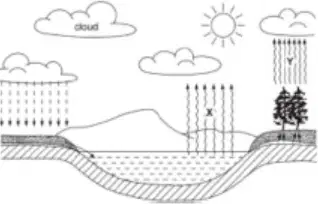
How does point "X" in the cycling of water affect the weather?
The ocean reflects the Sun’s rays into the atmosphere and causes the water vapor to condense into a cloud.
The cooler temperature of the ocean causes the water to evaporate into the atmosphere to later form clouds.
The Sun’s rays heat the ocean’s water and cause some of it to evaporate into the atmosphere to later form clouds.
The warmer temperature of the ocean causes the water vapor to release into the atmosphere through condensation.
A team of students analyzes weather data from two cities over the past decade to distinguish weather from climate. They find that one city experienced unusually heavy snowfall last winter, while the other city had its driest summer on record. Despite these anomalies, the average temperatures and precipitation levels for both cities have remained consistent over the decade. What key difference between weather and climate does this example illustrate?
Weather is limited to precipitation, while climate includes temperature data.
Climate changes faster than weather due to global warming.
Climate data is more reliable than weather data because it is less affected by anomalies.
Weather represents short-term conditions, while climate refers to long-term patterns.
The water cycle supports plant growth in the desert ecosystem by:
providing moisture through precipitation and groundwater recharge
increasing soil salinity and reducing water availability
preventing any water from reaching plant roots
causing rapid evaporation that eliminates all soil moisture
What role does the sun play in driving the water cycle?
It causes condensation by cooling the atmosphere.
It provides energy for evaporation, powering the movement of water through the cycle.
It increases infiltration by heating the ground.
It removes water vapor from the atmosphere, ending precipitation.
Why is it important to study both weather patterns and long-term climate trends?
Weather is random, while climate determines all temperature changes.
Understanding climate helps identify patterns, while weather reveals daily variations.
Weather is more consistent than climate trends over time.
Climate provides hourly forecasts, while weather studies yearly changes.
Why do weather forecasts often change within 48 hours of a predicted event?
New observational data can cause weather models to adjust predictions.
The weather is completely random and unpredictable.
Forecasts are never reliable for more than one day.
Changes in weather only occur during certain seasons.
How would scientists use both weather and climate data to assess the impact of a long-term drought in a region?
Focus only on one year of daily rainfall totals to measure drought severity.
Combine short-term weather data with long-term trends in precipitation and temperature.
Rely solely on global weather patterns to predict the drought’s duration.
Exclude temperature trends since droughts are only based on precipitation.
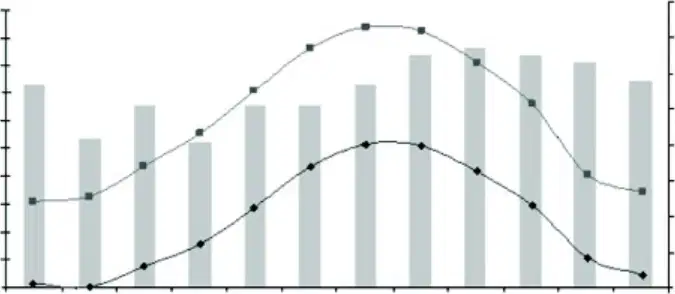
Refer to the graph titled 'TEMPERATURES AND PRECIPITATION FOR EDINBURGH, SCOTLAND'. Which statement best describes the graph?
It is an example of Edinburgh's climate, because it shows the daily temperature and precipitation.
It is an example of Edinburgh's weather, because it shows the daily temperature and precipitation.
It is an example of Edinburgh's climate, because it shows a long-term average of temperature and precipitation.
It is an example of Edinburgh's weather, because it shows a long-term average of temperature and precipitation.

A
Rain
B
Freezing Rain
C
Sleet
D
Snow


Which of the following correctly differentiates between weather and climate?
Weather describes short term conditions of the atmosphere, while climate describes long term conditions of the atmosphere.
Weather describes long term conditions of the atmosphere, while climate describes short term conditions of the atmosphere.
Weather describes conditions of the atmosphere, while climate only describes changes in temperature.
Weather describes changes in temperature over time, while climate describes changes in atmosphere over time.

Which observation describes a change in climate rather than a change in weather?
The thunderstorm dropped about three centimeters of rain today.
The average summer temperatures have increased over the last ten years.
The snowfall in this area was more this week than it was last week.
The average wind speed in April was less than it was in March.
Discuss the potential impacts of climate change on weather patterns.
Climate change has no impact on weather patterns.
Climate change can lead to more extreme weather events, such as stronger hurricanes, more intense heatwaves, and heavier rainfall.
Climate change will only cause colder weather.
Climate change will only affect weather patterns in the polar regions.
Which of the following is an example of weather?
A hot summer in Arizona
A rainy afternoon in New York
The snowy winters of Alaska
The dry seasons in California


In which part of the water cycle does condensation happen?
In the ocean
In the clouds
Falling from the clouds back to earth
When water travels from the ocean to the clouds

The process that occurs at 1 is (a)
The process that occurs at 2 is (b)
The process that occurs at 3 is (c)


When thinking about the water cyle baggies we made in class, which part of the water cycle was being demonstarted by the water droplets that foraed on the very top of the bag?
Condensation
Evaporation
Precipitation
Cloud Formation
Convection Currents cause daily patterns of clouds, wind, precipitation, and air pressure.
True
False
cloud, dew, or fog from the shower are examples of...
evaporation
collection
condensation
precipitation
The (a) is the driving energy of the water cycle
The changes to water when it collects in the air and condenses into clouds.
Precipation
Condensation
Evaporation
Accumulation
A process in the water cycle where liquid turns to gas is ___.
condensation
evaporation
precipitation
transpiration
Label the water cycle diagram using the labels below
Collection
Run off
Precipitation
Condensation
Evaporation
Transpiration

Name the processes labeled with letters by matching the name with the correct letter.
A
Precipitation
B
Transpiration
C
Runoff
D
Infiltration
E
Condensation
Match the following types of precipitation with their descriptions.
drops of water falling from the sky
rain
the raindrops that freeze into solid particles of ice
sleet
Round pellets of ice that form only in cumulonimbus clouds
hail
Raindrops that freeze when they touch a cold surface
freezing rain
water vapor in a cloud is converted directly into ice crystals to form a shape with six sides that clump together
snow
Match the following

Rain

Snow

Hail

Sleet

Fog
Match the following vocabulary
runoff
water flows downhill or on the surface
infiltration
the action of water sinking into soil
groundwater
water that is beneath the surface
collection
when water accumulates as larger bodies
Match the following water cycle terms
Standard (HS-LS2-5)
when the water droplets that form clouds become large enough, the water droplets fall to the earth (rain, sleet, snow)
Precipitation
liquid water returns to the atmosphere (vaporizes)
Evaporation
evaporation of water from plants
Transpiration
water vapor in the air condenses to form clouds, in a process called
Condensation
surface water found on land that is eventually carried back to an ocean or lake.
Runoff
Label the water cycle
Evaporation
Condensation
Precipitation
Transpiration
Collection

Evaporation
A
Condensation
B
Precipitation
C
Transpiration
D
Groundwater
E
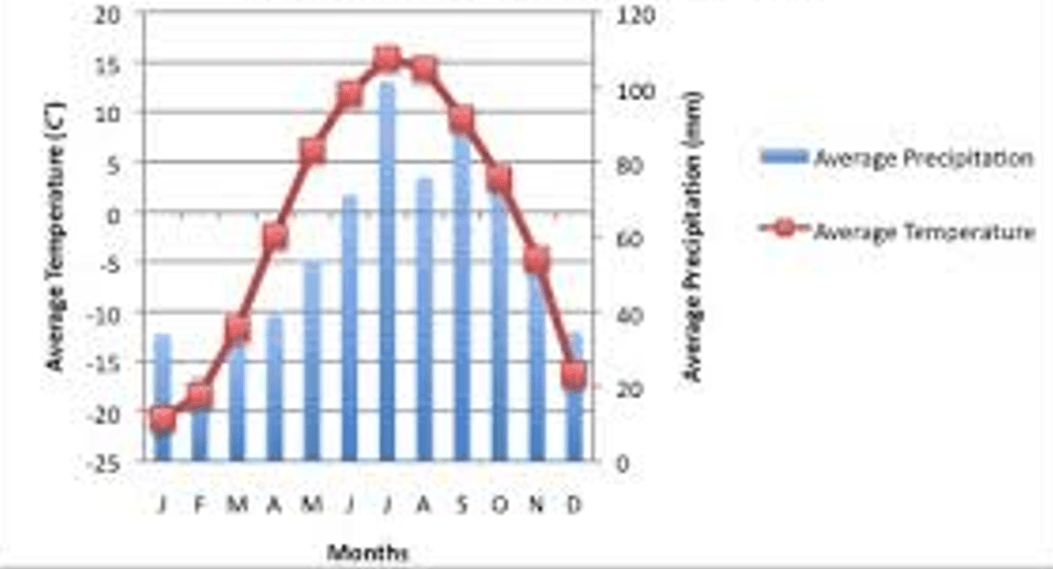

Temperature on a climate graph is shown with a ___________.
BAR
LINE

What do you notice about this climate graph?
temperature is warm year round
temperature is cold year round
dry summers
most rain in the winter
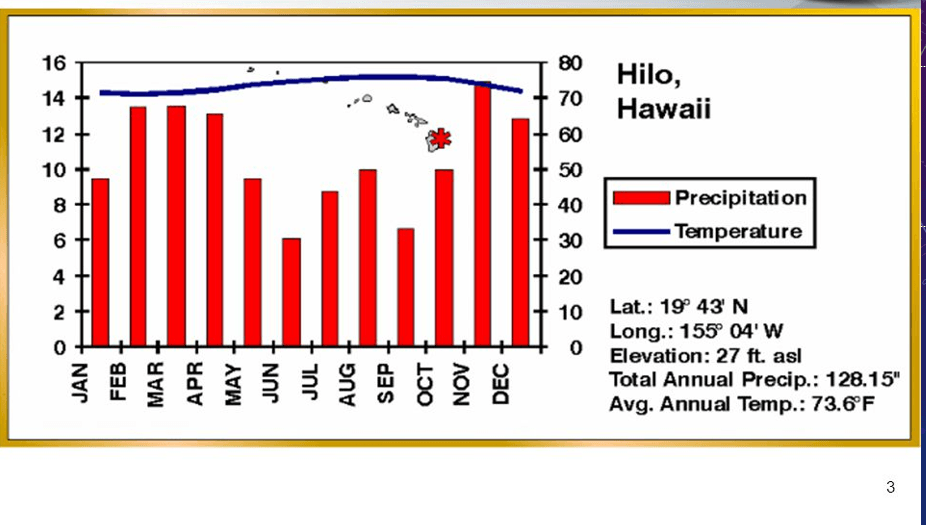
When does the least precipitation occur?
February - March
April - May
June - July
November - December

Which months have the warmest temperatures?
December, January, February
March, April, May
June, July, August
September, October, November
Which graph shows a place with a very dry climate all year long?


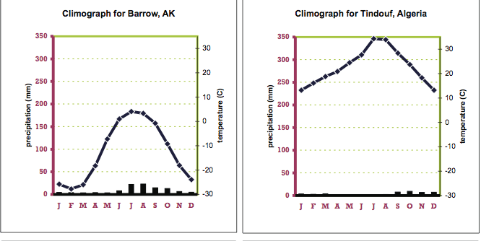
Which of the following is a similarity between the tundra and the desert?
low temperatures
high temperatures
low precipitation levels
permanently frozen ground
What are climate zones?
Areas of the Earth with different weather patterns and climate characteristics.
Areas of the Earth with similar geological features.
Areas of the Earth with similar weather patterns and climate characteristics.
Areas of the Earth with similar vegetation patterns.
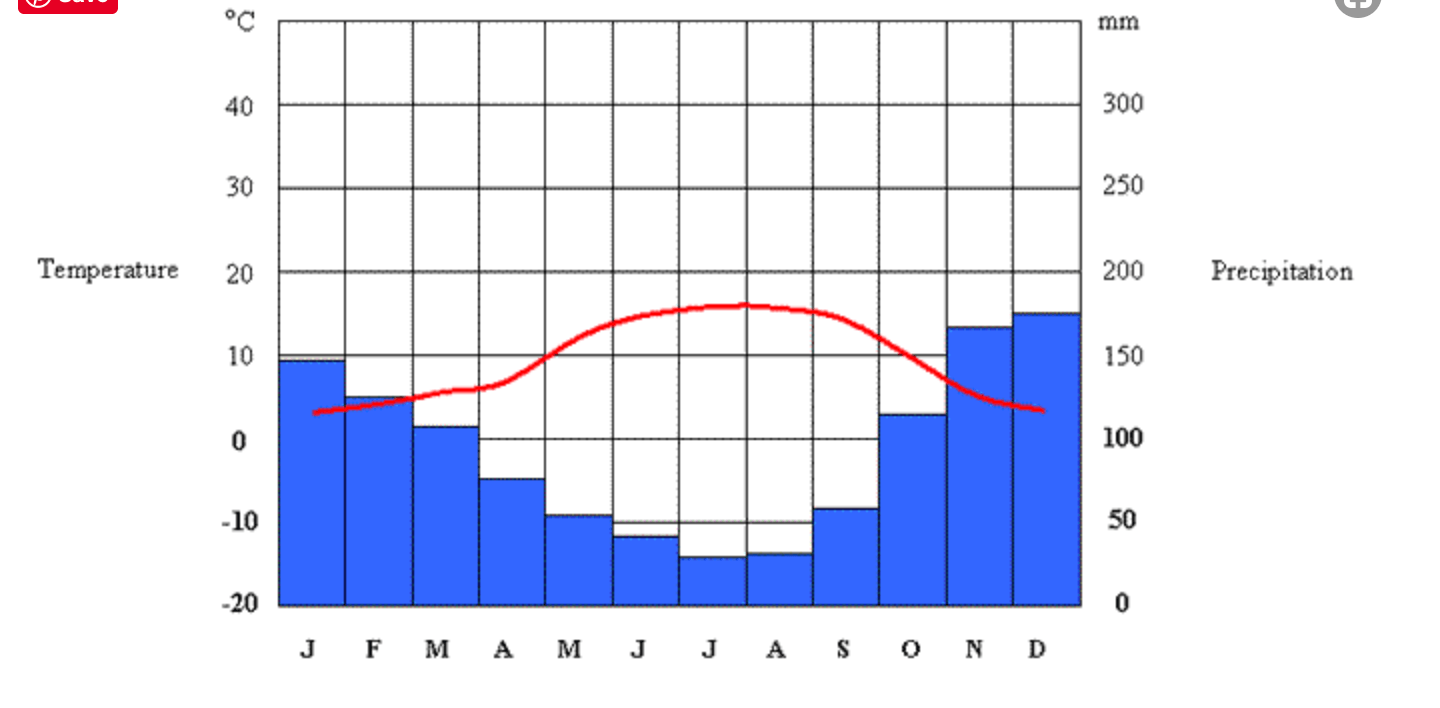
This graph shows the hottest temperatures (red line) in:
June, July and August
January, February, March
October, November, December
What is the water cycle?
the 3 forms of water
the movement of water on, above, or below the surface of the Earth
when water melts
when clouds form
Snow, sleet, hail, and rain are all examples of ________________.
evaporation
condensation
accumulation
precipitation

What is it called when plants give off water vapor as a waste product?
condensation
evaporation
sublimation
transpiration
What is the energy source for the water cycle?
the sun
the earth
water
the moon
What is the process during which water changes from a liquid to a gas as it heats up?
Condensation
Runoff
Precipitation
Evaporation
What step of the water cycle occurs when clouds become too heavy?
Condensation
Runoff
Precipitation
Evaporation
What is the process during which water cools and turns from a gas to a liquid?
Condensation
Runoff
Precipitation
Evaporation
What is the process during which water cools and turns from a gas to a liquid?
Condensation
Runoff
Precipitation
Evaporation

What is it called when water droplets form on the outside of a cool glass?
Condensation
Transpiration
Precipitation
Evaporation
The water that moves along the surface of the earth is called
ground water
surface water
runoff water
Precipitation that enters the soil is called
ground water
surface water
runoff water

Evaporation
A
Condensation
B
Precipitation
C
Transpiration
D
The process of water that is added to the atmosphere from plants is called
Condensation
Evaporation
Precipitation
Transpiration
occurs when the sun heats water up and it becomes vapor in the air.
Evaporation
the opposite of evaporation; it occurs when air cools and the vapor collects into liquid form.
Condensation
condensation falling onto land in the form of rain, sleet, hail, snow, and mist. Only 10% of water evaporated falls as precipitation.
Precipitation
the downward movement of water from the land surface into the soil or porous rock. Ground water begins as precipitation. Once water infiltrates the soil it can move vertically and horizontally through the soil.
Infiltration
is the water that runs off land back into an ocean or river.
runoff
Snow and hail are examples of (a)
Precipitation
Evaporation
Condensation
Jack noticed that a puddle was gone that was there on his walk to school. What happened to the puddle?
It evaporated
It melted
It condensed

This picture shows -
evaporation
condensation
precipitation
transpiration

During which stage do clouds form?
condensation
evaporation
precipitation
Which of the following are types of freshwater that can be used by people?
Select all that are true.
groundwater
ice caps and glaciers
oceans
rivers
lakes
Why does groundwater usually require less treatment than surface water?
The layers of Earth protect groundwater from pollutants.
As groundwater sinks into the ground, the layers of rock act like a natural filter and remove pollutants from the water.
Surface water has more exposure to pollutants in runoff and the atmosphere.
all of the above
Rain and snow are two different forms of precipitation that fall on Earth's surface. Which factor is responsible for there being different forms of precipitation?
Evaporation
Run-off
Temperature
Transpiration
A change directly from the solid to the gaseous state without becoming liquid
Sublimation
Infiltration
Runoff
Condensation
The process by which water on the ground surface enters the soil
Infiltration
Runoff
Groundwater
Liquid
Water that flows over the ground surface rather than soaking into the ground
Infiltration
Runoff
Groundwater
Sublimation
Water that fills the cracks and spaces in underground soil and rock layers
Solid
Sublimation
Transpiration
Groundwater
*Begins Section 3*
Change from a solid to a gas
Vaporization
Condensation
Sublimation
Melting
When sublimation occurs, what is the change in the state of matter?
Gas to liquid
Gas to solid
Solid to gas
Solid to liquid
What is wind?
Air in motion
Water vapor in the air
Force of air pushing on an area
Amount of heat in the air
What causes wind?
Uneven heating of the earth's surface
Amount of water vapor in the air
Force of air pushing on an area
Amount of heat in the air
What is humidity?
Amount of water vapor in the air
Air in motion
Force of air pushing on an area
Amount of heat in the air
What is air pressure?
Force of air pushing on an area
Air in motion
Amount of water vapor in the air
Amount of heat in the air
What happens to air pressure as you go higher in the air?
It decreases
It increases
It remains the same
It fluctuates
What is air temperature?
Amount of heat in the air
Air in motion
Force of air pushing on an area
Amount of water vapor in the air
What is rainfall?
Amount of water vapor in the air
Air in motion
Force of air pushing on an area
Amount of precipitation

Check all the characteristics of high air pressure.
air is more dense
air is less dense
colder air
winds flow away

Check all the characteristics of low air pressure.
warmer air
colder air
air is less dense
winds flow towards

Choose all examples of precipitation
rain
snow
hail
sleet
How do clouds form?
Clouds form when water liquid heats up.
Clouds form when water vapor freezes.
Clouds form when water liquid condenses.
Clouds form when water vapor condenses.
What are the factor that influence the weather?
the snow cycle, air masses, pressure systems, local winds, jet streams, and wind currents
the water cycle, air masses, pressure systems, global winds, jet streams, and ocean currents
the water cycle, air masses, pressure systems, lack of winds, water streams, and wind currents.
the water cycle, sunlight, pressure systems, winds, water streams, and ocean currents.
Weather conditions in a certain area over a long period of time is referred to as...
Weather
Climate
Relative Humidity
Precipitation

Phoenix, Arizona has extremely hot summers.
Weather
Climate

Today is much colder than yesterday!
Weather
Climate

We got 3 inches of rain yesterday.
Weather
Climate

Over the past 30 years, May has been the rainiest month.
Weather
Climate
____ is describe the current atmospheric conditions for a specific place.
weather
climate
storms
____ is what is expected for a specific area during a specific time of the year.
weather
climate
storms
Which of the following best describes weather?
day to day conditions of the atmosphere at a place in regards to heat, dryness, sunshine, wind, rain, etc.
long-term conditions (months/years) of the atmosphere at a place in regards to heat, dryness, sunshine, wind, rain, etc.
Which of the following best describes climate?
day to day conditions of the atmosphere at a place in regards to heat, dryness, sunshine, wind, rain, etc.
long-term conditions (months/years) of the atmosphere at a place in regards to heat, dryness, sunshine, wind, rain, etc.

Is it weather or climate?
Weather
Climate
The current state of the atmosphere right now.
Climate
Weather
Meteorology
Patterns
What is climate?
weather
rain, sleet, snow, or hail
average weather in a region over a long period of time
the amount of ice cream available in a city

What is air pressure?
the amount of water vapor in the air.
the measure of force that air molecules push on a surface
the movement of air because of differences in air pressure
how far (the distance) that someone can see depending on the weather.

The short-term state of the atmosphere, including temperature, humidity, wind and visibility.
weather
wind
visibility
relative humidity

Humidity is....
the temperature where water starts to condense into liquid water
the amount of water vapor in the air
the force that air molecules push on a surface
how far that someone can see because of the weather

The movement of air because of differences in air pressure.
wind
air pressure
weather
visibility

Any form of water that falls to the Earth's surface from the clouds.
humidity
relative humidity
dew point
precipitation

I live in Tornado Alley, therefore there is the risk of experiencing a tornado each year.
Weather
Climate

We average 200 inches of snow each winter.
Weather
Climate
A climatogram shows a biome's ___________ and ___________.
temperature and precipitation
temperature and plant life
precipitation and rainfall
precipitation and cloud cover
On a climatogram, the bar graph represents _____________.
precipitation
temperature

What is approximate rainfall(precipitation) in June?
225
25
5
50
What is approximate rainfall(precipitation) in June?
225
25
5
50
Which of the following is a similarity between the tundra and the desert?
low temperatures
high temperatures
low precipitation levels
permanently frozen ground

What is the average temperature in December?
120
20
15
-20

In which month is the temperature the lowest?
January
April
July
September
What is the average rainfall in September?
10
150
20
-20


This graph shows the hottest temperatures (red line) in:
June, July and August
January, February, March
October, November, December

In what month was Wellington the coldest?
Jun
July
Aug
May
In what month did Wellington have the least amount of rain?
Jan
Feb
Nov
Dec

In which month do they get the most rain in this biome?
January
May
August
November
Which months have the warmest temperatures?
December, January, February
March, April, May
June, July, August
September, October, November

When is there the most precipitation & highest temperatures?
February
July
September
December

How can you tell this is a tundra?
Temperatures are below zero most of the year
Temperatures go up and down
There is lots of precipitation (snow)
There is a wet season and dry season

Which is the desert climograph?
A
B
C
D
Which climograph has the most precipitation during the winter?
A
B
C
D
Which climograph has the most precipitation during the summer?
A
B
C
D
Which climograph has the largest degree difference between the average high and average low?
A
B
C
D
Which TWO climographs are closest to the equator (warmest)?
A
B
C
D

Which climograph do you think matches the place in the picture?


Which climograph do you think matches the place in the picture?
How much precipitation does this location get in August?
30 mm
200 mm
375 mm
37 mm
Which of the following is NOT correct?
Location C has warm and wet summers
The summers in all 4 locations are dry
Location A and C have both have periods where they get heavy rainfall
Location C and B have steady temperatures throughout the year

Which location is in the southern hemisphere?
A
B
C
D

Which location is closer to the equator?
Location A
Location B

Why do places near the equator tend to be warmer?
They are closer to the sun.
They receive direct sunlight all year long.
Greenhouse gases are more significant near the equator
More people live near the equator so there is more pollution

On average, how much precipitation does this city receive in the month of October?
2.5 inches
7.5 inches
11.8 inches
14.5 inches

Which biome has an average temperature that is below zero for several months of the year?
B
C
D
E
F
When does the least precipitation occur?
February - March
April - May
June - July
November - December
Which months have the warmest temperatures?
December, January, February
March, April, May
June, July, August
September, October, November

Which side of Oregon receives more precipitation?
East
West

Altitude is...
the height of an object or point in relation to sea level or ground level
the distance of a place north or south of Earth's equator

Latitude is...
the height of an object or point in relation to sea level or ground level
the distance of a place north or south of Earth's equator

How does latitude affect the climate of an area?
The higher the latitude, the warmer the temperature.
The higher the latitude, the lower the temperature.
The higher the latitude, the more precipitation.
The higher the latitude, the less precipitation.

How does elevation affect the climate of an area?
As elevation increases, air temperature increases.
As elevation increases, air temperature decreases.
As elevation increases, precipitation increases.
As elevation increases, precipitation decreases.

How do ocean currents affect the climate of an area? Choose all that apply.
Cold ocean currents have a cooling effect on nearby land.
Cold ocean currents have a warming effect on nearby land.
Warm ocean currents make nearby land warmer.
Warm ocean currents make nearby land colder.

How does the distance from a large body of water affect the climate?
Cities near the ocean have less precipitation.
Cities near the ocean have more precipitation.
Cities near the ocean have a smaller temperature range.
Cities near the ocean have a large temperature range.
What is latitude?
The distance of a location from the equator
The distance of the location from the prime meridian
The distance of a location from the sun
The distance of a location from the moon

What is the difference between climate and weather?
Climate averages the weather conditions in a specific place over a long period of time, while weather describes the state of the atmosphere at a specific moment in time.
Weather averages the weather conditions in a specific place over a long period of time, while climate describes the state of the atmosphere at a specific moment in time.
Climate describes the weather conditions at night, while weather describes the conditions during the daytime.
There is no difference between climate and weather.
Which two major factors are climates classified according to?
Elevation & Precipitation
Latitude & Temperature
Elevation & Latitude
Precipitation & Temperature
Large bodies of water affect the climate of the land next to them because:
Water heats up and cools more slowly than land
Water heats up and cools faster than land
Water and land cool at the same time
Water and land heat at the same rate
Which of the following could cause a planet's climate to change?
Volcanic ash from a huge eruption could block sunlight and cool the planet.
An increase in greenhouse gases.
Both of these are correct.
Which of the following could cause a planet's climate to change?
Volcanic ash from a huge eruption could block sunlight and cool the planet.
An increase in greenhouse gases.
Both of these are correct.
Which climograph has the most precipitation during the winter?
A
B
C
D
What is the term for the amount of water vapor in the air?
Evaporation
Condensation
Precipitation
Humidity
Which process in the water cycle involves water turning into vapor?
Precipitation
Transpiration
Condensation
Evaporation
What is the main factor that causes changes in weather patterns?
Wind
Temperature
Air Pressure
Humidity
Evaporation
A
Condensation
B
Precipitation
C
Transpiration
D
The process of water that is added to the atmosphere from plants is called
Condensation
Evaporation
Precipitation
Transpiration

These are examples of what?
precipitation
evaporation
transpiration
condensation
Where is groundwater stored?
in lakes and rivers
in underground lakes
in cracks and pores beneath Earth's surface
in mid-ocean ridges


What step of the water cycle does this picture show?
Condensation
Runoff
Precipitation
Evaporation

