
 Worksheets
revision sheet g6 q4
Total questions: 177
Worksheet time: 5hrs 32mins
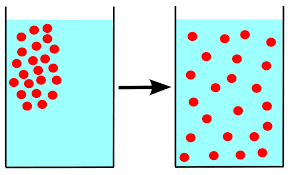
The movement of particles from an area of higher concentration (more particles) to an area of lower concentration. The particles spread out.
Dissolving
Diffusion
Density
Thermal Expansion

As temperature increases, kinetic energy ________.
stays the same
increases
decreases

Temperature is a measure of _____________.
average kinetic energy
average potential energy
the sum of kinetic & potential energy
the difference of kinetic & potential energy
The faster the particles move, the less kinetic energy there is.
True
False
As the kinetic energy of the particles increased, the _____ of the particles ________
speed; decreased
speed: increased
space; decreased
space; increased
Temperature is a measure of _____________.
average kinetic energy
average potential energy
the sum of kinetic & potential energy
the difference of kinetic & potential energy
As temperature increases, kinetic energy ________.
stays the same
increases
decreases

In which image has diffusion completed ?
1
2
3
The movement of particles from an area of higher concentration (more particles) to an area of lower concentration. The particles spread out.
Dissolving
Diffusion
Density
Thermal Expansion
Particles move in ______ with no pattern.
a square
a circle
random motion
When particles move faster they bump into each other and need more space. This is called ____.
random motion
diffusion
thermal expansion
thermal contraction
What best describes the particles in a solid?
close together and moving freely
far apart and moving freely
close together and vibrating in place
far apart and vibrating in place
When a substance is heated, the particles gain energy and move apart. The volume of the substance being heated ______.
increases
decreases
stays the same
Most highway bridges are built with expansion joints that can move back and forth. What is the reason for this?
expansion joints are cheaper than stationary joints
the materials that make up the bridge will expand and contract with changes in temperature
there is no real good reason to use expansion joints
A large balloon is taken to a shady area and filled with cool air. The balloon is then taken to a bright, sunny location. After a short time, the balloon begins to expand. WHAT explanation does this investigation verify?
A balloon filled with cool air will rise into the atmosphere
the sunlight had no effect on the balloon
as particles gain energy the material takes up more space

which one will have more kinetic energy?
blue picture
pink picture
which one have more total energy?


MORE movement of particles
MORE kinetic energy
more temperature
less temperature
LESS movement of particles
LESS kinetic energy
more temperature
less temperature
what is Temperature:
the measure of the average kinetic energy
the measure of the potential energy
When temperature increase particles will collide more so the volume of a material will increase.
which one is thermal contraction?
less temperture less volume
the measure of the average kinetic energy.
more temperature more volume
which one represent Thermal expansion?


In which glass the colour will diffuse faster?


Which one is Diffusion?


Kinetic energy is what type of energy?
chemical
electric
motion
sound
Adding energy to water causes the water particles to...
speed up
slow down
As the kinetic energy of the particles increased, the _____ of the particles ________
speed; decreased
speed: increased
space; decreased
space; increased
The faster the particles move, the less kinetic energy there is.
True
False
Temperature is a measure of _____________.
average kinetic energy
average potential energy
the sum of kinetic & potential energy
the difference of kinetic & potential energy
As temperature increases, kinetic energy ________.
stays the same
increases
decreases
Gas particle movement can best be described by the following:
predictable movement
awkward movement
Kelvin movement
random movement
The faster the particles move, the more _______. (Choose all that apply.)
kinetic energy they have.
quickly they solidify.
quickly diffusion occurs.
chemical energy they have.
The study of heat is known as (a) .
The study of heat is known as (a) .
An English physicist, who was a major contributor to his field. Energy is measured in a unit named after him.
Jacque Charles
James Prescott Joule
Francis Bacon
Sir Isaac Newton
When _______ is added to a substance, particle movement increases.
temperature
kinetic energy
thermal energy
potential energy
The measurement of average kinetic energy is called _____.
thermal energy
Kelvin
Celsius
temperature
When a substance has more ____, it has more energy.
kinetic energy
potential energy
mass
wishful thinking
Solids have no particle movement.
True
False
When indicating particle movement in a drawing, the more motion lines a particle has,
the slower it is moving.
the faster it is moving.
the more likely it is to be a solid.
the closer it is the absolute zero.

Which of the following is NOT a way in which thermal energy is transferred?
conduction
convection
radiation
sublimation

Which is the definition of heat?
the total kinetic energy of the particles in an object
the expansion of an object due to increased thermal energy
the difference in temperature between two objects
the movement of thermal energy from a warmer object to a cooler object

Evaporation and boiling are both types of which?
vaporization
melting
sublimation
radiation

Which statement is true of the image shown here?
the molecules in beaker A are moving faster than the molecules in beaker B
the molecules in beaker B are moving faster than the molecules in beaker A
the molecules in beaker A are moving at the same speed as the molecules in beaker B
beaker A contains more molecules that are moving than beaker B does

How can thermal energy be transferred from one object to another if the objects are not in contact?
by radiation only
by convection only
either by convection or by radiation
either by conduction or by radiation

Is a seat belt buckle a better thermal conductor than the cloth belt?
yes, of course it's metal
no, of course not!
What's a seat belt?
I have no idea what a thermal conductor is, I sleep in class.

What type of energy does this statue have?
electric
mechanical
sound
thermal

Which is a form of energy that cannot be stored?
chemical energy
gravitational potential energy
nuclear energy
sound energy
When a substance is heated, the particles gain energy and move apart. The volume of the substance being heated ______.
increases
decreases
stays the same
What best describes the particles in a solid?
close together and moving freely
far apart and moving freely
close together and vibrating in place
far apart and vibrating in place
Particles move in ______ with no pattern.
a square
a circle
random motion
Metric unit for measuring temperature; On this scale water freezes at zero and boils at 100.
Joules
Fahrenheit
Celsius
Be safe.
A solid is a state of matter that has a(n)
indefinite volume and indefinite shape
definite volume and a definite shape
definite volume and an indefinite shape
indefinite volume and a definite shape
In which state of matter are particles packed tightly together in fixed positions?
gas
solid
liquid
plasma
The freezing point of water is the same as its
melting point
boiling point
sublimation point
evaporation point
An uncovered pot of soup is simmering on a stove, and there are water droplets on the wall above the back of the stove. What sequence can you infer has occurred?
melting, then boiling
freezing, then thawing
vaporization, then condensation
condensation, then vaporization
In a(n) (a) , the particles are packed closely together, but they can move past each other freely.
The common state of matter that does not have a definite shape or a definite volume is a(n) (a) .
The characteristic temperature at which a pure solid changes to a liquid is its (a) point.
A shrinking puddle is an example of (a) , or vaporization that takes place only on the surface.

In which state of matter are the particles least able to move?
A
B
C

Which of these three states represents a liquid?
A
B
C

Which of these three states would you expect to be the most affected by the volume of its container?
A
B
C

The diagram shows arrangement of particles in a
Solid
Liquid
Gas
Define a liquid.
Matter that has fixed shape but no fixed volume
Matter that has fixed shape and fixed volume
Matter that has fixed volume, but no fixed shape
What is a gas?
Matter that has fixed shape but no fixed volume
Matter that has no fixed shape and no fixed volume
Matter that has no fixed shape but fixed volume
compounds

What state is represented in the gif?
Solid
Liquid
Gas
It is the amount of matter in an object.
volume
mass
weight
density
What is a transfer of heat energy by electromagnetic waves through space?
conduction
convection
radiation

In heat transfer, heat always flows from the _?_ substance to the _?_ substance.
hotter to colder
colder to hotter
hotter to hotter
colder to colder
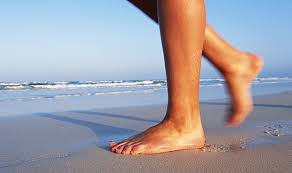
Walking on the warm sand sand with your bare feet demonstrates this type of heat transfer. This is an example of _?_.
conduction
convection
radiation

The candle will slowly heat the metal and transfer the heat directly to the mans hand. This is an example of _?_.
conduction
convection
radiation
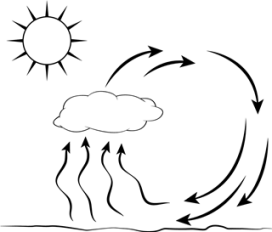
than in hot things.

Laying under the sun to get tan.
Conduction
Convection
Radiation
Why are wooden spoons used for stirring hot food?
they allow heat to move easily
they are easy to clean
they stop the heat from burning your hand
Metal pans heat up easily for cooking.
true
false

Which one is using more energy?
A
B
The ocean is cold even in summer because water _____
has high specific heat
has low specific heat
conducts heat well
is insulated from sunlight
The temperature of a piece of iron increases more than that of a sample of water with the same mass when the same amount of thermal energy is added. This is because _________
iron has a higher specific heat
iron has a lower specific heat
iron has a higher melting point
water is a liquid and iron is a solid
The amount of heat required to raise the temperature of 1 kg of a substance by 1°C is its (a)
A good __________ transfers heat easily.
conductor
insulator
A good __________ does not transfer heat easily.
conductor
insulator
Air is a good conductor of heat.
TRUE
FALSE
Which color is better to wear on a hot day?
Black because it absorbs energy.
White because it absorbs energy.
Black because it reflects energy.
White because it reflects energy.
Which of the following is a factor that determines thermal energy?
Mass
Heat
Transfer of thermal energy
Conduction
If a substance has many particles and we want to increase the kinetic energy of it, then what will it need more of from the surroundings?
Mass
Volume
Energy
Conduction
If a substance needed a lot of energy to raise the temperature by 1 degree Celsius, its specific heat is
Non-existant
Low
Undeterminable
High
What is a conductor?
A material in which kinetic energy transfers easily
A material in which kinetic energy does not transfer easily
A material in which mass is transferred easily
A material in which mass is not transferred easily
Materials are classified into two groups based on their specific heats: (Select all that apply!!)
Conductors
Insulators
Regulators
Convection
The surface area of a substance is
The amount of space taken up by an object
The amount of matter in a substance
The amount of exposed, outer area of a substance
The amount of matter per unit of volume in an object
Select all the factors that affect how thermal energy will transferred
Thickness of an object
Reflectivity of an object
Texture of an object
Exposed surface area
Metal pans heat up easily for cooking.
true
false

Which material has the highest specific heat?
gold
water
glass
steam
Thermal energy will always move __________.
wherever it is warm
toward the ground
from warm matter to cold matter
from cold matter to warm matter
As the mass decreases, what will the change in temperature do for the same energy output?
Decrease
Increase
Stay the same
Not determinable from the information given.
Changing the temperature of a substance with a low specific heat will not take much
Convection
Energy
Conductivity
Mass
What is thermal conductivity?
The rate at which particles move in a substance
The ability of a substance to have a large thermal energy
A factor that determines the amount of thermal energy of a substance
The rate at which a substance transfers heat
Metal pans heat up easily for cooking.
true
false

Why is Abu Dhabi cooler than Al Ain?
it has more trees
it is closer to the mountains
it is closer to the sea
Why is Abu Dhabi cooler than Al Ain?
it has more trees
it is closer to the mountains
it is closer to the sea
Light colours (a) heat.
The thicker the material, the (a) it takes to heat.
Increased surface area (a) energy transfer.

What is it called when water droplets form on the outside of a cool glass?
Condensation
Transpiration
Precipitation
Evaporation
As water evaporates it enters the air as
clouds
rain
water vapor
The water that moves along the surface of the earth is called
ground water
surface water
runoff water
What pulls the groundwater down until it cannot go any deeper?
substrate
succession
gravity

Snow, sleet, hail, and rain are all examples of ________________.
evaporation
condensation
accumulation
precipitation
When water droplets in the atmosphere form ice crystals, the water molecules ____________ energy.
absorb
release

moisture that falls from could and includes rain, snow, hail, and sleet
Evaporation
Condensation
Precipitation

Water falls from clouds due to gravity and ___
When ice or water droplets in clouds become heavy and the cloud becomes saturated
When condensation occurs to form clouds.

This causes water to flow down hill where it will enter streams, lakes, rivers, underground, and may eventually enter the ocean.
Gravity
Precipitation
Groundwater

These are underground areas were groundwater is found in an immense amount.
Aquifer
wells
aqueducts

the oceans and lakes are part of which Earth subsystem
Geosphere
Atmosphere
Hydrosphere
on p.108 - this Earth subsystem that includes trees/plants and living organisms
Geosphere
Atmosphere
Hydrosphere
Biosphere
on p.108 - In the diagram, the rocks are part of the Earth's
Geosphere
Atmosphere
Hydrosphere
Biosphere

The process in which gases, like water vapor, lose energy and turn to a liquid is called
Condensation
Evaporation
precipitation

When water vapor loses enough thermal energy it _ , and millions of droplets come together to form clouds.
Condenses
Evaporates
Transpires
precipitates
The area of Earth that receives the most solar radiation is the equator. Why?
Sunlight reflects off water more powerfully at the equator.
Near the equator, sunlight strikes Earth's surface at a low angle.
In latitudes near the equator, sunlight strikes Earth's Surface at a nearly 90 degree angle year round.
The higher the specific heat of a material, the more energy is needed to change the temperature.
True
False
At latitudes near the North Pole and South Pole, sunlight strikes Earth's surface at a low angle. This causes which effect?
The poles receive more energy than anywhere else on Earth.
There is more sunlight per unit of surface area.
Santa must use lights all day and night in the North Pole from June to September.
The poles receive very little energy per unit of surface area.
When Earth receives energy from the Sun, some of it is absorbed by the atmosphere.
True
False
When Earth receives energy from the Sun, some is absorbed by land and water.
True
False
When Earth receives energy from the Sun, the energy is spread evenly over Earth.
True
False
A light color has a higher albedo than a dark color.
True
False
The higher the albedo of a material, the more solar energy will reflect.
True
False
Radiation
The distance in degrees north or south of the equator
The amount of thermal energy required to increase the temp of 1 kg of material 1 degree Celsius.
The transfer of thermal energy between materials by the collisions of particles. (Transfer of energy through direct contact)
The transfer of thermal energy by electromagnetic waves.
Latitude
The distance in degrees north or south of the equator
The amount of thermal energy required to increase the temp of 1 kg of material 1 degree Celsius.
The transfer of thermal energy between materials by the collisions of particles. (Transfer of energy through direct contact)
The transfer of thermal energy by electromagnetic waves.
Specific Heat
The distance in degrees north or south of the equator
The amount of thermal energy required to increase the temp of 1 kg of material 1 degree Celsius.
The transfer of thermal energy between materials by the collisions of particles. (Transfer of energy through direct contact)
The transfer of thermal energy by electromagnetic waves.
Conduction
The distance in degrees north or south of the equator
The amount of thermal energy required to increase the temp of 1 kg of material 1 degree Celsius.
The transfer of thermal energy between materials by the collisions of particles. (Transfer of energy through direct contact)
The transfer of thermal energy by electromagnetic waves.
Which is a factor that affects the rate at which thermal energy is absorbed on Earth?
Latitude
Equator
Condensation
A factor that affects the rate at which thermal energy is absorbed is which of the following?
Condenvections
Albedo
The North and South Poles
How an area absorbs and releases thermal energy from the Sun depending upon its physical characteristics is which of the following?
Conduction
Latitude
Albedo
Rate of Absorption
Thermal energy always moves from areas of ________ temperature to areas of _______ temperature.
high; low
low; high
Thermal energy in the form of radiation can travel through the vacuum of space.
TRUE
FALSE
The angle of incoming sunlight and the amount of solar energy transferred to various parts of the Earth from the sun depends largely on ________.
longitude
latitude
Solar energy is more concentrated at Earth's _______, which results in higher temperatures and longer days.
poles
equator
In the lab "Warm Up and Cool Down," we learned that ________ is quicker to both absorb and release heat because it has a "lower specific heat."
sand
water
Specific heat is the amount of heat needed to raise the temperature of 1kg of a material by ______ degree(s) Celsius.
1
5
10
100
In the lab "Hot Air," we learned that the air above the sand absorbed the thermal energy _________ than the air above the water due to the sand's lower specific heat.
faster
slower
Air has a __________ specific heat that both water and land; this means that it absorbs and releases thermal energy _________ than both land and water.
lower; faster
higher; faster
lower; slower
higher; slower
In the lab "To Absorb or Not to Absorb," we learned that ________ paper absorbs thermal energy faster because it has a _________ albedo.
black; high
black; low
white; high
white; low
The measure of the ____________ of a surface is termed albedo.
reactivity
flamability
reflectivity
color
Select all that apply.
NASA monitors Earth's albedo so that scientists improve...
global weather forecasting
climate prediction
the assessment of changes to Earth's global temperature
the quality of restaurants worldwide
The Coriolis Effect.... (select all that apply)
helps distribute heat around Earth.
is due to gravity.
is caused by unequal heating to Earth's surface.
causes air masses to move in a curved direction.
Which statement is correct?
Upwelling is caused by winds that blow on the ocean's surface.
Upwelling moves water horizontally.
Surface currents are caused by differences in water density.
Surface currents move vertically through the water.

Winds are named by...
the direction they are blowing.
the tallest guy in the room.
the direction that is perpendicular to their motion.
the direction from where they originated.
The ___________________ is the wind system responsible for movement of weather from west to east across most of the continental United States.
jet stream
prevailing westerlies
polar easterlies
trade winds
Steady winds that range from lines of latitude 30 degrees North and 30 degrees South are known as
polar easterlies
prevailing westerlies
jet stream
trade winds

Which of the following occurs when wind blows across the ocean's surface, pushing water away from an area?
jet stream
surface current
density current
upwelling
Wind is used as a _______________ source of energy.
renewable
non-renewable
Wind is the movement of air from areas of _____ pressure to areas of _____ pressure.
low; high
high; low
Cool air over the land moving towards lower pressure over the water at night is called ___________.
land breeze
sea breeze
Cool air over the ocean moving towards lower pressure over the land during the day is called ___________.
land breeze
sea breeze
The only way that a sea breeze could occur at night is if the land stayed ________ than the water.
warmer
colder
The transfer of thermal energy by the movement of particles within matter is called ____________.
conduction
radiation
convection
Steady winds that flow from east to west between 30 degrees north and south latitude are called___________.
polar easterlies
prevailing westerlies
trade winds

