
 Worksheets
G6 Q1 QUIZ
Total questions: 172
Worksheet time: 5hrs 13mins
Who discovered Cell?(Full name)
(a)
what is Gene?
Jelly-like substances
Cell having nuclear material without nuclear membrane
unit of inheritance in living organisms
entire content of a loving cell is known as gene
A ___ is a thousand billion
10 billion
100 million
10 trillion
trillion
100 trillion
What organelle is called "power house of the cell"
Nucleolus
Endoplasmic
reticulum
chromosomes
Mitochondria
Which cell doesn't have a definite shape?
amoeba
paramecium
Cytoplasm
WBC(WHITE BLOOD CELL)
nuclear membrane
Size of smallest cell is
0.1 mm to 0.2 mm
0.1 mm to 0.3 mm
0.2 mm to 0.6 mm
0.2 mm to 0.5 mm
0.1 mm to 0.5 mm
Which is the smallest cell?
Bacteria
Red blood cells
white blood cell
amoeba
the largest cell measures?
160 mm * 140 mm
110 mm * 150 mm
170 mm * 130 mm
100 mm * 200 mm
which is the largest cell?
Egg of an ostrich
Chicken egg
long branched nerve cell
The basic components of a cell are
cell membrane, cytoplasm and nucleus
Cytoplasm, Nucleus and DNA
Cell, Nuclear membrane
Cell wall, chromosome and DNA
All organisms are made of smaller parts called ?
Tissue
chloroplast
prokaryotic cell
organs
Coloured bodies called plastids are found in
the animal cell only
Both
The plant cell only
Nucleus contains thread-like substances called
nuclear membrane
nucleolus
cytoplasm
chromosomes
Each organ is further made up of smaller parts called?
Tissues
Cork
chloroplasts
The cell membrane is a flexible covering that...
creates structure and support for plant cells
protects the cell from the environment outside of the cell
directs the cells activities
How is a cell membrane like a mesh screen?
it is metal and has holes in it
it allows big things to come through but keeps small things out
it allows small things to come through but keeps big things out
This is the fluid inside a cell that contains salts and other molecules.
cell membrane
chloroplasts
mitochondria
cytoplasm
Which type of cell has a cell wall?
plant cell
animal cell
both plant and animal cells
A cell wall helps the cell to keep its _____and gives it _____.
shape, support
fluid, nutrients
structure, nutrients
Which part of the cell directs cell activities?
cytoplasm
mitochondria
cell membrane
nucleus
Which organelle makes proteins?
chloroplasts
golgi bodies
ribosomes
endoplasmic reticulum
Which organelle turns food energy into ATP energy?
mitochondria
chloroplast
ribosomes
nucleus
Which organelle converts sunlight into glucose?
mitochondria
chloroplast
nucleus
golgi body
Where are proteins packaged in a cell?
ribosomes
lysosomes
nucleus
golgi bodies
Which organelle breaks down food and waste in animal cells?
golgi body
ribosomes
lysosomes
mitochondrias
Which two organelles are found ONLY in plant cells?
chloroplast and mitochondria
chloroplast and cell wall
cell wall and mitochondria
cell wall and lysosomes
Which organelle is found ONLY in an animal cell?
chloroplast
cell wall
cytoplasm
flagella

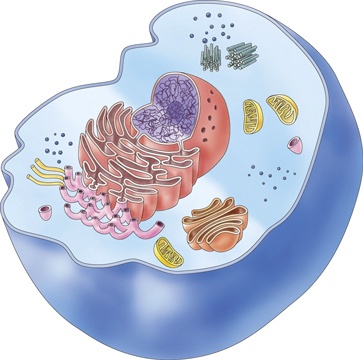
In the animal cell shown, structure A is the site where glucose is turned into ATP energy. What is this organelle called?
chloroplast
mitochondria
nucleus
Golgi Body

In the animal cell shown, structure C is the ________________, the organelle that directs the cells activities.
nucleus
endoplasmic reticulum
cell membrane
ribosomes

In the animal cell shown, structure E is the __________, which controls what enters and leaves the cell.
nucleus
cell wall
endoplasmic reticulum
cell membrane
Which organelle stores water and waste?
golgi body
vacuole
lysosome
cytoplasm

In the plant cell diagram, the part labeled "5" offers structure and support. What is it called?
cell membrane
cell wall
cytoplasm
mitochondria

In plant cells, there are green structures (labeled 7) that capture sunlight energy and convert it to glucose. What are they?
mitochondria
cell membranes
ribosomes
chloroplasts

Which cellular structure is represented by the number 1 on this diagram?
cytoplasm
ribosomes
cell membranes
cell wall

Who looked at cork and named what he saw cells?
Anton van Leeuwenhoek
Robert Hooke
Rudolph Virchow
Matthias Schleiden



This organelle stores water and other materials. It is larger in plant cells.
vacuole
cell wall
chloroplast
cytoplasm


Which two organelles are NOT found in animal cells?
Cell membrane
Cell wall
Cytoplasm
Nucleus
Chloroplast
What is the function of a cell wall?
to protect and support the cell
to perform different functions in each cell
to prevent water from passing through it
to prevent oxygen from entering the cell
Cells were first observed by Robert Hooke in cork in the year (a) .
The cytoplasm and nucleus make up the (a) .
The shape and the size of the cell is related to its (a) .
Tisssues make up an (a) .
Organ systems make up an (a) .

What are the labeled parts ---- X,Y
Cell wall,Plasma menbrane
Ribosome,Nucleus
Nucleus,Cytoplasm
none of these
Outer covering in onion cells is more clear than in cheek cells due to the presence of :
nucleus
cell membrane
cell wall
nuclear membrane.
Which of the following is a unicellular organism?
Hydra
Euglena
Tapeworm
Man
Which of the following saves the specimen / material from drying?
Water
Glycerine
Safranin
Red ink
The microscope used by Robert Hooke was
simple microscope
compound microscope
light microscope
both B and C
Which of the following cell organelle has genetic material and helps to control several function within the cell?
Lysosome
Nucleus
Ribosome
Mitochondrion
Cell is a latin word which means:
Dark room
Honey comb
Little room
Bright room

These organisms are.....
Unicellular organisms
multicellular organisms
Protozoans
A and C
Which of the following statement(s) is(are)true about cell :
A] Cell is the basic unit of life
B] Both plant cell and animal cell posses cell wall
C] Nucleus was first observed by Robert Brown
A and B
A,B and C
B and C
A and C
Which of the following is the largest cell?
Plant cell
Ostrich egg
Hen egg
Human cheek
A microscope can :
magnify a object
rectify shapes and sizes size of an object
magnify the part of an object kept on the slide
minimise the size of an object
The smallest unit of an organism is called:
ecosystem
cell
cell wall
organelle
Cell was first observed by:
Robert Brown
Robert Hooke
Antony van Leeuwenhoek
None of these
Unicellular organisms are
organisms that can be seen easily
small organisms that cannot be seen eas
organisms that are made up of a single cell
organisms that are made up of more than one cell
The colour of chlorophyll pigment is
yellow
green
red
blue
Levels of organisation can be seen in:
unicellular organisms
multicellular organnisms
both A & B
none of the above
All cells are enclosed in a thin
cell membrane
endoplasmic reticulum
ribosomes
nucleus
Organelles are :
small living organisms found outside the cell
organs found in the body
small living structures found scattered in the cytoplasm
cover of the cell
Mitochondria is responsible for
giving food to the cell
providing energy
protecting the cell
cell division
Chromosomes are located in
Plastids
Nucleus
Golgi apparatus
Centrosome
Organize the parts of the body from smallest to largest (organ, tissue, organ system, cell, organism)
(a)
When two or more different types of organs work together they make a(n) _
(a)
When two or more different types of cells work together they make a(n)
(a)
When two or more different types of tissues work together they make a(n)
(a)
When ALL of the organ systems work together they make a(n)
(a)
Your skin is made of several different types of tissues working together. This means your skin is a(n)
(a)
The digestive system has many parts, including the large and small intestines and the stomach. What are those parts considered? _
(a)
Complete the following analogy below with the words: organism, organ system, tissue, cell, organ.
Texas: ________________________ Houston: _______________________ Family: __________________________ Person: __________________________ Neighborhood: _________________________
(a)
Name the 4 types of tissues.
(a)
Organize the following analogies by (organ, cell, organ system, tissue, organism)
_______________ : grade level/ class
_______________ : block/hour/period
_______________ : student
_______________ : all Decatur City Schools
_______________ : Career Academies of Decatur
Organize the following analogies by (organ, cell, organ system, tissue, organism)
_______________ : can of green beans
_______________ : Grocery Store
_______________ : canned food section
_______________ : aisles and checkout counter
_______________ : aisle 7
Organize the following analogies by (organ, cell, organ system, tissue, organism)
_______________ : paragraph
_______________ : sentences
_______________ : chapter
_______________ : words
_______________ : letters
Organize the following analogies by (organ, cell, organ system, tissue, organism)
_______________ : catcher & pitcher
_______________ : whole baseball team and their fans
_______________ : all fielders (outfielders, infielders, pitcher, catcher)
_______________ : whole baseball team
_______________ : 1st baseman
The tissue that supports, and binds together other body tissue
Connective tissue
Epithelial tissue
Nervous tissue
Muscle tissue
Is tissue that contracts and shortens to produce movement
Connective tissue
Epithelial tissue
Nervous Tissue
Muscle tissue
Lining and covering tissue of the body
Connective tissue
Epithelial tissue
Nervous Tissue
Muscle tissue
Tissue that receives and conducts electrochemical impulses from one part of the body to another
Connective tissue
Epithelial tissue
Nervous Tissue
Muscle tissue
What is the correct order of body organization?
The maintenance or “balance” of an organism’s internal environment is called
CPR
Homeostasis
Survival
Infection Control
The digestive system has many parts, including the large intestine and small intestine and the stomach. What are those parts called?
(a)
Select the answer with three (3) kinds of tissue.
Bone, Stomach, Muscle
Heart, Respiratory, Nerve Cell
Bone, Muscle, Nerve
Brain, Stomach, Heart
Select the answer with three (3) kinds of organs.
Bone, Stomach, Muscular
Heart, Respiratory, Nerve Cell
Bone, Muscle, Nerve
Brain, Stomach, Heart
Select the answer with three (3) kinds of body systems.
Bone, Stomach, Muscular
Heart, Respiratory, Nerve Cell
Skeletal, Muscular, Nervous
Brain, Stomach, Heart
Choose the most accurate organizational level for:
DOG
cell
tissue
organ
organ system
organism
Choose the most accurate organizational level for:
BRAIN
cell
tissue
organ
organ system
organism
Choose the most accurate organizational level for:
RESPIRATORY
cell
tissue
organ
organ system
organism
Choose the most accurate organizational level for:
BONE CELL
cell
tissue
organ
organ system
organism
Choose the most accurate organizational level for:
FAT TISSUE (LIPIDS)
cell
tissue
organ
organ system
organism
Choose the most accurate organizational level for:
HEART
cell
tissue
organ
organ system
organism
Choose the most accurate organizational level for:
SHARK
cell
tissue
organ
organ system
organism
Choose the most accurate organizational level for:
NEURON (NERVE CELL)
cell
tissue
organ
organ system
organism
Choose the most accurate organizational level for:
LIVER
cell
tissue
organ
organ system
organism
Choose the most accurate organizational level for:
DIGESTIVE SYSTEM
cell
tissue
organ
organ system
organism
Choose the most accurate organizational level for:
KIDNEY
cell
tissue
organ
organ system
organism
Choose the most accurate organizational level for:
BONE
cell
tissue
organ
organ system
organism
Choose the most accurate organizational level for:
CIRCULATORY
cell
tissue
organ
organ system
organism
Choose the most accurate organizational level for:
EAR
cell
tissue
organ
organ system
organism
Choose the most accurate organizational level for:
ENDOCRINE
cell
tissue
organ
organ system
organism
Choose the most accurate organizational level for:
LUNGS
cell
tissue
organ
organ system
organism
Choose the most accurate organizational level for:
SKELETAL
cell
tissue
organ
organ system
organism
Organize the parts of the body from smallest to largest (organ, tissue, organ system, cell, organism)
(a)
When two or more different types of organs work together they make a(n) _
(a)
When two or more different types of cells work together they make a(n)
(a)
When two or more different types of tissues work together they make a(n)
(a)
When ALL of the organ systems work together they make a(n)
(a)
Your skin is made of several different types of tissues working together. This means your skin is a(n)
(a)
The digestive system has many parts, including the large and small intestines and the stomach. What are those parts considered? _
(a)
Complete the following analogy below with the words: organism, organ system, tissue, cell, organ.
Texas: ________________________ Houston: _______________________ Family: __________________________ Person: __________________________ Neighborhood: _________________________
(a)
Name the 4 types of tissues.
(a)
Organize the following analogies by (organ, cell, organ system, tissue, organism)
_______________ : grade level/ class
_______________ : block/hour/period
_______________ : student
_______________ : all Decatur City Schools
_______________ : Career Academies of Decatur
Organize the following analogies by (organ, cell, organ system, tissue, organism)
_______________ : can of green beans
_______________ : Grocery Store
_______________ : canned food section
_______________ : aisles and checkout counter
_______________ : aisle 7
Organize the following analogies by (organ, cell, organ system, tissue, organism)
_______________ : paragraph
_______________ : sentences
_______________ : chapter
_______________ : words
_______________ : letters
Organize the following analogies by (organ, cell, organ system, tissue, organism)
_______________ : catcher & pitcher
_______________ : whole baseball team and their fans
_______________ : all fielders (outfielders, infielders, pitcher, catcher)
_______________ : whole baseball team
_______________ : 1st baseman
The tissue that supports, and binds together other body tissue
Connective tissue
Epithelial tissue
Nervous tissue
Muscle tissue
Is tissue that contracts and shortens to produce movement
Connective tissue
Epithelial tissue
Nervous Tissue
Muscle tissue
Lining and covering tissue of the body
Connective tissue
Epithelial tissue
Nervous Tissue
Muscle tissue
Tissue that receives and conducts electrochemical impulses from one part of the body to another
Connective tissue
Epithelial tissue
Nervous Tissue
Muscle tissue
What is the correct order of body organization?
The maintenance or “balance” of an organism’s internal environment is called
CPR
Homeostasis
Survival
Infection Control
The digestive system has many parts, including the large intestine and small intestine and the stomach. What are those parts called?
(a)


The first and second step of the scientific method are:
Question and Conclusion
Question and Hypothesis
Question and Experiment
Hypothesis and Data
An independent variable is the variable that is being:
Analyzed
Tested
Controlled
Measured
A dependent variable is the variable that is being:
experimented on
measured
tested
controlled
A control variable is the variable that is:
controlled and measured and stays the same between experiments
controlled and tested and stays the same between experiments
controlled and stays the same between experiments
controlled and analyzed and stays the same between experiments
A _______ observation is one that describes something. Example: The grass is green.
blind
quantitative
controlled
qualitative
A _____ observation uses numbers to explain. Example It is 67 degrees outside.
quantitative
qualitative
blind
experimental
The scientific method is a process to _______ establish empirical facts through testing and observation.
use a theory to
use facts to
subjectively
objectively
In everyday use, the word theory often refers to _______
a guess
an untested hypothesis or a guess without supporting evidence
a well substantiated explanation of an aspect of the natural world
an uneducated guess
I create an experiment to measure which brand of sponge can absorb the most water. I use 3 different brands of sponge, 3 of the same beakers filled with 30 mL of water from the faucet at room temperature. What is the independent, dependent, and control variable. Select 3 options.
how much water that is absorbed is the dependent variable
the water is the independent variable
the brands of sponges are the independent variable
the beakers are the control variable
the water from the faucet is the dependent variable
If your hypothesis supports your conclusion then you successfully completed the steps of the scientific method. If your hypothesis does not support your conclusion then you will need to redo your _______ and retest your experiment.
data
analysis
question
hypothesis
Non-striated and under involuntary control
Skeletal Muscle
Smooth Muscle
Cardiac Muscle
Striated and under voluntary control
Skeletal Muscle
Smooth Muscle
Cardiac Muscle
Striated and under involuntary control
Skeletal Muscle
Smooth Muscle
Cardiac Muscle
This is the ability of skeletal muscle wherein it recoils to its original resting length after it has been stretched
Contractility
Excitability
Extensibility
Elasticity
This attaches your muscle to bone
Tendons
Ligaments
Aponeurosis
This attaches your bone to bone
Tendons
Ligaments
Aponeurosis
What percentage of the body is made of muscles?
75%
25%
40%
15%
Muscles are classified as cardiac, skeletal and
smooth
long
short
fiberous
The deltoid is a muscle in
the back
leg
chest
arm
The heart beating is an example of
a voluntary movement
slow-twitch muscles
fast-twitch muscles
an involuntary movement
The inside of the stomach is condsidered to be this type of muscle
cardiac
skeletal
smooth
voluntary
1 of the 4 main jobs of the muscular system is
to give us posture
sensory response (taste, smell, touch, etc)
protect from disease
deliver oxygen to the body
The largest muscle in the body is the
gluteus medius
gluteus maximus
gluteus minimus
buccinator
Bones are made up of
calcium
iron
potassium
oxygen
Babies are born with more bones than adults because some of their bones haven't _____________ yet
fused
calcified
ossified
developed

What are the 26 bones that make up your backbone called?
carpals
Tarsals
phalanges
vertebrae
What are the bones in the chest that protect your heart and lungs?
ribs
vertebrae
teeth
phalanges

