
Font size
 Worksheets
Matter Review
Total questions: 52
Worksheet time: 31mins

Elements, compounds, and mixtures are all made of
atoms
molecules
compounds
energy

Chellie is picking tomatoes from her garden. She finds a tomato on the ground that is soft and runny. Which sentence best describes what happened to the tomato?
The tomato decayed, which is a chemical change
The tomato moved, which is a chemical change
The tomato deflated like a flat tire, which is a physical change
The tomato ignited like a firecracker, which is a chemical change

A block of wood, a block of aluminum, a block of stone, and a block of clay all have the same volume. Which of these has the greatest density?
aluminum
clay
stone
wood

Does air have mass?
yes
no

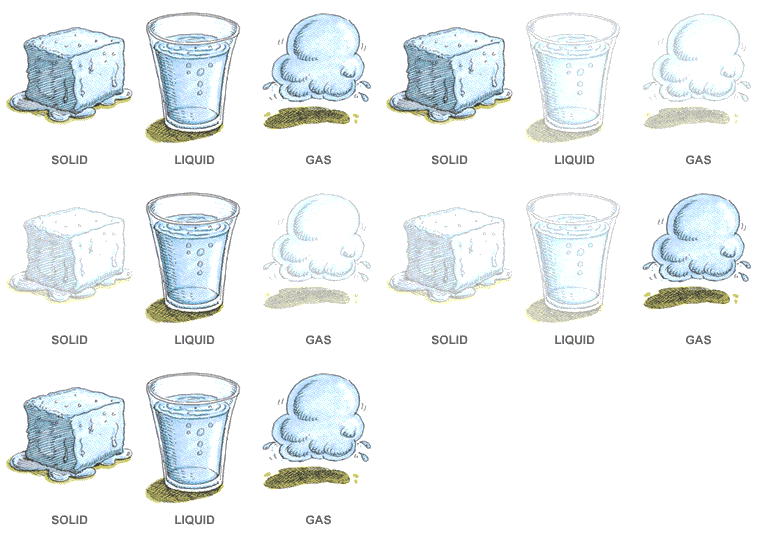
Define a liquid.
Indefinite shape, volume
Definite shape, definite volume
Found in stars
Definite volume, indefinite shape


The volume of water in a beaker was 215 mL. After 5 days, the volume of the water was 200 mL. What best explains the change in volume?
Some of the water absorbed the air.
Some of the water evaporated and escaped into the air as water vapor.
Some of the water disappeared.
Some of the water was released due to condensation.

_____ have molecules that are packed together and hardly move.
solids
liquids
gases
plasma

Which property of matter would stay the same after a crayon is melted.
shape
state
texture
mass

Which phase of matter has no definite shape and no definite volume?
solid
liquid
gas

Identify what type of change happening in the picture below...
Chemical Change
Physical Change
Endothermic Reaction
Exothermic Reaction

Identify what type of change happening in the picture below...
Chemical Change
Physical Change
Endothermic Reaction
Exothermic Reaction

Which type of change is most often easily reversed?
Chemical
Physical
Both a physical and chemical change.
Neither a physical or chemical change.

The difference between a Physical change and a Chemical change is…
Physical changes include changes in the state of matter (solid, liquid and gas)
Chemical change is when matter is changed into a new substance.
Atoms are rearranged in chemical changes & not in physical.
All are correct.


Physical or Chemical Change? Baking a cake.
Chemical Change
Physical Change


Jacob added 50mL of salt to 250mL of water. He stirred it until it completely dissolved. He was asked by Mr. Lopez to separate the salt from the water. After the water evaporated how much salt was left in the beaker?
There was 300mL left in the beaker.
There was 50mL left in the beaker.
There was 200mL left in the beaker.
There was no salt left in the beaker.

Students collected data on four substances.
If the same students were then given a mystery substance made of tan crystals that dissolves in water, it could be –
corn starch
brown sugar
white sugar
sand

Students collected data on the appearance of four substances and how they reacted when mixed with water.
Which substances dissolved when mixed with water?
A and B
A and C
B and C
C and D

What are mixtures?
different materials placed together but keeping their own properties
a mixture in which substances spread out evenly and will not settle
the degree to which a material will dissolve in another substance
the substance in a solution that has the greatest amount
the substance in a solution that has the least amount


Matter that is made of only one kind of atom.
compound
volume
element
atom

The smallest unit into which an element can be divided and still retain all the properties of that element.
atomic theory
compound
element
atom

A mixture that has the same composition throughout because all the parts are mixed evenly.
reaction
solution
mixture
atam
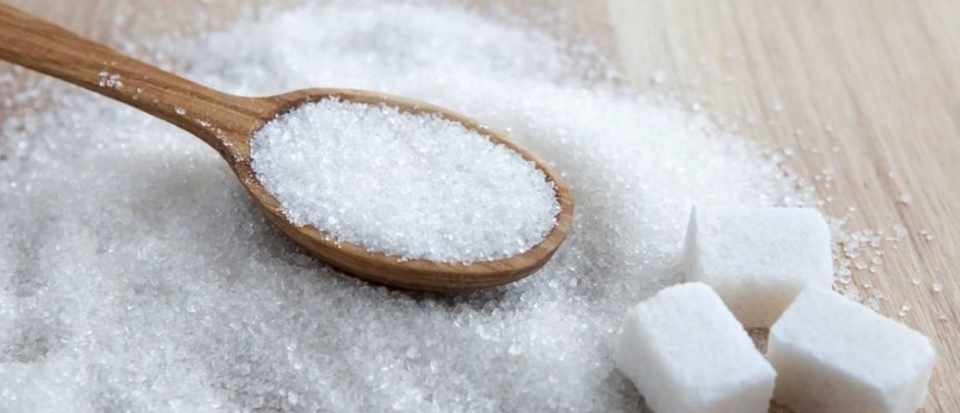
What happens when sugar dissolves in water?
Physical change because a new substance is formed
Chemical change because a new substance is formed
Physical change because the sugar is just getting smaller
Chemical change because the sugar is just getting smaller

What are the common signs of a chemical change? (select more than 1)
Release of light or heat
a new smell or odor
Change in Color
gas bubbles

THE LAW SAYS - Matter cannot be created nor destroyed: it can only be...
Destroyed a little bit
Invisible
Transformed or changed
None of the above

What is the Law of Conservation of mass?
Mass is created in a chemical reaction
Mass is created in a physical change
New chemicals formed from a chemical reaction have a larger overall mass than the original reactants
Matter or mass is never created or destroyed -

Which of these is not a chemical reaction?
Burning of wood
Milk going bad
Mixing vinegar and baking soda
Melting of ice

Got a question for you. What's heavier - a kilogram of steel or a kilogram of feathers?
Steel - because steel is heavier than feathers
Feathers - look at all of them
They're both a kilogram (same mass)

In a closed system with a lid, a chemical reaction takes place. The mass of the ingredients in the beginning of the reaction is 25g. What does the mass have to be in the end of the reaction in order to follow the law of conservation of mass?
25g
You can't tell with the given information.
30g
15g


Which states of matter have a definite volume? (remember definite means it remains the same)
solid and gas
solid and liquid
gas and liquid
solid, liquid, and gas

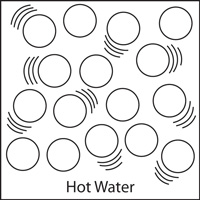
When the temperature of matter increases the particles...
speed up and move closer
speed up and move farther apart
slow down and move closer together
slow down and move farther apart



Four students are dissolving sugar in water to perform an experiment. Each student dissolved 1 tsp of sugar in 1 cup of hot water and stirred the water a different number of times. The students recorded how long it took for the sugar to dissolve in each cup. The results are shown in the following table.
Which of the following happened as the number of stirs increased?
The speed of dissolving increased.
The speed of dissolving decreased.
The amount of sugar dissolved increased.
The amount of sugar dissolved decreased.

Salim is studying how the rate of stirring affects the time it takes for salt to dissolve. He added 1 g of salt to each of four beakers filled with water, stirred the water at different speeds, and recorded how long it took for all the salt to dissolve each time. Salim’s results are shown in the following table.
Which conclusion could Salim draw based on his results?
Salt will not dissolve in water unless the water is stirred.
Stirring a solution of water increases the rate at which a salt dissolves.
Stirring a solution of water decreases the rate at which a salt dissolves.
Stirring a solution of water has no effect on the rate at which a salt dissolves.

