

wayground logo

Free Printable Worksheets

NEW

Font size

S
M
L
XL
Worksheets

Energy Transformation ( Ecology)

Total questions: 33

Worksheet time: 8hrs 15mins

Name
Class
Date
1.

An organism that needs to eat other organisms to obtain energy is known as a:

a)

Autotroph

b)

Producer

c)

Consumer

d)

Mutualist

2.
What does a food web represent?
a)
All connections of energy flow throughout all organisms in a habitat.
b)
The specific ways that mutualism is carried out.
c)
A single pathway or energy flow between organisms. 
d)
How carnivores get their food. 
3.
A collection of organisms that make up a community as well as all of the nonliving aspects of the environment.
a)
Population
b)
Community
c)
Habitat
d)
Ecosystem
4.
Study of interactions between organisms and their environment 
a)
niche
b)
community 
c)
ecology
d)
ecosystem
5.

In the wild, some alligators gets their teeth cleaned by birds. The birds gets their food from the alligators' teeth.

What type of symbiosis is this?

a)

Mutualism

b)

Commensalism

c)

Parasitism

d)

Neutralism

6.

Barnacles are animals that cannot move. In order to get food, they attach to whales and catch any floating plankton in the water. The whale is neither helped nor harmed in the interaction. What type of symbiosis is this?

a)

Mutualism

b)

Commensalism

c)

Parasitism

d)

Neutralism

7.

In an ecosystem, there are populations of moose, rabbits, grass, and pine trees. Suddenly, a fire blazes through the area, which kills all of the populations. As the months go on, new species of grass begin to take root. This attracts animals, and eventually the ecosystem is restored.


What type of ecological succession happened?

a)

Primary succession

b)

Secondary succession

c)

Tertiary succession

d)

None of the above

8.
The Galapagos Islands were formed from volcanic activity. Which of the following organisms would have been the pioneer species to be observed growing on the islands? 
a)
moss
b)
trees
c)
shrubs
d)
weeds
9.
Which of the following correctly lists the flow of matter in the food web above? 
a)
plants, animals, nematodes, arthropods
b)
animals, nematodes, arthropods, plants
c)
plants, nematodes, arthropods, animals
d)
nematodes, plants, arthropods, animals
10.
Sharks are hunted for their fins for use in shark fin soup, a specialty food item in Asia. Sharks grow slowly and take years to reproduce, which makes them vulnerable to overfishing. If overfishing of sharks is not reduced, sharks may become endangered in the next few years.  What would occur to the Pacific Ocean fish population if their natural predator, sharks, are overfished? 
a)
overpopulation
b)
extinction
c)
migration
d)
adaptation
11.
Based on the food web shown above, which of the following is most likely responsible for the rabbit population trend as shown in the graph? 
a)
increase in amount of grass
b)
decrease in amount of grass
c)
overpopulation in squirrel population
d)
increase in rabbit population
12.
Yeast was added to a flask containing a water/nutrient mixture, and the yeast population was monitored over a twenty-four hour period. The results are shown on the graph above.

The graph shows that after 16 hours, the yeast population — 
a)
is close to the food source sustainability of its habitat 
b)
is beginning to feed on itself 
c)
could continue reproducing at an increasing rate 
d)
is about to increase dramatically in population 
13.
Which of the following lists the level of biological organization in order, from least inclusive to most inclusive? 
a)
individual, community, population, ecosystem, biosphere, biome 
b)
individual, population, community, ecosystem, biome, biosphere 
c)
individual, community, ecosystem, population, biome, biosphere 
d)
individual, population, ecosystem, community, biosphere, biome 
14.
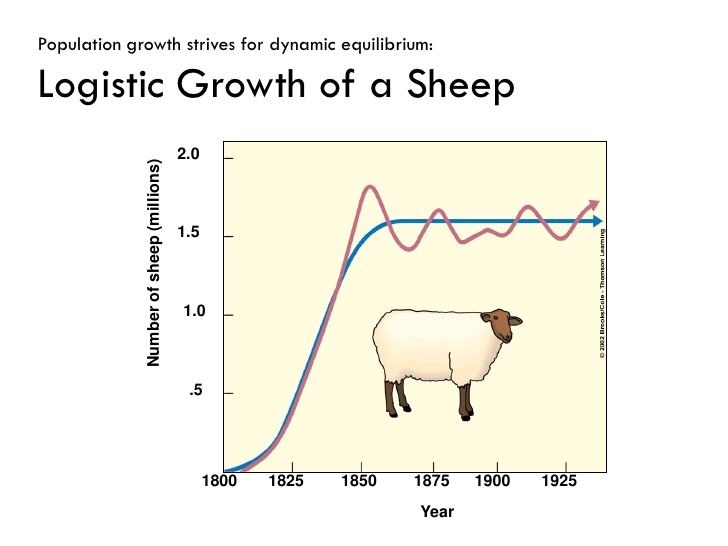
What is the carrying capacity for this sheep population?
a)
1.8 million
b)
1.25 million
c)
1.6 million
d)
1.o million
15.
In a forest ecosystem, which of the following is the best example of a limiting factor for a rabbit population?
a)
Squirrel Population
b)
Sunlight
c)
Grass available
16.
Any thing or organism that regulates the size of a population of another organism is known as __________.
a)
a limiting measure
b)
a limiting factor
c)
factorization
d)
materialization of precipitation
17.
which statement sounds accurate based on the graph data. 
a)
The zebra and lions do not affect each other
b)
when lions population increases, so does the zebra population
c)
When the zebra population increases, it causes the lion population to also increase
d)
when zebra populations go down, the zebra population goes up. 
18.
What type of growth is represented behind?
a)
exponential
b)
logistics
c)
a good kind
d)
representative
19.
What point on the graph represents the carrying capacity?
a)
A
b)
B
c)
C
d)
D
20.
diagram that shows the energy available to each trophic level in an ecosystem; 10% is passed on to upper levels, the rest is lost as heat
a)
succession 
b)
cellular respiration
c)
energy pyramid
d)
biochemical cycle
21.

Which statement best describes the relationship between species A and B?

a)

Species A is the prey of Species B

b)

Species A is a parasite of Species B

c)

Species A is a consumer and B is a producer

d)

Species A and B has a mutualistic relationship

22.

The portion of the planet in which living things are found

a)

ecosystem

b)

biosphere

c)

biome

d)

atmosphere

23.

Organisms that break down decaying material are

a)

consumers

b)

producers

c)

decomposers

24.

Darwin referred to the process of promoting certain traits by selective breeding members with those traits as ___________.

a)

gradualism

b)

ancestral breeding

c)

artificial selection

d)

vestigial structures

25.
The ingredients of photosynthesis are
a)
sugar and water.
b)
sugar and oxygen.
c)
carbon dioxide and water.
d)
carbon dioxide and oxygen.
26.
Which of the following best describes photosynthesis?
a)
Photosynthesis converts radiant energy into chemical energy.
b)
Photosynthesis produces carbohydrates.
c)
Plants need sunlight, carbon dioxide, water, nutrients, and chlorophyll to complete photosynthesis.
d)
Plants use chlorophyll, water, and carbon dioxide to make sugar.
27.

C6H1206 +6O2--> 6H20 + 6CO2 + Energy (ATP)

This equation represents ___________________.

a)

Human Respiration

b)

Cellular Respiration

c)

DNA Replication

d)

Photosynthesis

28.

The reactants in photosynthesis are ____________

a)

Sunlight, Water, and Carbon Dioxide

b)

Glucose and Water

c)

Carbon Dioxide and Water

d)

Oxygen and Glucose

29.

Which of the following statements is true

a)

The products of photosynthesis are the reactants of cellular respiration.

b)

The products of photosynthesis are not necessary for respiration to occur.

c)

The reactants of photosynthesis are also the reactants of cellular respiration.

d)

The products of photosynthesis are also the products of cellular respiration.

30.

Which of the following organisms perform cellular respiration?

a)

A

b)

D

c)

B and C

d)

All of these

31.

Fermentation is an anaerobic process for releasing energy from glucose. Anaerobic means it takes place in:

a)

An oxygen-rich environment.

b)

an environment devoid of light

c)

an environment devoid of oxygen

32.

In cellular respiration, the first step in releasing the energy of glucose in the cell is known as:

a)

electron transport

b)

glycolysis

c)

the Krebs Cycle

d)

the Calvin Cycle

33.

What are the correct steps, in order, of cellular respiration?

a)

Light Dependent Reaction, Calvin Cycle, Dark Reaction

b)

Glycolysis, Krebs Cycle, Electron Transport Chain

c)

Photosynthesis, Glucose, Respiration

d)

Krebs Cycle, Glycolysis, Electron Transport Chain
