Wayground logo

Free Printable Worksheets

Font size

S
M
L
XL
Worksheets

TEST - Properties of Waves

Total questions: 27

Worksheet time: 3hrs 54mins
Name
Class
Date
1.
What type of wave has the highest energy on the electromagnetic spectrum?
a)
visible waves
b)
radio waves
c)
gamma rays
d)
microwaves
2.

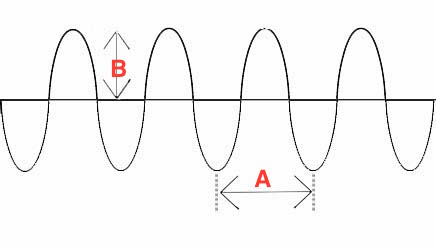
What property of this wave is represented by the letter "A"

a)

amplitude

b)

crest

c)

trough

d)

wavelength

3.
The highest point on a wave is:
a)
the crest
b)
the trough
c)
the top
d)
the coast 
4.
The lowest point on a wave is the:
a)
Amplitude
b)
Crest
c)
Trough
d)
Wavelength
5.
When the frequency of a wave increases, what happens to the wavelength?
a)
The wavelength is not directly affected by the frequency of a wave.
b)
The wavelength increases.
c)
The wavelength decreases.
d)
More specific information is needed to form a conclusion about the wavelength.
6.
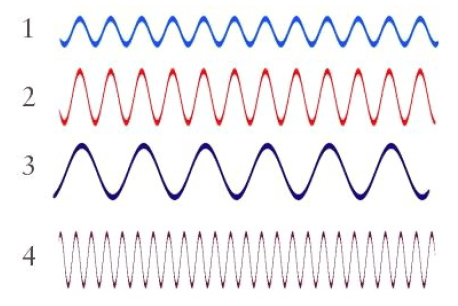
Which wave in the diagram has the greatest frequency?
a)
1
b)
2
c)
3
d)
4
7.
What are the spaced out sections of this wave called?
a)
Reflections
b)
Rarefactions
c)
Compressions
d)
Wavelengths
8.
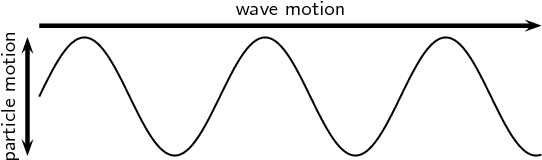
What kind of wave is pictured below?
a)
compressional wave
b)
transverse wave
c)
sound wave
d)
mechanical wave
9.
Amplitude reflects the amount of ____________________ in a wave.
a)
energy
b)
compression
c)
rarefaction
d)
speed
10.

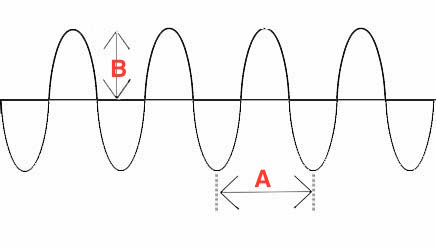
What property of this wave is represented by the letter "A"

a)

amplitude

b)

crest

c)

trough

d)

wavelength

11.
What property of the wave is represented by the letter "B"?
a)
amplitude
b)
crest
c)
trough
d)
wavelength
12.
The number of wavelengths that pass a point each per second is:
a)
frequency
b)
period
c)
longitudinal 
d)
transverse wave 
13.
Which wave in the diagram has the greatest wavelength?
a)
1
b)
2
c)
3
d)
4
14.
The units for frequency are measured in _____________.
a)
hertz
b)
seconds
c)
m/s
d)
m
15.
Calculate the wavelength of a water wave with a speed of 3 m/s and a frequency of 4 Hz. (Equation: λ=v/f)
a)
0.75 m
b)
12 m
c)
1.3 m
d)
5 m
16.
Which property of these waves differs?
a)
Frequency
b)
Wavelength
c)
Amplitude
d)
Pitch
17.
What type of waves have compressions and rarefactions?
a)
longitudinal
b)
transverse
18.
What do all waves transfer?
a)
Light
b)
Sound
c)
Heat
d)
Energy
19.
The type of waves that require medium to pass:
a)
Mechanical Waves
b)
Electromagnetic Waves
20.
A mechanical wave cannot travel through...
a)
a vacuum(empty space).
b)
water.
c)
air. 
d)
glass.
21.
which material does sound travel the fastest?
a)
solid 
b)
liquid 
c)
gases
22.

The wavelength of this wave is

a)

25 cm

b)

85 cm

c)

65 cm

d)

40 cm

23.

Waves that vibrate parallel to the direction of wave movement are

a)

Transverse waves

b)

Longitudinal waves

c)

Combination waves

d)

Amplitude waves

24.

Waves that vibrate perpendicular to the direction of wave movement are

a)

Transverse waves

b)

Longitudinal waves

c)

Amplitude waves

d)

Combination waves

25.

Visible light, x-rays and microwaves are all examples of

a)

Transverse waves

b)

Mechanical waves

c)

Electromagnetic waves

d)

Longitudinal waves

26.

Why is it that an explosion in space can be seen but not heard on Earth?

a)

Space is a vacuum, so sound cannot travel in space.

b)

Light waves are mechanical waves and do not need a medium to travel

c)

Because space is too far away

d)

The explosion is not big enough

27.
If there is no wave, the particles would be at the _____________________.
a)
wavelength
b)
resting point
c)
trough
d)
beach