Wayground logo

Free Printable Worksheets

Font size

S
M
L
XL
Worksheets

20: Test 2L

Total questions: 27

Worksheet time: 27mins

Name
Class
Date
1.

When nuclei decay, massive amounts of __________ is released.

a)

energy

b)

electrons

c)

protons

d)

neutrons

2.
What is Half-life?
a)
The amount of time it takes for some of the nuclei in a sample of the isotope to decay
b)
The amount of time it takes for half the electrons in a sample of the isotope to decay
c)
The amount of time it takes for half the nuclei in a sample of the isotope to decay
d)
the amount of time it takes to double the nuclei in a sample of the isotope to decay
3.

What type of decay is shown here

23892U ---> 23490Th + 42He.

a)

alpha

b)

beta

c)

gamma

4.

Identify the type of nuclear decay shown here

21483Bi → 0-1e + 21484Po

a)

alpha

b)

beta

c)

gamma

5.
The type of radioactive particle that can be stopped by a sheet of paper is the ____.
a)
alpha particle
b)
beta particle
c)
gamma ray
d)
uranium
6.

Finish this equation

20983Bi--> _______ + 20581Tl

a)

42He

b)

0-1e

c)

y

7.
The most dangerous type of radiation is the ____. 
a)
alpha particle
b)
gamma ray
c)
beta particle
d)
uranium
8.
In the symbol 20682Pb what does 206 stand for?
a)
Mass number
b)
Atomic number
c)
Atomic mass
d)
Number of protons
9.
What is the symbol for an alpha particle?
a)
42He
b)
0-1e
c)
0+1 e
d)
10n
10.
Two or more nuclei combine to form one larger nucleus in the process of nuclear _____.
a)
Fusion
b)
Fission
c)
Tracing
d)
Decay
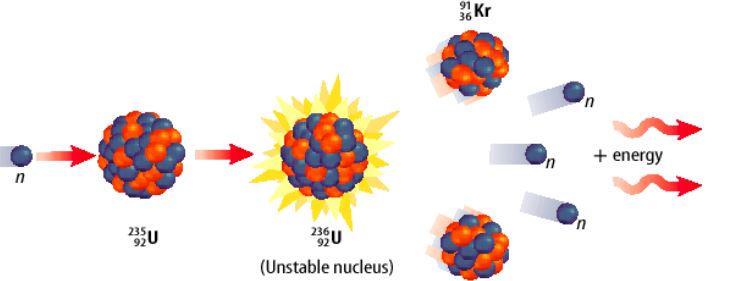
11.
This is an example of...
a)
Fission  reaction
b)
Fusion reaction
c)
Decomposition reaction
d)
Decay
12.
The splitting of a nucleus into smaller nuclei is
a)
fusion
b)
fission
c)
decay
d)
gamma radiation
13.
What type of nuclear reaction occurs in the Sun?
a)
Nuclear fission
b)
beta decay
c)
alpha decay
d)
Nuclear fusion
14.
Which is NOT a characteristic of gamma radiation?
a)
High energized photon of light
b)
Can be stopped by a sheet of aluminum foil
c)
Is the most harmful type of radiation to humans
d)
Our use of protection is concrete, or several inches of lead
15.
Where does radioactivity have application in our lives?
a)
Medicine
b)
Energy (electricity)
c)
Agriculture
d)
All of the above
16.
In a nuclear reactor, electricity is produced from what element?
a)
Plutonium
b)
Uranium 235
c)
Radon 220
d)
Lead 232
17.
Neutrons released in a fission reaction can strike other nuclei and cause a 
a)
meltdown
b)
take down
c)
break down
d)
chain reaction
18.
The process by which nuclei having small masses are united to form a single larger nucleus is called nuclear ____.
a)
fusion
b)
fission
c)
reactivity
d)
waste
19.
Name the instrument used to detect radioactivity.
a)
voltmeter
b)
ohmeter
c)
seismograph
d)
geiger counter
20.
What makes something radioactive?
a)
elements with an atomic number above 81
b)
an unstable nucleus
c)
contaminated sewage
d)
It decays over time
21.
How do nuclear power-plants work?
a)
Fusion
b)
Half-life
c)
Fission
d)
Fusion or fission
22.
_______________ is the process by which unstable atoms emit radiation until they become stable.
a)
Radiation
b)
Chemical Reaction
c)
Radioactive Decay
d)
Isotopes
23.
Which particles make up the nucleus of an atom?
a)
protons and neutrons
b)
electrons and protons
c)
electrons, protons, and neutrons
d)
electrons and neutrons
24.
In order of most to least penetrating radiation we have
a)
Alpha , Beta,  Gamma
b)
Beta , Gamma , Alpha
c)
Gamma, Beta, Alpha
d)
Gamma, Alpha, Beta
25.

How do the nuclear reactions that power the Sun compare to the nuclear reactions that occur in a reactor at a nuclear power facility?

a)

Power plants release radiation and the sun does not

b)

Nuclear reactions on the sun are less powerful than nuclear reactions in power plants

c)

The Sun is powered via nuclear fusion while a nuclear power facility harnesses energy from nuclear fission

d)

Fission occurs on the sun while fusion occurs in a nuclear power facility

26.

External-beam radiation therapy for cancer patients is delivered in the form of a high radiation photon beam directed at cancer cells. What type of radiation provides the high energy photons that can penetrate deep into patients’ tissues?

a)

Alpha

b)

Beta

c)

Acids

d)

Gamma

27.

What is an isotope?

a)

forms of the same element that contain equal numbers of electrons but different numbers of protons

b)

forms of the same element

c)

forms of the same element that contain equal numbers of protons but different numbers of neutrons

d)

An atom with no nucleus