wayground logo

Free Printable Worksheets

NEW

Font size

S
M
L
XL
Worksheets

Erosion

Total questions: 35

Worksheet time: 41mins

Name
Class
Date
1.

What is the process of moving sediments from location to another?

a)

Deposition

b)

Erosion

c)

Weathering

d)

Compaction

2.
What is sediment?
a)
the process of rocks being broken down and carried away
b)
bits of rock, sand, and silt caused by the weathering of rocks
c)
the top layer of the soil
d)
decaying plant or animal material 
3.

Which of these is an example of erosion?

a)

Light shinning onto a mountain

b)

Rain breaking down rock

c)

Wind blowing away sediment

d)

All of the above

4.
How does freezing water cause the weathering of rocks?  The freezing water—
a)
keeps the rocks in place
b)
makes the rocks last longer
c)
expands cracks and breaks rocks
d)
causes rocks to fall in landslides
5.
Which agents  break down earth materials?
a)
wind only
b)
earthquakes and gravity
c)
ice and 007
d)
wind, water, and ice
6.
What is an enormous mass of ice moving over land?
a)
Ice wedging
b)
Glacier
c)
Iceberg
d)
Dune
7.

Rain washing away soil from a hillside

a)

Weathering

b)

Erosion

c)

Deposition

8.
Wind blowing sand from one location to another
a)
Weathering
b)
Erosion
c)
Deposition
9.

How do sandy beaches form?

a)

Waves pounding pebbles int smaller and smaller peices

b)

Wind eroding pebbles into smaller pieces

c)

Water freezing and thawing the cracks of pebbles

d)

Rain wearing away rocks into smaller and smaller pieces

10.

How do plants in the soil affect how fast erosion happens?

a)

It doesn't affect erosion.

b)

It slows down erosion.

c)

It speeds up erosion.

11.
How do plants weather rocks?
a)
during photosynthesis
b)
when roots grow into cracks of rocks and expand the rock
c)
when the plant moves water from the roots to the leaves
d)
Plants don't weather rocks
12.
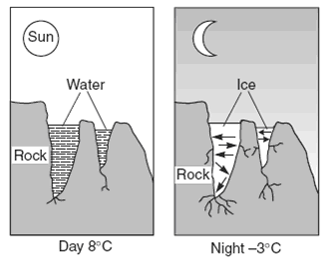
The diagrams  shows a natural process that weathers rock.
 Which statement best explains why this process results in weathering?
a)
frozen water acts as a solute
b)
water expands when it freezes
c)
the mass of water increases when it freezes
d)
frozen water dissolves most types of rock
13.

Which of the following is NOT an element of erosion?

a)

Water

b)

Wind

c)

Chemical

d)

Electrical Current

14.

Which of the following was formed through erosion?

a)

Eiffel Tower

b)

The Grand Canyon

c)

Mt. Rushmore

d)

The Pyramids of Giza

15.
What happens when weathering and erosion work together?
a)
New Mountains are created
b)
The climate changes overnight
c)
Metal objects become rusty
d)
They change the Earth's surface
16.
What is the major cause of weathering and erosion to form canyons?
a)
wind
b)
ice
c)
glaciers
d)
moving water
17.
the breakdown or decomposition of rock that takes place when minerals change through chemical processes
a)
chemical weathering
b)
mechanical weathering
c)
erosion
d)
deposition
18.
fossil fuels react with water producing acid rain that wears minerals away in the rock
a)
chemical weathering
b)
mechanical weathering
c)
erosion
d)
deposition
19.

Fantasy Canyon, located in Uintah County, is a classic example of

a)

weathering and erosion in mudstone and claystone have been stripped away by water and wind, leaving the slightly more durable sandstone to be carved into bizarre, melted wax-like forms.

b)

organic erosion

c)

plate tectonics

20.
The process by which small pieces of rocks and soil are carried away to new locations is called...
a)
deposition
b)
erosion
c)
weathering
d)
faults
21.
What made this landform known as a valley?
a)
Glacier
b)
hill
c)
deposition
d)
rocks
22.

A landform made of sediment that is deposited where a river flows into an ocean or lake is called a...

a)

sea cave

b)

mountain

c)

delta

23.

Erosion occurs when natural forces alter the landscape. What does it mean to alter a landscape?

a)

To blow dust around

b)

To change what land looks like

c)

To deposit silt at the mouth of a river

d)

To create a floodplain

24.

Which term BEST describes the rate at which glacial erosion takes place?

a)

Quick

b)

Short

c)

Slow

d)

Sudden

25.

Why is it hard to see glacial erosion in action?

a)

Because glaciers are so big

b)

Because light from glaciers refracts too much

c)

Because glaciers move very, very slowly

d)

Because glacial erosion is usually very subtle

26.

What do floodplains, sandbars, and river deltas have in common?

a)

They've all been formed by water erosion

b)

They've all been formed by glacial erosion

c)

They've all been formed by wind erosion

d)

They've all been formed by sandblasting

27.
Glaciers shape and carve away the land beneath them and can drastically reshape the landscape over hundreds or even thousands of years.
a)
True
b)
False
28.
A small stream or other source of flowing water cannot form a canyon?
a)
True
b)
False
29.
Layers mix and bind together to make a new type of rock.
a)
True
b)
False
30.

An avalanche is an example of which process?

a)

Weathering

b)

Erosion

31.
The process that breaks down rocks and other materials on Earth's surface is called
a)
Weathering
b)
Erosion
32.
A cliff formed near the ocean.  Which statement best describes how this cliff formed?
a)
Warm air melted the rock.
b)
Sun rays evaporated the rock.
c)
Ocean waves washed away rock.
d)
Plant roots pushed away the rock.
33.

What is the process that picks up and moves weathered rocks?

a)

Erosion

b)

Weathering

34.
What causes the greatest erosion effect on our beaches?
a)
Waves
b)
Gravity
c)
Glaciers
d)
Wind
35.

Which of these is an example of erosion?

a)

Light shining onto a mountain.

b)

Rain breaking down rocks on a mountain into smaller pieces.

c)

Wind blowing away bits of dirt to a new place on the mountain.

d)

All of the above.