
 Worksheets
Our Place in Space - Summative Assessment
Total questions: 34
Worksheet time: 44mins
The Sun is a:
star
satellite
planet
asteroid
Which of the following are gas planets?
Mars
Mercury
Jupiter
Neptune
Label the planets in the order from the Sun.
The large group of rocks travelling around the Sun between Mars and Jupiter are known as:
meteorites
the Milky Way
a meteor shower
the Asteroid Belt
What are two differences between the Solar System and the Milky Way?
The Milky Way has over 100 billion stars, the Solar System has only one star
Earth is in the Solar System but not in the Milky Way
The Solar System has no stars in it
The Milky Way is much bigger than the Solar System
What is the difference between a planet and a moon?
A year on Earth is 365.25 days. This is the time it takes:
all planets to orbit the Sun
the Earth to orbit the Sun
the Earth to spin on its axis
the Moon to orbit the Earth
What keeps the planets in their orbits around the Sun?
Gravity
Sunlight
Magnetism
Friction
What is a satellite?
A piece of rock or ice moving through space in a straight line
A star
An object that orbits around another object
A spacecraft sent to land on a planet or moon
Mars takes 687 days to orbit the Sun. This means that its years are __________ long.
687 days
365 days
500 days
730 days
Which planet takes the longest to travel around the Sun?
Neptune
Saturn
Mercury
Earth
Why do the planets in our Solar System orbit the Sun instead of a massive planet like Jupiter? Explain using the word gravity.
The following claims have been made by scientists at different points in history. Which ones are correct?
The Earth rotates on its axis
The Earth and other planets orbit around the Sun
The Earth is at the centre of the Solar System and does not move
Planets travel in perfect circles

This animation shows the Earth rotating on its axis. If you were in a location as it moves from the sunlight into the shadow, you would see:
the Moon setting
the Sun setting
the Moon rising
the Sun rising
How long does one rotation of the Earth take?
12 hours
24 hours
Between 28 and 31 days
365 days
It takes Jupiter 9 hours and 56 minutes to rotate on its axis. The length of one day on Jupiter is:
9 hours and 56 minutes
19 hours and 52 minutes
24 hours
9 Earth days
It takes Neptune 16 hours and 6 minutes to rotate once on its axis. A day on Neptune is ____________ a day on Earth.
longer than
exactly twice as long as
half as long as
shorter than
the same as
Which of the following statements about the Moon are true?
The Moon orbiting around Earth causes night
The Sun orbits around the Moon
The Moon produces its own light
The Moon reflects light from the Sun
What is the tilt of the Earth's axis?
35.0°
0°
10.0°
23.5°
Why can't the shape of Earth's orbit around the Sun explain the seasons?
The Earth's orbit is perfectly circular so the heating effect of the Sun is the same throughout the year
The shape of Earth's orbit changes from one year to the next
The two hemispheres experience different seasons at the same times
The Earth does not orbit the Sun
The tilt of the Earth's axis is the main reason we have seasons because it means that:
the amount of sunlight a location receives varies through the day
the southern hemisphere is always tilted away from the Sun
some locations never receive any sunlight
the amount of sunlight a location receives varies through the year
When the southern hemisphere is tilted towards the Sun it experiences:
summer
winter
autumn
spring
Label the seasons that occur in each hemisphere as the Earth orbits the Sun.
Explain why the northern hemisphere has winter at the same time that the southern hemisphere has summer.
A gibbous moon occurs when we can see _________ of the bright side of the Moon.
less than half
more than half
none
all
Waning means:
rotating
getting smaller
orbiting
getting larger
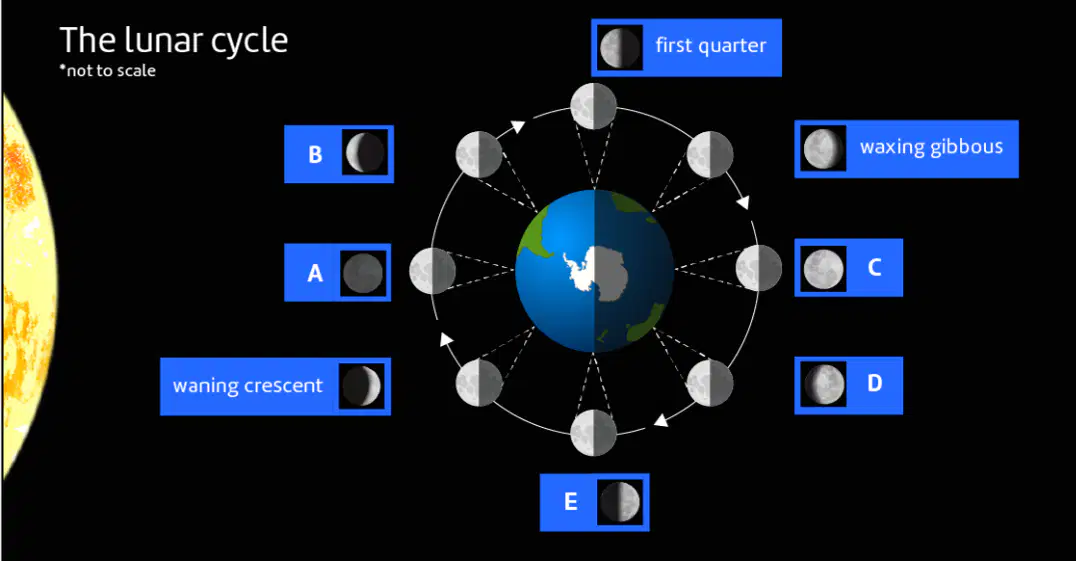
Which of the phases in the diagram above is a new moon?
A
B
C
D
E

Which of the phases in the diagram above is a waning gibbous moon?
A
B
C
D
E
What causes the phases of the Moon?
What type of eclipse is this? Fill in the blanks in the sentence
What type of eclipse is this? Fill in the blanks to complete the sentences.
A lunar eclipse happens when the Sun appears to be blocked out by the Moon.
True
False
During a solar eclipse, which phase must the Moon be in?
Full moon
First quarter
New moon
Waxing gibbous
Explain why a solar eclipse can only be seen during the daytime.

