wayground logo

Free Printable Worksheets

NEW

Font size

S
M
L
XL
Worksheets

Quiz #7: Physical Properties of Matter

Total questions: 15

Worksheet time: 8mins

Name
Class
Date
1.

The ability of a substance to be pressed or pounded into a thin sheet.

a)

magnetism

b)

conductivity

c)

ductility

d)

malleability

2.

The temperature at which a substance changes from a solid to a liquid.

a)

melting point

b)

boiling point

c)

ductility

d)

buoyancy

3.
The water is ______ dense than the boat
a)
more
b)
less
4.

Which process changes a gas to a liquid?

a)

freezing

b)

evaporation

c)

melting

d)

condensation

5.

Which of the following statements is true about the arrangement of particles in matter?

a)

The particles in a gas are closer together than the particles in a liquid.

b)

The particles in a liquid are spread farther apart than the particles in a gas.

c)

The particles in a gas are spread farther apart than the particles in a solid.

d)

The particles in a solid are spread farther apart than the particles in a liquid.

6.
Which state of matter has a fixed shape and volume and it's molecules move very slowly?
a)
Liquid
b)
Gas
c)
Solid
d)
Plasma
7.
What are the three states of matter?
a)
gas, liquid, mass
b)
solid, liquid, gas
c)
mass, volume, thermal energy
d)
gas, temperature, solids
8.
Molecules are tightly packed together
a)
solid
b)
liquid
c)
gas
9.
Mass, relative density, solubility, color, texture, state of matter, conductivity, etc.
a)
Physical state
b)
Insulators
c)
Physical Properties 
d)
Inferences
10.
If an ice cube is left out in  room it will change from one state of matter to another.  Which is the correct order of State of Matter that the ice cube will go through?
a)
Gas, Solid, Liquid
b)
Liquid, Solid, Gas
c)
Liquid, Gas, Solid
d)
Solid, Liquid, Gas
11.

When heat is added to a liquid, what occurs?

a)

Liquid molecules begin to condense to form a solid.

b)

Liquid molecules are being slowed down to become a gas.

c)

Liquid molecules speed up and begin to spread out to become a gas.

d)

Liquid molecules begin to slow down to become a solid.

12.
change from liquid to gas is called....
a)
expansion
b)
evaporation
c)
condensation
d)
sublimation
13.
Change from Liquid to Solid is call......
a)
fusion
b)
Freezing
c)
sublimation
d)
evaporation
14.
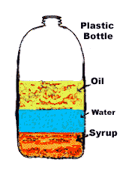
Why do the liquids form different layers?
a)
They have different densities.  
b)
They have different masses.  
c)
They have different volumes.  
d)
They are different temperatures.  
15.
Which liquid is the least dense?
a)
oil
b)
water
c)
syrup 
d)
plastic bottle