wayground logo

Free Printable Worksheets

NEW

Font size

S
M
L
XL
Worksheets

Unit 8/9 Practice Test

Total questions: 49

Worksheet time: 4hrs 5mins

Name
Class
Date
1.

Which gas law would you use to solve the following problem?

If a nitrogen gas occupies a volume of 500 ml at a pressure of 0.971atm. What volume will the gas occupy at a pressure of 1.50 atm?

a)

P1V1 = P2V2

b)

PV = nRT

c)

P1/T1 = P2/T2

d)

V1/n1 = V2/n2

2.

Which gas law would you use to solve the following problem?

A sample of a gas has a volume of 852 mL at 298 K. What temperature is necessary for the gas to have a volume of 945 mL?

a)

Pt = P1 + P2 + P3 + ...

b)

P1V1 = P2V2

c)

V1/T1 = V2/T2

d)

P1V1/T1 = P2V2/T2

3.

Which gas law would you use to solve the following problem?

A gas that has a pressure of 2 atm and a volume of 10 L. What would be the new volume if the pressure was changed to 1 atm?

a)

P1/T1 = P2/T2

b)

P1V1 = P2V2

c)

V1/n1 = V2/n2

d)

PV = nRT

4.

Which gas law would you use to solve the following problem?

Determine the number of moles in a container of gas at STP with a volume of 99.2 L.

a)

V1/n1 = V2/n2

b)

PV = nRT

c)

P1/T1 = P2/T2

d)

V1/T1 = V2/T2

5.

Which gas law would you use to solve the following problem?

A container is filled with H2, and H2O. What is the partial pressure of H2 when the pressure of water is 17 kPa. The total pressure of the gases is 750 kPa.

a)

P1V1 = P2V2

b)

Pt = P1 + P2 + P3 +...

c)

P1/T1 = P2/T2

d)

V1/n1 = V2/ n2

6.
How do gas molecules move? 
a)
in an orderly fashion 
b)
constantly and randomly
c)
in straight line paths
d)
in a circular motion
7.
What type of relationship is Charles' Law?
a)
Inverse
b)
Direct
c)
Not enough information
d)
#goals
8.
When Pressure increases then the Volume must...
a)
Increase
b)
decrease
9.
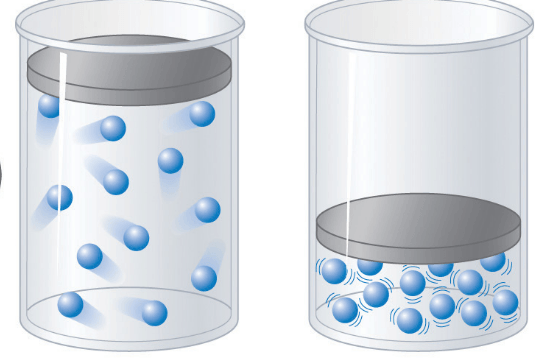
Which container will have a lower pressure?
a)
left
b)
right
c)
they both have the same pressure
d)
I don't know
10.
In order to convert to Kelvin, you add ______ to the Celsius measurement.
a)
372
b)
273
c)
237
d)
732
11.
If a balloon is cooled what will happen to the volume?
a)
Volume will increase
b)
Volume will decrease
c)
Volume will not change
12.
Which of the following would increase the (gas) pressure of a system?
a)
Increase the Temperature
b)
Pump in more gas
c)
Decrease the volume
d)
All of these
13.
Boyle's law :  The pressure and volume of a gas show a _____ relationship. 
a)
Inverse 
b)
Direct 
14.

760 mmHg is equal to

a)

1 torr

b)

760 atm

c)

760 torr

d)

101 Pa

15.

What does STP (standard temperature and pressure) stand for?

a)

0.0 degree Celcius and 1 atm

b)

1.0 mmHg and 273 degree Kelvin

c)

1.0 degree Celcius and 0 atm

d)

1.0 atm 273 degree Celcius

16.
Calculate the volume that a 0.323-mol sample of a gas will occupy at 265 K and a pressure of 0.900 atm.
a)
7.18 L 
b)
7.81 L
c)
4.63 L
d)
4.36 L
17.
Determine the Celsius temperature of 2.49 moles of gas contained in a 1.00-L vessel at a pressure of 143 kPa. 
a)
-266 degrees C
b)
-622 degrees C
c)
622 degrees C 
d)
266 degrees C
18.

While mixing gases, Dalton noticed that the total internal pressure of his container was always equal to ___

a)

the sum of the individual pressures of the gases

b)

the product of the individual pressures of the gases

c)

the pressure of the most abundant gas

d)

the pressure of the least abundant gas

19.

Which liquid has the highest vapor pressure at 75oC?

a)

ethanoic acid

b)

ethanol

c)

propanone

d)

water

20.

According to the reference table, what is the boiling point of ethanoic acid at 80 kPa?

a)

28 oC

b)

100oC

c)

111oC

d)

125oC

21.

The substance being dissolved is called the ________

a)

solvent

b)

solid

c)

solute

d)

solvate

22.

What does "like dissolves like" mean?

a)

polar solvents dissolve in polar solutes

b)

polar solutes dissolve in polar solvents

c)

non-polar solvents dissolve in polar solutes

d)

non-polar solutes dissolve in polar solvents

23.

Molarity is defined as ________ divided by _____________

a)

liters solution, mols solute

b)

mols solute, liters solvent

c)

kg solvent, mols solute

d)

mols solute, kg solvent

24.
When a certain amount of solvent cannot hold any more solute it is called a ________ solution.
a)
Diluted
b)
Saturated
25.
The concentration of a mixture can be increased in which of the following ways?
a)
Heating the mixture
b)
Adding more water “solvent”
c)
Adding more powder “solute”
d)
Stirring the mixture
26.
When a Koolaid mix in water is dark in color and very sweet it is a __________ solution.
a)
concentrated 
b)
Diluted
27.
How many grams of K2Cr2O7, are soluble in 100 g of water at 95 ºC?
a)
83 grams
b)
75 grams
c)
40 grams
d)
12 grams
28.
Which solute is the most soluble at 10 ⁰C?
a)
KI
b)
KClO3
c)
NH4Cl
d)
NH3
29.
What is the molarity of 3 mole of hydrochloric acid in 3 L of water. 
a)
3
b)
1
c)
6
d)
9
30.
What is the molarity of 4 grams of sodium chloride in 3,800 mL of solution?
a)
0.018 M
b)
0.018 mol
c)
1.052 M
d)
1.052 mol
31.
How many L are required to make 3.5 M hydrochloric acid using 1.1 moles? 
a)
3.18 L
b)
0.31 L
c)
3.85 L
d)
4.6 L
32.
What is the molarity in 650. ml of solution containing 63 grams of sodium chloride?
a)
2.4 M
b)
0.86 M
c)
1.7 M
d)
0.54 M
33.
If you have 0.045 L of 0.465 M potassium bromide. How many moles of potassium bromide are present?
a)
20.9 mol
b)
0.021 mol
c)
0.02 mol
d)
0.0209 mol
34.

Which of the following is the Dilution Formula?

a)

V1M1 = V2M2

b)

M = m/V

c)

V = mT

d)

PV = nRT

35.

A dilution is when

a)

solute is added to the volume of solution

b)

water is added to the volume of solution

c)

solute is removed from the volume of solution

d)

water is removed from the volume of solution

36.

What volume, in milliliters, of 10.0 M NaOH is needed to prepare 300.0 mL of 2.00 M NaOH by dilution?

a)

0.067 mL

b)

60.0 mL

c)

100 mL

d)

125 mL

37.

What is the molarity of a solution made by diluting 26.5 mL of 6.00M HNO3 to a volume of 250.0 mL?

a)

15.9 M

b)

0.636 M

c)

0.642 M

d)

1.59 M

38.
How many mL of 10.8M HCl are required to make 100.0 mL of 3.00M acid?
a)
27.8 mL
b)
27.78 mL
c)
2.8 mL
d)
278 mL
39.
What volume of 1.50 M KBr can be made from 15.6 mL of concentrated KBr with a molarity of 9.65 M?
a)
150. mL
b)
151 mL
c)
1.00 L
d)
100. mL
40.

If I have 340.0 mL of a 0.500 M NaBr solution, what will the concentration be if I add 560.0 mL more water to it? (Remember to use the total new volume)

a)

.188 M

b)

3.78 M

c)

.389 M

d)

1.76 M

41.

If I dilute 250 mL of 0.10 M lithium acetate solution to a volume of 750 mL, what will the concentration of this solution be?

a)

2 M

b)

0.02 M

c)

0.033 M

d)

0.08 M

42.
The freezing point of a solution is ____ the freezing point of the pure solvent.
a)
the same as
b)
lower than
c)
higher than
d)
no relation to
43.
The boiling point of a solution is ______ the boiling point of the pure solvent.
a)
higher than
b)
the same as
c)
lower than
d)
higher or lower than
44.

Adding a nonvolatile solute to a liquid will ___.

a)

depress both the freezing point and the boiling point

b)

elevate both the freezing point and the boiling point

c)

depress the freezing point and elevate the boiling point

d)

elevate the freezing point and depress the boiling point

45.
A container is filled with H2, and H2O. Calculate the partial pressure of H2 when the pressure of water is 17torr. The total pressure of the gases is 750torr.
a)
767.5torr
b)
732torr
c)
42.86torr
46.
Determine the initial temperature of a random gas when the initial volume is 2.2 L and it is cooled to 88K with a volume of 0.85 L. 
a)
0.029 K
b)
0.021 K
c)
227.76 K
d)
34 K
47.

What is the pressure of a car tire that had an initial pressure of 1.8 atm but was heated from 38°C to 123°C? The volume remains constant.

a)

0.9 atm

b)

2.3 atm

c)

1.6 atm

d)

3.4 atm

48.

Absolute zero is

a)

0 K

b)

where there is no molecular movement

c)

the coldest temperature possible

d)

all of these

49.

What is the pressure exerted by 5.00 moles of nitrogen gas contained in a 30.0 Liter container at 25.0 °C?

a)

3670 atm

b)

0.245 atm

c)

4.08 atm

d)

605 atm