
Font size
 Worksheets
full sound
Total questions: 60
Worksheet time: 1hrs 4mins
Which one of the following material will reflect sound better?
Thermocole
Curtain made from cloth
Steel
Paper
The velocity of sound in vacuum is
330 m/s
1430 m/s
6100 m/s
0
The human perception of how much energy a sound wave carries
frequency
loudness
distance
Some animals use this to navigate and hunt
frequency
ecolocation
vibration
The total time for sound waves to return to a ship was 8 seconds after being released. What is the depth in meters?
Distance (Depth) = Velocity x (Total time/2)
Velocity of sound in water = 1500 m/s
12,000m
6000m
375m
187.5m
The total time for sound waves to return to a ship was 4.5 seconds after being released. What is the depth in meters?
Distance (Depth) = Velocity x (Total time/2)
Velocity of sound in water = 1500 m/s
6750m
333.33m
667m
3375m
If the depth of the ocean floor is 7500 meters, how long does it take sound waves to reach the bottom of the ocean?
Distance (Depth) = Velocity x (Total time/2)
Velocity of sound in water = 1500 m/s
10sec
5sec
11,250,000sec
0.2sec

______________ sounds have a larger amplitude
quiet
loud
How sound is made?
From vibration that disturbs the surround molecules
Ultrasonic transmission from transmitter
The ossicles detection pass into the inner ear
The ability to perceive sounds by detecting vibrations
Water waves and light waves are both examples to ___
Longitudinal Wave
Transverse Wave
Frequency wave
Sound Wave
As the wavelength increases, the frequency ____
increases
decreases
remain same
none of the above
The lowest point on the transverse wave is called_______
trough
crest
wavelength
frequency

This is the distance from the equilibrium position to the crest or to the trough.
crest
trough
wavelength
amplitude
What do all waves transmit
energy
matter
frequency
water

The height of the peaks above the resting line in a wave illustrated at point B in the image
Amplitude
Trough
Node
Wave
In a transverse wave, the vibrations are (a) to the direction of the wave.
The vibrations in a longitudinal wave are (a) to the direction of energy transfer.
The vibrations in a longitudinal wave are (a) to the direction of energy transfer.


What type of waves are these?
Transverse waves
Longitudinal waves
It is an animal that uses echolocation.
Mole
Cachalot
Moth
Oilbird
People who use echolocation.
Blind People
Scientists
Some lucky people
None of the above
Some radar uses.
Vaccines
Cave exploration
Photography
Astronomy
Sonar evolution
Radar
Microbiology
Music
Fishing
Some radar uses.
Vaccines
Cave exploration
Photography
Astronomy
Wavelength= .5m
Frequency= 150 hertz
Wavelength= 2.0m
Frequency= _________
Wavelength= 80 m
Frequency= ___________
Wavelength= 1.2 m
Frequency= 210 hertz
Wavelength= 3.0 m
Frequency= 120 hertz
Wavelength= __________
Frequency= 600 hertz
Wavelength= _________
Frequency= 1.1875hertz
Wavelength= ___________
Frequency= 300 hertz
Wavelength= 6.5 m
Frequency= ____________
The distance between two corresponding points on adjacent waves is...
wavelength
frequency
amplitude
wave velocity
The lowest point on a wave is called a....
anti-node
node
trough
crest
Which of the following is TRUE?
A higher amplitude causes a longer wavelength
A higher frequency causes a shorter wavelength
A faster wave velocity causes a longer wavelength
A lower amplitude causes a slower wave velocity
Which of the following could effect the wave's velocity?
The wave's frequency
The wave's amplitude
The wavelength
The medium the wave is travelling through
The full length of a wave from a crest to a crest is...
frequency
amplitude
node
wavelength
trough
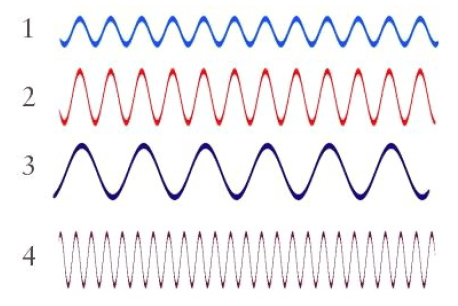
A guitar string vibrates with a frequency of 320 hz. If the wavelength of the vibration is 0.23 meters what is the speed of the wave?
320.23 m/s
1391.3 hz
73.6 m/hz
73.6 m/s
Review: Frequency and period are reciprocally related. Therefore, if the frequency of a wave is 5 Hz, then the period is__________.
5 sec
1/5 sec
50 sec
1/2 sec
Review: What is the frequency of a wave?
How fast the wave moves from one point to the next
The time it takes for one wave to happen
The length of a wave
How many waves pass a fixed point in 1 second
Review: frequency and period are reciprocally related. Therefore, if the period is 1/2 seconds, then the frequency is ___________.
2 Hz
1/2 Hz
2 sec
5 Hz
V=fλ
If the frequency is 5 Hz and the wavelength is 2 m, then what is the wave's velocity?
10 m/s
5/2 m/s
2/5 m/s
7 m/s
V=fλ
If the wave velocity is 20 m/s and the wavelength is 2 m, then what is the frequency?
10 Hz
40 Hz
0.1 Hz
V=fλ f=T1
If the time period of a wave is 2 seconds and the wavelength is 4 m long, then what is the wave's velocity?
2 m/s
8 m/s
1/2 m/s
V=fλ
If the velocity of the wave is 10 m/s and the frequency is 5 Hz, then what is the wavelength?
2 m
50 m
5 m
15 m

Which wave has a greater frequency?
A
B

