wayground logo

Free Printable Worksheets

Font size

S
M
L
XL
Worksheets

Egypt - Geography, pyramids, religion, mummies

Total questions: 58

Worksheet time: 34mins
Name
Class
Date
1.
If you were making natron, which of these household items would you include in the recipe?
a)
baking soda
b)
sugar
c)
vinegar
d)
seltzer
2.
How does natron work to preserve bodies?
a)
It dries up the liquids and fats.
b)
It puts a thin protective film on surfaces.
c)
It hardens the internal organs.
d)
It stiffens the cell walls of human cells.
3.
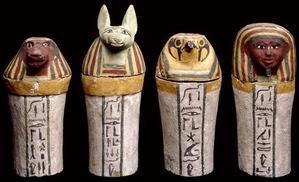
What might you find in canopic jars?
a)
A mummy's ka
b)
A mummy's internal organs
c)
A mummy's posessions
d)
A mummy's limbs
4.
After the mummification process was complete, the mummy was placed in an elaborately decorated sarcophagus.  What was a sarcophagus?
a)
a grave
b)
a pyramid
c)
a jar
d)
a coffin
5.
What can you conclude from the fact that the Egyptians painted the walls of the mummies' tombs with pictures of servants, food and animals?
a)
They wanted to liven up the dull brick walls.
b)
They believe the dead needed these things in the afterlife.
c)
They wanted to protect the dead against grave robbers.
d)
They believe these images warded off evil spirits.
6.
What is a delta
a)
one trading path
b)
The title of a ruler
c)
a triangle shaped area of fertile land
d)
None of the above
7.
The captial city of Egypt
a)
Cairo
b)
New York
c)
ROME
d)
Athens
8.
where is eygpt ?
a)
Asia
b)
Africa
c)
Europe
d)
AUSTRALIA
9.
Which way did the Nile flow?
a)
North to South
b)
South to North
c)
East to West
d)
West to East
10.
How did the yearly flooding of the Nile River affect the people of Egypt and Kush?
a)
It isolated the settlements.
b)
It left silt that improved the soil.
c)
It spread diseases that destroyed whole empires.
d)
It attracted hunters and gatherers looking for wildlife.
11.
What was a MAJOR purpose for building the pyramids?
a)
temples for religious worship
b)
storehouses for reserves of grain
c)
homes for the pharaohs' servants
d)
tombs for pharaohs when they died
12.
An Egyptian king was called a ___________
a)
scribe
b)
servant
c)
papyrus
d)
pharaoh
13.
True or False? There was an Upper and Lower Egypt.
a)
True
b)
False
14.
Both the Egyptians and the Mesopotamians were__________.
a)
Monotheistic
b)
Polytheistic
c)
Atheistic
d)
Christians
15.
The wrapped body of the dead pharaoh was called a ___________.
a)
Priest
b)
Mummy
c)
Cataract
d)
Delta
16.
How did the desert help the people of Egypt and Kush?
a)
It had fertile land for crops.
b)
It made trade and travel easier.
c)
It was grassy for grazing sheep.
d)
It gave protection from invaders.
17.
Besides providing a stable food diet, what other advantage did Egypt's location provide for early Egyptians?
a)
Temples to worship in
b)
Sumerian artwork
c)
Natural barriers to protect them
d)
2 dynasties to celebrate religious tradtion
18.
Why were tombs filled with art, jewelry, etc.....?
a)
Tombs were museums.
b)
Tombs were private storage for the pharaoh.
c)
Tombs were the safest place in the kingdom.
d)
They believed the dead enjoyed their materials in the afterlife.
19.
The first pharaoh and rulers after him wore a double crown to symbolize
a)
their rule of the queens
b)
their rule over upper and lower Egypt
c)
the Nile flowed 2 ways
d)
both farming and herding were important
20.
Pharaoh means
a)
great king
b)
great house
c)
great family
d)
great friend
21.
Where is the most fertile soil in Egypt?
a)
Nile Delta
b)
desert
c)
far south
d)
cataracts
22.
Steep river rapids, almost impossible to sail by boat
a)
delta
b)
canal
c)
dam
d)
cataracts
23.

A decorative coffin used for the Pharaohs and the wealthy in Egypt was called a

a)

tomb

b)

sarcophagus

c)

grave

d)

mummy

24.
The process of preserving a body for the afterlife
a)
Cremation
b)
Mummification
c)
Autopsy
d)
Surgery
25.
The region of Egypt closest to the Mediterranean Sea; Northern Egypt
a)
Upper Egypt
b)
Lower Egypt
c)
Fertile Crescent
d)
Mesopotamia
26.

The Nile River flows through two important regions in Egypt called

a)

Upper Egypt & Lower Egypt.

b)

Mesopotamia.

c)

Eastern Egypt & Western Egypt.

d)

Nubia & Cairo.

27.

Why did the pharaohs of Egypt have so much power?

a)

They were considered both gods and kings.

b)

They were considered to be the wealthiest Egyptians.

c)

They were considered to be dynasties.

d)

They were the most important citizens in the democracy.

28.

Who was the first pharaoh

a)

King Tut

b)

King Menes

c)

King Ramses the Great

d)

King Hatshepsut

29.

The Great Pyramids of Giza were built for...

a)

King Tut

b)

King Khufu

c)

Hatshepsut

d)

King Ramses

30.
The Nile is the longest river in the world.
a)
true
b)
false
31.
Egypt is called the "gift of the Nile" because people would not have been able to settle in the Egyptian desert without the floods of the Nile.
a)
true
b)
false
32.
Which Egyptian pharaoh united Upper and Lower Egypt?
a)
Khufu
b)
King Tut
c)
Menes
33.
Which of the following beliefs was central to Egyptian religion?
a)
the afterlife
b)
the pyramids
c)
the pharaohs
34.
The Egyptians believed that when a person died, their __________, or a person's spirit or life force, left the body to travel to the afterlife.
a)
mummy
b)
ka
c)
sarcophagus
35.

How did the desert help the people of Egypt and Kush?

a)

It had fertile land for crops.

b)

It made trade and travel easy.

c)

It was grassy for grazing sheep.

d)

It gave protection from invaders.

36.

How did the yearly flooding of the Nile River affect the people of Egypt and Kush?

a)

It isolated the settlements.

b)

It left silt that improved the soil.

c)

It spread diseases that destroyed whole empires.

d)

It attracted hunters and gatherers looking for wildlife.

37.

The body was wrapped in ....

a)

clothes.

b)

blankets.

c)

bandages.

38.

The mummification process took ... days.

a)

70

b)

17

c)

700

39.

Osiris was the god of ........

a)

the afterlife

b)

the sun

c)

the moon

d)

chicken salad

40.

Pharaoh's mummies were always entombed with...

a)

The Book of the Dead

b)

their personal belongings

c)

canopic jars holding their organs

d)

all of the above

41.

Osiris' wife was

a)

Cleopatra

b)

Lizzo

c)

Isis

d)

Deborah

42.

In Egyptian mythology, who killed his brother out of jealousy?

a)

Seth

b)

Anubis

c)

Thoth

d)

Horus

43.
Egyptian god of the sun
a)
Ra
b)
Ka
c)
Ba
d)
Osiris
44.
Salt mixture used to mummify bodies
a)
Natron
b)
Nitrogen
c)
Saline
d)
Mineral
45.
A book of spells used to help obtain life after death
a)
Book of the Dead
b)
Afterlife Book
c)
Book of Scribes
d)
Book of Life
46.
Number of gods recognized in ancient Egypt
a)
2000
b)
1
c)
3
d)
200
47.
During the Weighing of the Heart, a person's heart is weighed against...
a)
A Feather
b)
A Grain of Sand
c)
Gold
d)
A Scareb
48.
Process of embalming and drying a corpse to preserve it
a)
Mummification
b)
Burial
c)
Cremation
d)
Preservation
49.
Egyptian believed this had to be written down in order to enter the afterlife
a)
Name
b)
Birthday
c)
Religion
d)
Social Class
50.
God of mummification
a)
Anubis
b)
Ra
c)
Ka
d)
Pharaoh
51.
How the bodies of the poor in Egypt were preserved
a)
Buried in the Sand
b)
Cremated
c)
Buried in a Tomb
d)
Put in the Nile
52.
Egyptians believed doing good deeds would ______________.
a)
Lighten their heart for the afterlife
b)
Make themselves happy
c)
Please the Phaoraoh
d)
Built up their souls
53.
Many gods were shown as humans with ___________ heads.
a)
animal
b)
mummy 
c)
banana
d)
two
54.

The greatest pyramid in the world was built for whom?

a)

Menes

b)

Ramses

c)

Khufu

d)

Ahmose

55.

What continent is Egypt located on?

a)

South America

b)

Europe

c)

Africa

d)

Asia

56.

What major river is in Egypt?

a)

Euphrates River

b)

Tigris River

c)

Nile River

d)

Indus River

57.

Which sea does the Nile River empty into?

a)

Red Sea

b)

Arabian Sea

c)

Mediterranean Sea

d)

Black Sea

58.

What types of religions are polytheistic?

a)

Religions that believe in one god

b)

Religions that do not believe in god

c)

Religions that believe in many gods

d)

Religions that believe in aliens