Worksheets
Pre PAT quiz
Total questions: 40
Worksheet time: 48mins
Which of the following is not a SI base unit ?
Yang manakah antara yang berikut bukan unit asas S.I.?
Meter
Meter
Kilogram
Kilogram
Ampere
Ampere
Hour
Jam
A student draws graph y against x. The relationship between y and x is y = r + px, r and p are constants. The gradient of graph y against x is
Seorang pelajar melukis graf y lawan x. Hubungan antara y dan x ialah y=r+px, r dan p adalah pemalar. Kecerunan graf y lawan x ialah
p
r
y
x
Which of the following physical quantity is a derived quantity ?
Yang manakah antara kuantiti fizik berikut adalah kuantiti terbitan?
Mass
Jisim
Temperature
Suhu
Length
Panjang
Area
Luas
Which of the following is a vector quantity?
Yang manakah antara berikut adalah kuantiti vektor?
Age of sun
Usia matahari
Acceleration of gravity
Pecutan graviti
Mass of a ball
Jisim bola
Distance between Ipoh and Melaka
Jarak antara Ipoh dan Melaka

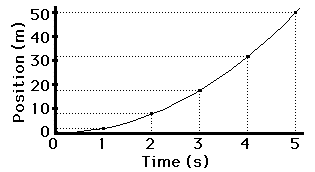
What is the relationship between y and x?
y is directly proportional to x
y is inversely proportional to x
y is increasing with x
y is decreasing with x
Distance is a _________ quantity but displacement is a _________ quantity.
scalar, vector
vector, scalar
base, derived
derived, base

The frequency of ticker timer is 50 Hz. What is the time taken for two dots made?
0.01 s
0.02 s
0.1 s
0.2 s

The ticker tape chart shows that the trolley is having (a)

A motorcycle moves from rest with an acceleration of 10 m s-2 for 5 seconds. Find its final velocity.
5 m s-1
10 m s-1
50 m s-1
100 m s-1

The motion of an object falling only by the influence of gravity is called (a)


Newton said that any two masses will...
combine into a larger mass.
attract each other.
create gravitational fields.
push each other apart.

The distance between the two masses in the previous situation is halved. Determine the gravitational force in this new situation.
20 N
40 N
80 N
160 N

The picture shows two identical satellites, A and B, in circular orbits around the Earth. Upon which satellite does the Earth exert a stronger gravitational force?
Satellite A
Satellite B
Equal on both
Cannot be determined
The centripetal force on an object in circular motion is
in the same direction as the tangential speed.
in the direction opposite the tangential speed.
in the same direction as the centripetal acceleration.
in the direction opposite the centripetal acceleration.
The gravitational force between two masses is 72 N. What is the gravitational force if the distance between them is tripled?
(G = 6.673 x 10⁻¹¹ N•m2/kg2)
8.0 N
9.0 N
36 N
54 N

In the figure, according to Kepler’s laws of planetary motion,
A1 = A2.
Δt1 > Δt2.
if Δt1 = Δt2, then the orbit is circular.
if Δt1 = Δt2, then A1 = A2.

Kepler's First Law states
objects attract other objects with a force that is directly proportional to the product of their masses
the square of the ratio of the periods of any two planets revolving around the Sun is equal to the cube of the ratio of their average distance from the Sun
An imaginary line joining a planet and the sun sweeps out an equal area of space in equal amounts of time.
Planets move about the Sun in an elliptical orbit with the Sun at one of the foci.

Kepler's Second Law states
objects attract other objects with a force that is directly proportional to the product of their masses
the square of the ratio of the periods of any two planets revolving around the Sun is equal to the cube of the ratio of their average distance from the Sun
An imaginary line joining a planet and the sun sweeps out an equal area of space in equal amounts of time.
Planets move about the Sun in an elliptical orbit with the Sun at one of the foci.

Which of the following most accurately describes the movement of the Earth around the Sun?
The Earth moves at a constant speed around the Sun.
The Earth moves faster when it is closest to the Sun.
The Earth moves slowest when it is closest to the Sun.
The Earth's speed varies dependent upon the phase of the moon.

Which of the following is the most accurate description of "escape velocity"?
Escape velocity is the velocity needed to get away from the Earth's gravitational force.
Escape velocity is the velocity needed to get away from the Earth's gravitational force and is dependent upon the mass of the satellite.
Escape velocity is the velocity needed to get away from the Earth's gravitational force and not dependent upon the mass of the satellite.
Escape velocity is the velocity needed to get away from the Earth's gravitational force and not dependent upon the mass of the satellite but is dependent upon the geometric structure of the launch vehicle.
State the definition of Gravitational field strength
Gravitational force per unit time acting on a body at a point in a gravitational field
The force between two bodies of mass M and m is directly proportional to the product of their masses
Gravitational force per unit mass acting on a body at a point in a gravitational field
A person walks 70 meter east, then 40 meter west. What is the total distance traveled by the person?
110 meters
30 meters
55 meters
30 km