wayground logo

Free Printable Worksheets

NEW

Font size

S
M
L
XL
Worksheets

Fundamentals of Functions_Unit_Test

Total questions: 75

Worksheet time: 3hrs 27mins

Name
Class
Date
1.

Which graph represents a function?

a)
b)
c)
d)
2.
What is the definition of function?
a)
Has inputs and outputs
b)
Every input has only ONE output
c)
Inputs have different outputs every time
d)
x-values and y-values
3.
All of the x values or inputs are called what?
a)
Domain
b)
Range
c)
Relation
d)
Function
4.
All of the y values or outputs are called what?
a)
Domain
b)
Range
c)
Relation
d)
Function
5.
Which relation is NOT a function?
a)
{(1,-5), (3,1), (-5,4), (4,-2)}
b)
{(2,7), (3,7), (4,7), (5,8)}
c)
{(1,-5), (-1,6), (1,5), (6,-3)}
d)
{(3,-2), (5,-6), (7,7), (8,8)}
6.
Is the relation a function? Why.
a)
Yes, because the x-value 11 has two y-values pair with it.
b)
Yes, because each x-value has only one y-value paired with it.
c)
No, because the x-value 11 has two y-values pair with it.
d)
No, because each x-value has only one y-value paired with it.
7.
Is this a function? 
a)
Yes
b)
No
8.
Is this mapping a function or not a function? 
a)
Function
b)
Not a Function
9.
Is this mapping a function or not a function? 
a)
Function
b)
Not a Function 
10.
Is this graph a function or not a function? 
a)
Function
b)
Not a Function
11.
What would the graph of y = 8 look like?
a)
Horizontal line
b)
Vertical line
c)
Slanted line
d)
No way to tell
12.
Which graph does NOT pass the vertical line test?
a)
Graph 1
b)
Graph 2
c)
Graph 3
d)
Graph 4
13.
Is this graph a function or not a function? 
a)
Function 
b)
Not a Function
14.

What is the Domain of this linear function?

a)

D = [0 , 6]

R = [ -6 , 6]

b)

D = [-6 , 6]

R = [0 , 6]

c)

D = [-6 , 6)

R = (0 , 6]

d)

D = [-6 , 6]

R = (0 , 6)

15.

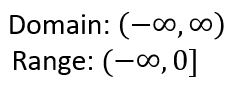
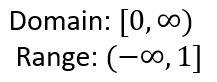
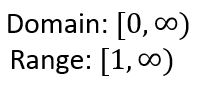
What are the domain and range of the graph? State whether it the graph of a function or not.

a)

D = (-♾ , ♾)

R = [1 , ♾)

Function

b)

D = [1 , ♾)

R = [1 , ♾)

Not a Function

c)

D = (-♾ , ♾)

R = (1 , ♾)

Function

d)

D = [1 , ♾)

R = (-♾ , ♾)

Not a Function

e)

D = [1 , ♾)

R = (-♾ , ♾)

Function

16.

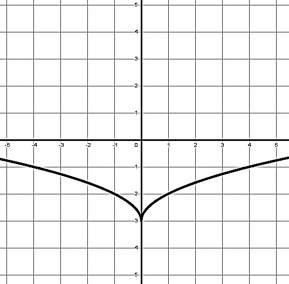
Determine the domain and the range of the relation shown in the graph and state whether it is function or not a function.

a)

D = (-♾ , ♾)

R = (-♾ , ♾)

Function

b)

D = (-♾ , ♾)

R = (-♾ , ♾)

Not a Function

c)

D = (-♾ , ♾)

R = (-♾ , 4)

Function

d)

D = (-♾ , ♾)

R = (-♾ , 4]

Not Function

17.

If f(x) = 3x-1 and g(x) = x2+2,

what is (f ° g)(x) ?

a)

3x2 +5

b)

x2 +1

c)

3x2 +1

d)

3x2 +6

18.

If f(x) = 2x - 5, g(x) = 2x2 + 3 which of the following represents g(f(x))?

a)

g(f(x)) = 16x2 - 28

b)

g(f(x)) = 16x2 + 28

c)

g(f(x)) = 16x2 - 40x + 28

d)

g(f(x)) = 8x2 - 40x + 53

19.

Which of the following is the range of the relation in the above graph

a)

{1, 0, -2}

b)

{-2, -1, 1, 2}

c)

{-2, -1, 0, 1, 2}

d)

{-2, -1, 0, 1}

20.

Which of following is a function?

a)

{(9,5), (10,5), (9,-5), (10,-5)}

b)

{(3,4), (4,-3), (7,4), (3, 8)}

c)

{(6,-5), (7, -3), (8, -1), (9, 1)}

d)

{(2, -2), (5, 9), (5, -7), (1, 4)}

21.
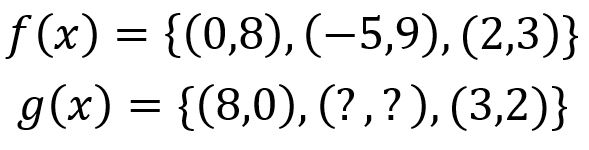
What are the missing values if g(x)=f-1(x)?
a)
(9,-5)
b)
(-9,-5)
c)
(5,9)
d)
(-9,5)
22.

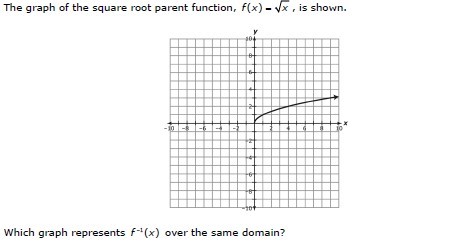
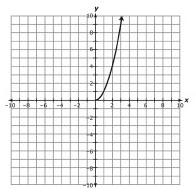
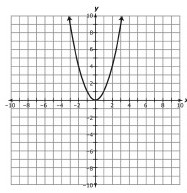
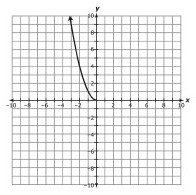
Which graph represents f-1(x) over the same domain?
a)
b)
c)
d)
23.

f(x) = -4x - 12

What is f-1(x)?

a)

f-1(x) = 4x - 3

b)

f-1(x) = -1/4x - 3

c)

f-1(x) = 1/4x + 3

d)

f-1(x) = -4x - 3

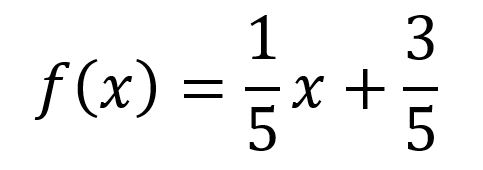
24.

Which is f -1(x)?

a)

f -1(x) = 5x + 3

b)

f -1(x) = 5x - 3

c)

f -1(x) = 5x - 15

d)

f -1(x) = 1/5(x) + 3/5

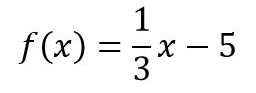
25.

Which is f -1(x)?

a)

f -1(x) = 3x + 5

b)

f -1(x) = 3x - 5

c)

f -1(x) = 3x - 15

d)

f -1(x) = 3x + 15

26.
a)
b)
c)
d)
27.
a)

Inverse Functions

b)

Not Inverse Functions

28.
a)
Inverse Functions
b)
Not Inverse Functions
29.
What is the inverse of this function?
a)
A
b)
B
c)
C
d)
D
30.

 f(x)=3x+107f\left(x\right)=\frac{3x+10}{7}  
Find  f1(x)f^{-1}\left(x\right)  

a)

 7x1037x-\frac{10}{3}  

b)

 7x310\frac{7x}{3}-10  

c)

 7(x10)3\frac{7\left(x-10\right)}{3}  

d)

 7x10³\frac{7x-10}{3}  

31.
If the equation of f(x) goes through (1, 4) and (4, 6), what points does f-1(x) go through?
a)
(1, 4) and (4, 6)
b)
(-4, -1) and (-6, -4)
c)
(-1, -4) and (-4, -6)
d)
(4, 1) and (6, 4)
32.


a)

b)

4

c)

2

d)

√8

33.
Find the inverse of f(x) = x2 - 5
a)
f-1(x) = √(x) + 5
b)
f-1(x) = ∛(x-5)
c)
f-1(x) = ±√(x+5)
d)
f-1(x) = x2 - 5
34.
Are the following inverses of each other?
a)
True
b)
False
35.
Given f(x)= -3x+7 and g(x)=2x2 - 8, find g(f(x)).
a)
g(f(x))= -6x2+31
b)
g(f(x))= -6x2+24
c)
g(f(x))=18x2-84x+90
d)
g(f(x))=9x2-42x-41
36.

 h(x)=x2h\left(x\right)=x^2  being a parent function, What is the equation of the function obtained from vertically translating the parent function 17 units down and then reflecting across the x-axis?

a)

f(x)= -x2-17

b)

f(x)= -(x-17)2

c)

f(x)= -(x+17)2

d)

f(x)= -x2+17

37.
What is the equation of the quadratic function obtained from vertically stretching the parent function by a factor of 2 and then vertically shifting up 3 units?
a)
f(x)= 2(x-3)2
b)
f(x)= 2(x+3)2
c)
f(x)= 2x2+3
d)
f(x)= (x-2)2+3
38.
What would the equation for the new quadratic function be if it was vertically shifted up 3 units  from the function f(x)=4x2+2?
a)
 g(x)=x2+3
b)
 g(x)=7x2+2
c)
 g(x)=4x2+3
d)
 g(x)=4x2+5
39.
What would the equation for the new quadratic function be if it was horizontally shifted right 1 unit  from the function f(x)=x2+4?
a)
g(x)=x2+5
b)
g(x)=(x+1)2+4
c)
g(x)=(x-1)2+4
d)
g(x)=x2+3
40.

Which quadratic function is represented by the graph?

a)

y = 2(x - 4)2 + 5

b)

y = 2(x + 4)2 + 5

c)

y = -2(x - 4)2 + 5

d)

y = -2(x + 4)2 + 5

41.
What is the equation of this graph?
a)
f(x) = (x -5)2 + 1
b)
f(x) = (x - 1)2 - 5
c)
f(x) = (x + 1)2 - 5
d)
f(x) = (x + 5)2 +1
42.
If the blue graph is
f(x) = x
the red must be...
a)
g(x) = (x + 3)2
b)
g(x) = (x - 3)2
c)
g(x) = x+ 3
d)
g(x) = x- 2
43.

Given the parent function :

 g(x) =xg\left(x\right)\ =\sqrt{x}  

Which of the following is a translation two units to the right followed by a reflection across the x-axis/ flip of the graph of g(x)?

a)

f(x)=x2f\left(x\right)=\sqrt{x-2}

b)

f(x) = x2f\left(x\right)\ =\ -\sqrt{x-2}

c)

f(x)=x2f\left(x\right)=\sqrt{x}-2

d)

None of the above

44.

 f(x) =x2f\left(x\right)\ =x^2  is a parent function. Which of the following has the characteristics below: 

- Translation right 3 units


- Reflection across the x-axis.

a)

f(x)= (x+3)2f\left(x\right)=\ -\ \left(x+3\right)^2

b)

f(x) = x23f\left(x\right)\ =-\ x^2-3

c)

f(x) = (x3)2f\left(x\right)\ =-\ \left(x-3\right)^2

d)

f(x)= x2+3f\left(x\right)=\ -\ x^2+3

45.

In the given picture the blue solid line represents the cubic parent function and the pink dotted line is the result of a transformation. Which of the following rules describes the graph after transformation.

a)

f(x - 3) - 1

b)

f(x + 3) - 1

c)

f(x - 3) + 1

d)

f(x + 3) + 1

46.

In the given picture the blue graph on the left represents the absolute value parent function f(x) = |x| and the red graph on the right is obtained after the following transformations.

1. Translation left 1 unit.

2. Reflection across the x-axis.

3. Translation down 2.

Which of the following rules describes the graph after transformation.

a)

g(x) = |x + 1| - 2

b)

g(x) = - |x + 1| - 2

c)

g(x) = -|x - 1| + 2

d)

g(x) = -|x - 2| + 1

47.

Given the following transformation:  (x , y)(15x , y)\left(x\ ,\ y\right)\rightarrow\left(\frac{1}{5}x\ ,\ y\right)  


Which of the following is True?

a)

This transformation is a vertical stretch of factor 5

b)

This transformation is a horizontal Stretch of factor 5

c)

This transformation is a vertical shrink of factor 1/5

d)

This transformation is a horizontal shrink of factor 1/5

48.

Given (x , y) (x , 7y)\left(x\ ,\ y\right)\ \rightarrow\left(x\ ,\ 7y\right)   


Which of the following is TRUE?

a)

This transformation is a vertical stretch of factor 7

b)

This transformation is a horizontal shrink of factor 1/7

c)

This transformation is a vertical shrink of factor 1/7

d)

This transformation is a horizontal horizontal stretch of factor 7

49.

Which of the following is True about the transformation below?
 (x , y)  (4x , y) \left(x\ ,\ y\right)\ \rightarrow\ \left(4x\ ,\ y\right)\   

a)

This transformation is a horizontal stretch of factor 4

b)

This transformation is a vertical shrink of factor 1/4

c)

This transformation is a vertical stretch of factor 4

d)

This transformation is a horizontal shrink of factor 1/4

50.

The transformations are being applied to a function f(x)

- Translation right of 6 units.

- Horizontal shrink of a factor 1/2.

- Vertical stretch of a factor 2.

- Translation up of 3 units.

Which of the following rules corresponds to the resulted transformation?

a)

2f[12(x6)]+32f\left[\frac{1}{2}\left(x-6\right)\right]+3

b)

2f[2(x6)]+32f\left[2\left(x-6\right)\right]+3

c)

12f[2(x6)]+3\frac{1}{2}f\left[2\left(x-6\right)\right]+3

d)

2f[2(x+6)]+32f\left[2\left(x+6\right)\right]+3

51.

In the above picture the blue graph represents the absolute value parent function and the red graph is the result of some transformation of the parent graph.

which of following best describes the transformations on the original graph?

a)

1. Translation left of 2 units.

2. Horizontal stretch of an undetermined factor.

3. Translation down of 3 units.

b)

1. Translation right of 3 units.

2. Horizontal Stretch of an undetermined factor.

3. Translation down of 2 units.

c)

1. Translation left of 2 units.

2. Horizontal Stretch of an undetermined factor.

3. Translation up of 2 units.

d)

1. Translation left of 3 units.

2. Horizontal Stretch of an undetermined factor.

3. Translation up of 3 units.

52.

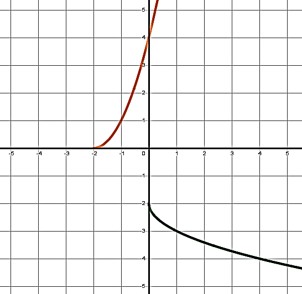
Which graph represents the functions f(x) and f-1(x)?
a)
b)
c)
d)
53.
Are these functions inverses?
a)
Yes
b)
No
54.
What is the inverse of the points
(1,3)(2,4)(6,8)
a)
(3,1)(4,2)(8,6)
b)
(-3,-1)(-4,-2)(-8,-6)
c)
(1,3)(2,4)(6,8)
d)
(-1,-3)(-2,-4)(-6,-8)
55.
If f-1(-25) = 7 then what is f(7) = 
a)
25
b)
7
c)
No enough information. 
d)
-25
56.
Are these inverse functions?
a)
no
b)
yes
c)
no way to tell
57.
What's the name of the inverse of g(x)?
a)
f(x)
b)
f-1(x)
c)
y
d)
g-1(x)
58.

Which is the inverse of the table?

a)
b)
c)
d)
59.

Which is the inverse of the table?

a)
b)
c)
d)
60.

Which graph is the inverse of the graph shown?

a)
b)
c)
d)
61.
What is g(7) if:
a)
-17
b)
-13 
c)
13       
d)
17
62.
What is m(-3) if:    
a)
-3
b)
0.5
c)
3
d)
-3.5
63.
Which piecewise function corresponds to this graph? (Take your time)
a)
f(x) = { x  if x < 4;   -x+1  if x ≥ 4
b)
f(x) = { x  if x ≤ 4;  -x+1  if x > 4
c)
f(x) = { -x+1  if x < 4;  x  if x ≥ 4
d)
f(x) = { -x+1  if x ≤ 4;  x if x > 4
64.
Find f(-2)
a)
-3
b)
6
c)
8
d)
-6
65.

Find f(0)

a)

-3

b)

18

c)

4

d)

0

66.
Determine the transformation 
a)
left 3, up 2
b)
right 3, up 2
c)
left 3, down 2
d)
right 3, down 2
67.
Determine the transformation
a)
down 2
b)
flip, down 2
c)
flip, left 2
d)
left 2
68.
Determine the transformation
a)
Left 5, up 1
b)
Left 5, down 1
c)
Right 5, up 1
d)
Right 5, down 1
69.
What is the equation of the graph below? You can click the picture to zoom in!
a)
f(x) = I x + 2 I 
b)
f(x) = I x  I + 2
c)
f(x) = I x  I - 2
d)
f(x) = I x - 2 I 
70.
What is the equation of the graph below? You can click the picture to zoom in!
a)
y = - | x + 2| + 4
b)
y = - | x - 2| + 4
c)
y = | x - 2 | + 4
d)
y = | x - 2| - 4
71.
What is the equation of the graph below?
a)
f(x ) = I x + 4 I + 2
b)
f(x ) = -I x - 4 I + 2
c)
f(x ) = I x - 4 I + 2
d)
f(x ) = -I x + 4 I + 2
72.
Which of the following describes the horizontal and vertical translations of the following functions:
f(x) = |x + 4| - 9
a)
Left 4
up 9
b)
Left 4
Down 9
c)
Right 4
up 9
d)
Right 4
Down 9
73.
Describe the transformation from the Absolute Value Parent Function.
a)
Stretches more narrow, shifts up 4 units
b)
Stretches more narrow, shifts down 4 units
c)
Compresses wider, shifts up 4 units
d)
Compresses wider, shifts down 4 units
74.
Describe the transformations of the absolute value equation.
a)
Flips to A shape, compresses wider, shifts right 1 unit
b)
Flips to A shape, compresses wider, shifts up 1 unit
c)
Flips to A shape, stretches more narrow, shifts right 1 unit
d)
Flips to A shape, stretches more narrow, shifts up 1 unit
75.
Write an absolute value function given the following transformations:
Reflection across the x-axis
Vertical shift right 2 units
Horizontal shift down 7 units

a)
y = -|x + 2| - 7 
b)
y = |x - 2| - 7 
c)
y = -|x - 2| - 7
d)
y = -|x - 2| + 7