wayground logo

Free Printable Worksheets

NEW

Font size

S
M
L
XL
Worksheets

Segment 1 Review

Total questions: 50

Worksheet time: 29mins

Name
Class
Date
1.

A group of students proposes a scientific idea and post their arguments and steps online. A different group of students reviews the idea and has different outcomes. Can the original idea be considered scientific?

a)

yes, the scientific method was followed

b)

no, different results each time leads to pseudoscience

c)

no, peer reviews are not good in science

d)

yes, different results is normal in science

2.

A scientist suggested a scientific idea after observations were made and data was collected. the opinion of different people was implemented and recorded. Can this idea be considered scientific?

a)

No, opinions can be biased

b)

yes all steps of the scientific method were followed

c)

no, the opinion of the community is the same as the scientist

d)

yes, the idea was made after observation

3.

Does the amount of water affect the plant's height?

Which hypothesis is correct?

a)
If the plant receives 20ml of water, then the plant will grow the shortest.
b)
The plant will receive 20 ml of water, then the plant will grow the tallest.
c)
If the plant receives, then the plant will grow the tallest.
d)
If the plant receives 10 ml of soda, then it will grow tall.
4.
Ralph is concerned about the number of ants in his kitchen. He wonders if cleaning the kitchen more than once a month would fix the problem.
What is the best hypothesis for this situation?
a)
If the kitchen is cleaned once a week instead of once a month, then the number of ants will be fewer than if the kitchen is cleaned once a month. 
b)
If the kitchen is cleaned, then will the number of ants go down?
c)
The filthiness of the kitchen is causing the ant infestation.
d)
If the kitchen is cleaned, then the number of ants will decrease.
5.
If a piece of matter changes shape, what happens to its mass?
a)
It increases
b)
It decreases
c)
it changes randomly
d)
it stays the same
6.
Anything made of matter must _____________________.
a)
take up space and have mass
b)
have mass and be a solid
c)
be a solid and not move
d)
take up space and be a liquid
7.

Object A has a mass of 1800kg. Object B has a mass of 450 kg. The weight of object B is __________ times the mass of object A if both objects are placed in the same planet

a)

1/4

b)

3/4

c)

4

d)

1

8.
What is the formula for density?
a)
density = mass x volume
b)
density = mass / volume
c)
density = mass + volume
d)
density = mass - volume
9.
Jack has a rock. The rock has a mass of 14g and a volume of 2cm3. What is the density of the rock?
a)
7 mL
b)
7 g/cm3
c)
28 g/cm3
d)
1/7 g/cm3
10.
Which box has a higher density?  
a)
Box A
b)
Box B
c)
cannot be determined
d)
they are the same
11.

2 liters of water boil at 100°C. What temperature is required to boil 1 liter of water?

a)

10°C ince boiling point is an intensive property

b)

200°CC since boiling point is an extensive property

c)

100°C ince boiling point is an intensive property

d)

50°C C since boiling point is an extensive property

12.

Tony cuts a piece of gold of 10cm with a density 19.9 g/cm3 into 5 smaller pieces. What is the density of on small piece of gold?

a)

one-fifth 19.9 g/cm3 since density is an intensive property

b)

19.9 g/cm3 since density is an intensive property

c)

19.9 g/cm3 since density is an extensive property

d)

one-fifth 19.9 g/cm3 since density is an extensive property

13.

Dean is making a trivet. A trivet is placed on a table beneath a hot pot.


He knows that he must choose something that will NOT allow heat to pass easily from the hot pot to the table. Which material should Dean use to make the trivet?

a)

Wood

b)

Aluminum

c)

Copper

d)

Silicon

14.

Which set of properties, intensive or extensive, are based on the size of a sample?

a)

intensive

b)

extensive

15.

What is the definition of intensive property?

a)

Properties that vary depending on the amount of matter

b)

Properties that do not change with amount of matter

16.
Which form of matter does not take the shape of its container?
a)
liquid
b)
gas
c)
solid
d)
air
17.
In the above diagram, "State of Matter B" is a liquid. This means that it has:

a)
definite shape and volume.
b)
no definite shape or volume.
c)
definite volume, but changing shape.
d)
definite shape, but changing volume.
18.
State of matter with no definite shape or volume.
a)
solid
b)
liquid
c)
gas
d)
Mississippi
19.
what is the definition of physical change?
a)
any change that results in the formation of new chemical substances. 
b)
rusting
c)
changes affecting the form of a chemical substance, but not its chemical composition.
d)
any property that is measurable, whose value describes a state of a physical system
20.
what is burning?
a)
physical change
b)
physical property
c)
chemical change
d)
chemical property
21.
which one is a chemical property?
a)
odor
b)
combustibility
c)
solubility
d)
all of the above
22.
What is the definition of chemical change?
a)
any change that results in the formation of new chemical substances. 
b)
changing clothes
c)
matter cannot be created or destroyed, only change form
d)
changes affecting the form of a chemical substance, but not its chemical composition.
23.
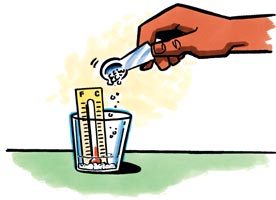
In an exothermic reaction, heat is ...
a)
taken in or absorbed
b)
given out or released
24.
In an endothermic reaction, heat is ...
a)
taken in or absorbed
b)
given out or released 
25.
Is photosynthesis an exothermic or endothermic reaction?
a)
Endothermic
b)
Exothermic
c)
Neither
26.

_____ reactions usually feel hot!

a)

endothermic

b)

exothermic

27.
John Dalton stated:
a)
elements are made of atoms
b)
atoms of a given element are identical
c)
atoms cannot be subdivided, created, nor destroyed
d)
all of the above
28.
The scientist responsible for "discovering" the nucleus is:
a)
Bohr
b)
Rutherford
c)
Schroedinger
d)
Einstein
29.
What does the nucleus of an atom contain?
a)
Electrons and neutrons
b)
Protons and neutrons
c)
Neutrinos and positrons
d)
DNA and RN
30.
Subatomic particles with a positive charge
a)
neutrons
b)
atomic mass
c)
protons
d)
isotopes
31.

a negatively charged subatomic particle that orbits the nucleus of an atom

a)

proton

b)

neutron

c)

electron

d)

matter

32.

an arrangement of the elements according to their atomic numbers so that elements with similar properties are in the same column and properties repeat from row to row

a)

Periodic Table of Elements

b)

Atomic Theory

c)

Isotopes

d)

Subatomic Particles

33.

a grouping of elements based on similar properties, arranged by columns in the periodic table; also known as a group

a)

family

b)

period

c)

row

d)

isotope

34.

If an atom had the same properties as fluorine (F), it would probably be located in

a)

period 1.

b)

period 2.

c)

group 2.

d)

group 17.

35.
Atoms with similar properties are most likely located...
a)
in the same period.
b)
in the same group.
c)
in different periods.
d)
to the right and left of each other.
36.

what is the name of group number 1

a)

halogens

b)

noble gases

c)

alkali

d)

alkaline earth

37.

what group number are the halogens

a)

18

b)

1

c)

2

d)

17

38.

what group number are the noble gases

a)

17

b)

18

c)

14

d)

15

39.

How many different atoms

are there in a compound?

a)

0

b)

1

c)

2 or more

d)

-1

40.

Example of a homogeneous mixture

a)

sweet tea

b)

pizza

c)

guacamole

d)

helium

41.

What is a mixture?

a)

an atom

b)

2 or more substances that are together in the same place, but their atoms are not chemically bonded

c)

a substance that cannot be broken down into any other substances by physical or chemical means

d)

A substance made of 2 or more elements that are chemically

combined in a set ratio

42.
What is H2SO4 
 made up of?
a)
2 hydrogen, 1 sulfur, 4 oxygen
b)
1 hydrogen, 2 sulfur, 4 oxygen
c)
2 hydrogen & 4 sodium
d)
1 hydrogen & 6 sodium
43.
You are eating a pizza. What type of mixture are you consuming?
a)
homogeneous
b)
heterogeneous
c)
pure substance
d)
The Periodic Table
44.
A pure substance...
a)
is an element or a compound
b)
is an element or a mixture
c)
is a compound or a mixture
d)
is a mixture
45.

A sour taste is a characteristic of:

a)

acids

b)

bases

c)

neutral

d)

pH scale

46.

Which is a characteristic of a base?

a)

tastes sour

b)

found mostly in foods

c)

feels slippery

d)

turn litmus paper red

47.

pH is the measure of the concentration of ______.

a)

Acids

b)

H+ ion

c)

OH- ion

d)

Bases

48.

According to Hydrogen concentration, what is the definition of an ACID?

a)

a substance that contains hydroxide and ionizes to produce OH-

b)

a substance that contains hydrogen and ionizes to produce H+

c)

a substance that contains hydrogen and ionizes to produce OH-

d)

a substance that contains hydroxide and ionizes to produce H+

49.

What is the definition of a BASE with regard to Hydrogen concentration?

a)

a substance that donates a hydrogen (H+) ion

b)

a substance that donates a hydroxide (OH-) ion

c)

a substance that accepts a hydrogen (H+) ion

d)

a substance that accepts a hydroxide (OH-) ion

50.

According to the pH scale, which item is a stronger base than soap?

a)

baking soda

b)

ammonia solution

c)

tomato

d)

bleach