
Font size
 Worksheets
Unit 4
Total questions: 60
Worksheet time: 3600secs

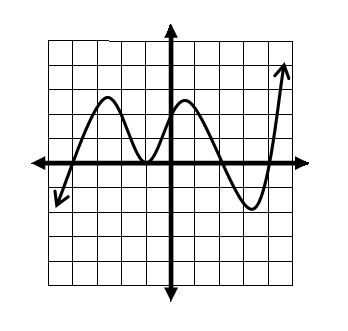

How many roots are shown in the picture?
0
1
2
3

How many zeroes are shown in the graph?
1
2
3
4

Which root has a multiplicity of 2?
-1
2
4
-4
The degree of the polynomial determines the max number of roots.
True
False
is -3 a POSSIBLE zero of f(x)=3x3+2x2−5x+2
no, 3 is not a factor of 3
yes
no, 2 is not a factor of 3
no, 3 is not a factor of 2
List the ACTUAL rational zeros of
f(x) = x³ + 7x² - 2x -14 ?
±1,±2,±7,±14
7, 2
7
- 7
List the possible rational zeros of
f(x) = x3 - 4x2 -4x + 16
1, 2, 4, 8, 16
±1,±2,±4,±8,±16
±1,±4,±41
-2 and-4
f(x) = 2x3 - 3x2 + 4x -10
State the maximum number of turns the graph of f(x) could make.
3
2
1
0
f(x) = 2x3 - 3x2 + 4x -10
What is the degree of f(x)?
3
2
1
0
f(x) = 5x4-8x3+4x2-6x+3 have?
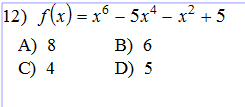
If the graph of a function crosses the x-axis, what does that mean about the multiplicity of that zero?
Even
Odd
None
What are the
zeros of the polynomial
y = 5(x + 4)(x + 1)(x - 3)?
-4, -1, 3
3, 5, 4, 1
4, 1, -3
3, -4, -1, 5
What are the zeros of the polynomial function?
y = 3x(x - 6)(x + 5)
0, 6, -5
6, -5
0, -6, 5
3, 6, -5
What are the zeros of the polynomial function?
y = (x + 2)(x - 7)3
-2, 7 multiplicity 3
-2, 7, 3
2, -7 multiplicity 3
2, -7, 3
Odd Multiplicities have which of the following effects on the x-axis?
Cross the x-axis
Tangent to the x-axis


How many real zeros are shown in the graph?
1
2
3
4

Find the choice that is correct
The leading coefficient is 2, the degree is 4
The leading coefficient is 3, the degree is 2
The leading coefficient is 3, the degree is 4
The leading coefficient is 2, the degree is 2.

Find the correct statement about the zeros.
−5 is a zero with multiplicity 1
−5 is a zero with multiplicity 2
−2 is a zero with multiplicity 1
2 is a zero with multiplicity 2
Which function has zeros: x=0, x=5(multiplicity of 3) and x=-6.
f(x) = 9x(x + 5)3(x - 6)
f(x) = 3(x - 5)3(x + 6)
f(x) = -7x(x - 5)3(x + 6)
f(x) = (x - 3)(x - 5)(x + 6)
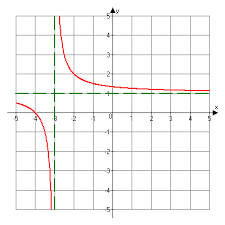
What are the asymptotes?
x=−3, y=1
x=−3, y=−1
x=1, y=−3
x=1, y=3

R: All real number y≠ 1
R: All real number y≠ -3
R: All real number y≠ 1
R: All real number y≠ 3
Find the domain of the function. f(x)=x+8x3
x cannot equal to 8
x cannot equal to 0
x cannot equal to -8
All real numbers
Find the domain of the function. f(x)=2x+4x
x cannot equal to 2
x cannot equal to 1/2
x cannot equal to -2
All real numbers
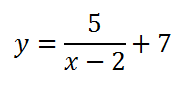

Which is the graph of the rational equation:


Which function matches this graph?
f(x)=x−4−2
f(x)=x−4+2
f(x)=x−2−4
f(x)=x+2−4

Which functions match this graph?
f(x)=x4+1
f(x)=x4−1
f(x)=x+44
f(x)=x−44


Select the graph that show the corresponding vertical & horizontal asymptotes to this function


Select the graph that show the corresponding vertical & horizontal asymptotes to this function


What's the horizontal asymptote of the function?
y = 0
No horizontal asymptote
y = 2
y = 4

What's the horizontal asymptote of the function?
y = 0
No horizontal asymptote
y = 1
y = 9

What's the horizontal asymptote of the function?
y = 0
No horizontal asymptote
y = 1/2
y = 1

What's the vertical asymptote of the function?
x = -9
x = 9
x = 3 , x = -3
x = 3

What's the vertical asymptote of the function?
x = 4
x = 16
x = 4 , x = -4
No vertical asymptote

Select the graph that show the corresponding vertical & horizontal asymptotes to this function


What's the vertical asymptote of the function?
x = 5
x = 0
x =5 , x = -5
x = 25

What are the coordinates of the hole, if one exists.
(-1, -2)
(-1, ½)
(-1, -½)
there isn't one

What are the coordinates of the y-intercept, if one exists.
(0, 0)
(0, 1)
(0, -1)
there isn't one

What is the equation of the slant asymptote?
y = x + 1
y = x + 2
y = x + 3
y = x

What are the x and y intercepts?
(4, 0) and (0, -4)
(-4, 0) and (0, -4)
(-4, 0) and (0, 4)
(0, 0) and (0, -4)

What is the equation of the graph?


Find the y-intercept.
(0, -2)
(0, 2)
(0, 4)
it is undefined
Solve the inequality in interval notation
(−∞,−3)∪(3,∞)
(−3,3)
[−∞,−3]∪[3,∞]
[−3,3]
Solve the inequality in interval notation
(−∞,4)∪(7,∞)
(4,7]
[−∞,4]∪[7,∞]
[4,7)
Solve the inequality in interval notation
(−∞,−3)∪(4,∞)
(−3,4)
[−∞,−3]∪[4,∞]
[−3,4]
Solve the inequality in interval notation
(−∞,−21)∪(1,∞)
(−21,1]
(−∞,−21]∪[1,∞)
[−21,1)
Solve the inequality in interval notation
[−3,1]∪[4,∞]
(−3,1)∪(4,∞)
(−3,1]∪[4,∞)
[−3,1]∪[4,∞)
Solve the inequality in interval notation
[−∞,−2]∪[0,1]
(−∞,−2)∪(0,1)
(−∞,−2]∪[0,1]
(−∞,−2)∪[0,1]
Solve the rational inequality and state your solution in interval notation.
x2+1x2−1≤0
(−1, 1)
[−1, 1]
(−∞, −1)∪(−1, 1)∪(1, +∞)
(−∞, −1]∪[1, +∞)
Solve the rational inequality and state your solution in interval notation.
x2−4x+4x2+4x−12>0
(−∞, −2]∪[6, +∞)
(−∞, −2)∪(6, +∞)
(−∞, −6]∪[2, +∞)
(−∞, −6)∪(2, +∞)

