
NEW
Font size
 Worksheets
Series and Parallel Circuits
Total questions: 10
Worksheet time: 5mins
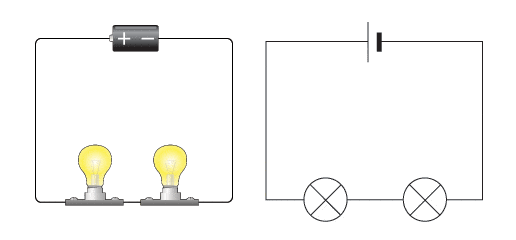

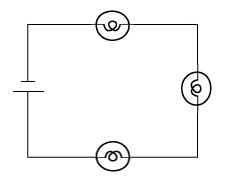

Which circuit diagram represents the correct way to measure the current in a resistor?


A 3-ohm resistor and a 6-ohm resistor are connected in parallel across a 9-volt battery. Which statement best compares the potential difference across each resistor?
The potential difference across the 6-ohm resistor is four times as great as the potential difference across the 3-ohm resistor.
The potential difference across the 6-ohm resistor is half as great as the potential difference across the 3-ohm resistor.
The potential difference across the 6-ohm resistor is the same as the potential difference across the 3-ohm resistor.
The potential difference across the 6-ohm resistor is twice as great as the potential difference across the 3-ohm resistor.
A 3.0-ohm resistor and a 6.0-ohm resistor are connected in series in an operating electric circuit. If the current through the 3.0-ohm resistor is 4.0 amperes, what is the potential difference across the 6.0-ohm resistor?
12 V
24 V
2.0 V
8.0 V
Three resistors, 4 ohms, 6 ohms, and 8 ohms, are connected in parallel in an electric circuit. The equivalent resistance of the circuit is
between 4 ohms and 8 ohms
less than 4 ohms
18 ohms
between 10. ohms and 18 ohms

