Wayground logo

Free Printable Worksheets

Font size

S
M
L
XL
Worksheets

Checkpoint Joints/Blood

Total questions: 35

Worksheet time: 26mins

Name
Class
Date
1.
What are joints
a)
A place where one bone meets 
b)
A place where  two  bones meet 
c)
Bones don't meet 
d)
A place where three bones meet 
2.
This type of joint allows the your first two vertebrate to rotate as in shaking your head no
a)
condyloid
b)
gliding
c)
pivot
d)
saddle
3.
The knee joint is
a)
Hinge
b)
Gliding
c)
Ball and socket
d)
Pivot
4.
Carpals and tarsals (flat bones) are examples of this type of joint
a)
condyloid
b)
gliding
c)
hinge
d)
saddle
5.
Hip and shoulder have examples of this type of joint
a)
ball and socket
b)
condyloid
c)
hinge
d)
gliding
6.
Name this joint
a)
gliding
b)
saddle
c)
condyloid
d)
pivot
7.
Fibrous joints are?
a)
freely moveable
b)
partially moveable
c)
immovable
8.

Which type of joint gives you the largest range of motion?

a)

Pivot joint

b)

Ball-and-socket joint

c)

Hinge joint

d)

Gliding joint

9.

The main purpose of synovial fluid is:

a)

Keeping bones moist

b)

Lubrication/reduce friction

c)

Strengthening tendons and cartilage

d)

Protecting the spinal cord

10.

What is the slippery surface that cover the bones?

a)

synovial membrane

b)

synovial fluid

c)

ligament

d)

cartilage

11.
These joints all have a fibrous capsule lined with synovial membrane surrounding a joint cavity
a)
fibrous
b)
cartilaginous
c)
synovial
12.
Joints between skull bones
a)
diarthrotic/synovial
b)
fibrous/suture
c)
amphiarthrotic/epiphyseal disk
13.
These blood cells are the protectors and help fight off disease.
a)
Red blood cells
b)
White blood cells
c)
Plasma
d)
Platelets 
14.
These blood cells deliver oxygen to the parts of the body.
a)
Red
b)
White
c)
Patelets
d)
Plasma
15.
_______ is made mostly of water and makes up about 55% of the blood
a)
Plasma
b)
Platelets 
c)
Red blood cells
d)
White blood cells
16.
What part of blood is responsible for carrying oxygen and carbon dioxide to or from body cells?
a)
Red Blood Cells
b)
White Blood Cells
c)
Platelets
d)
Plasma
17.

What protein is found in red blood cells that binds to and transports oxygen?

a)

peptidoglycan

b)

iron

c)

hemoglobin

d)

plasma

18.

These are found in blood and help the blood to clot...

a)

white blood cells

b)

platelets

c)

plasma

d)

red blood cells

19.

This is the colorless liquid in which the components of blood are suspended...

a)

red blood cells

b)

platelets

c)

plasma

d)

white blood cells

20.

Someone with Type A blood also has...

a)

Type A antibodies

b)

Type B antibodies

c)

both Type A & B antibodies

d)

neither Type A nor B antibodies

21.

Someone with both Type A & B antibodies is which blood type?

a)

A

b)

B

c)

AB

d)

O

22.

A substance on the surface of red blood cells that can trigger the production of antibodies

a)

agglutinates

b)

antigens

c)

anemia

d)

Rh Factor

23.

Proteins produced by the immune system that destroy foreign substances...

a)

antigens

b)

agglutinates

c)

platelets

d)

antibodies

24.

This determines whether a person's blood type is positive or negative...

a)

Rh factor

b)

platelets

c)

D antibodies

d)

plasma

25.

Which blood type is known as the universal donor? (can be used by all)

a)

AB +

b)

AB -

c)

O+

d)

O-

26.

What is this blood type?

a)

A+

b)

AB+

c)

AB-

d)

A-

27.

What is the blood type?

a)

O+

b)

AB+

c)

AB-

d)

Not Valid

28.

What is the blood type?

a)

B+

b)

A-

c)

A+

d)

B-

29.

What is the blood type?

a)

B+

b)

O+

c)

O-

d)

Not Valid

30.

What is the blood type?

a)

O-

b)

O+

c)

Not Valid

d)

AB+

31.
What antigens are present in a person with type B- blood?
a)
B, only
b)
B and Rh
c)
A and Rh
d)
A, only
32.
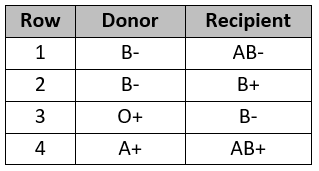
In which row of the chart would agglutination most likely occur?
a)
Row 1
b)
Row 2
c)
Row 3
d)
Row 4
33.
Which of the following is not a primary function of blood?
a)
help fight disease
b)
transports nutrients, oxygen, wastes, and hormones
c)
to provide structure 
d)
distributes heat
34.
Blood is classified as ___ tissue.
a)
connective
b)
circulatory
c)
epithelial
d)
muscular
35.
Where does hematopoiesis take place, producing new RBCs?
a)
red bone marrow
b)
yellow bone marrow
c)
synovial membrane
d)
articular cartilage