wayground logo

Free Printable Worksheets

NEW

Font size

S
M
L
XL
Worksheets

Weather Factors Review

Total questions: 26

Worksheet time: 31mins

Name
Class
Date
1.

Wind is the movement of air from ___ pressure to ____ pressure

a)

high to low

b)

low to high

c)

zero to high

2.

What is a Meteorologist?

a)

Scientist who studies rocks

b)

Scientist who studies diseases

c)

Scientist who studies the causes of weather

d)

Scientist who studies the Earth

3.

Instruments used to measure wind

a)

psychrometer, hygrometer

b)

wind vane, hygrometer

c)

thermometer, anemometer

d)

anemometer, wind vane

4.
The temperature at which water vapor condenses is the 
a)
relative humidity
b)
humidity
c)
freezing point
d)
dew point
5.
Clouds form in which step of the Water Cycle?
a)
Evaporation
b)
Condensation 
c)
Precipitation 
d)
Run Off
6.

convection cells

a)

warm, less dense air rises

b)

cool, dense air sinks

c)

large, circular patterns of moving air

d)

movement of air caused by differences in air pressure

7.
What kind of breeze is this and when would it form?
a)
Land breeze - daytime
b)
Land breeze - nighttime
c)
Sea breeze - daytime
d)
Sea breeze - nighttime
8.

Where do MARITIME air masses form?

a)

Over water

b)

Over land

9.

What type of air mass is found over EGYPT?

a)

Maritime Polar

b)

Maritime Tropical

c)

Continental Polar

d)

Continental Tropical

10.

Which type of air mass is HOT and DRY?

a)

Maritime Polar

b)

Maritime Tropical

c)

Continental Polar

d)

Continental Tropical

11.

A(n) _____________ is the boundary where two air masses meet.

a)

air mass

b)

storm

c)

collision

d)

front

12.
Type of cloud seen here?
a)
cirrus
b)
stratus
c)
cumulus
d)
cumulonimbus
13.
Type of cloud seen here?
a)
cirrus
b)
stratus
c)
cumulus
d)
cumulonimbus
14.
Type of cloud seen here?
a)
cirrus
b)
stratus
c)
cumulus
d)
cumulonimbus
15.
Fog is an example of a ground level ______ cloud.
a)
cirrus
b)
stratus
c)
cumulus
d)
cumulonimbus
16.
What type of air mass is described as dry and cold?
a)
maritime tropical
b)
arctic
c)
continental polar
d)
continental tropical
17.
What is the process that creates clouds?
a)
precipitation
b)
condensation
c)
evaporation
d)
transpiration
18.
We live in the __________________layer, a level of the atmosphere.
a)
Troposphere
b)
Stratosphere
c)
Mesosphere
d)
Exosphere
19.
What absorbs ultraviolet rays in the atmosphere?
a)
troposphere
b)
stratosphere
c)
ozone layer
d)
greenhouse gases
20.
The coldest layer.
a)
troposphere
b)
thermosphere
c)
exosphere
d)
mesosphere
21.
The hottest layer.
a)
troposphere
b)
thermosphere
c)
exosphere
d)
mesosphere
22.
What does the earth's atmosphere do?
a)
help to regulate the temperature on Earth
b)
Help UV rays to reach the Earth's surface
c)
Creates meteors in the sky
d)
Keep ocean waters cold
23.
Without the Greenhouse Effect the Earth would be
a)
warm 
b)
cold
c)
dead
24.
What is the greenhouse effect?
a)
The warming of a planet due to trapped radiation.
b)
The cooling of Earth due to air pollution.
c)
The heating of a solid, such as a rock.
25.
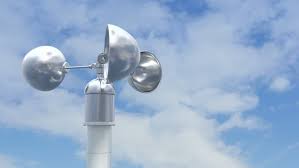
An anemometer is used to measure...
a)
rain fall
b)
snow
c)
wind speed
d)
wind direction
26.
Weather is the current conditions outside.
a)
True
b)
False