wayground logo

Free Printable Worksheets

Font size

S
M
L
XL
Worksheets

CC-12-Molecular Structure and Bonding

Total questions: 70

Worksheet time: 45mins

Name
Class
Date
1.
Giant lattice structure held together by attraction between  positive and negatively charged ions 
a)
simple covalent molecules
b)
metallic
c)
ionic
d)
giant covalent 
2.
Elements such as  Silicon, diamond and graphite.  Compounds include  SiO2
a)
simple covalent molecules
b)
metallic
c)
ionic
d)
giant covalent 
3.
Low melting and boiling points which increase with increasing molecule size due to increased intermolecular forces.
a)
simple covalent molecules
b)
metallic
c)
ionic
d)
giant covalent 
4.
Melting points are very high – a large amount of energy is needed to break all the covalent bonds
a)
simple covalent molecules
b)
metallic
c)
ionic
d)
giant covalent 
5.
Conductors due to delocalised electrons
a)
simple covalent molecules
b)
metallic
c)
ionic
d)
giant covalent 
6.
Melting points are generally high – lots of energy is needed to overcome the attractions between positive ions and delocalised electrons.  
a)
simple covalent molecules
b)
metallic
c)
ionic
d)
giant covalent 
7.
Formulae of these might include H2O
each molecule contains 1 O and 2H atoms 
a)
simple covalent molecules
b)
metallic
c)
ionic
d)
giant covalent 
8.
Compounds containing a metal and non-metal.
a)
simple covalent molecules
b)
metallic
c)
ionic
d)
giant covalent 
9.
Conductors due to delocalised electrons
a)
simple covalent molecules
b)
metallic
c)
ionic
d)
giant covalent 
10.
Covalent compounds
a)
Share electrons
b)
transfer electrons
c)
contain a sea of electrons
d)
conduct electricity
11.
Predict the bond that will form between Sr and S.
a)
Ionic
b)
Covalent
12.
Which of these is covalent?
a)
NaCl
b)
Pb(NO3)2
c)
CO2
d)
AlCl3
13.
Which elements tend to lose electrons?
a)
metals
b)
nonmetals
14.
Which of the following is relevant for copper?
a)
Ion
b)
Ionic bonding
c)
Metallic bonding
d)
Covalent bonding
15.
Magnesium bromide is an ionic compound with the chemical formula MgBr₂.  What does the "2" tell you?
a)
There are 2 bromide ions for every magnesium ion
b)
Bromide has a 2- charge
c)
Bromide has a 2+ charge
d)
There are 2 magnesium ions to every bromide ion
16.
When an atom loses an electron, it becomes a:
a)
positive ion
b)
negative ion
c)
neutral ion
d)
neutral atom
17.
In metals, the _______ electrons form a shared sea of electrons.
a)
Metallic
b)
Inner
c)
Outer
d)
Ionic
18.
Atoms form ions in order to become
a)
isotopes
b)
stable
c)
metals
d)
nonmetals
19.

Many alloys are softer than the elements that are in them.

a)

True

b)

False

20.

Why are alloyed metals usually stronger?

a)

They have atoms of different metals in them, which makes it easier for the layer to move past each other...less likely to break

b)

They have atoms of different metals in them, which makes it harder for the layer to move past each other...less likely to break

21.

An alloy is made of __________ size particles while a pure metal is made up of _________ size particles.

a)

same, different

b)

different, same

c)

same, same

d)

different, different

22.

Which of the following molecules is not an exception to octet rule?

a)

BF3

b)

PF5

c)

CO2

d)

IF7

23.

For which of the follwoing hybridisation the bond angle is maximum?

a)

Sp2

b)

Sp

c)

Sp3

d)

dSp2

24.

Which of the following molecule is not polar?

a)

NH3

b)

NF3

c)

BF3

d)

CHCl3

25.

PCl5 molecule has the follwoing geometry

a)

Trigonal bipyramidal

b)

Octahedral

c)

Square Planar

d)

Pyramidal

26.

In which of the following species is the underlined carbon having Sp3 hybridisation?

a)

CH3COOH

b)

CH3CH2OH

c)

CH3COCH3

d)

CH2=CHCH3

27.

Which one of the following statements is not correct for sigma and pi bonds between two carbon atoms?

a)

Sigma bond is stronger than pi bond

b)

Bond energies of sigma and pi bonds are of the order of 264 kJ /mol

c)

Free rotation of atoms around a sigma bond is allowed but not in case of a pi bond

d)

Sigma bond is formed from hybridised orbital and pi bond is formed from unhybridised orbital.

28.

Which among the following is diamagnetic?

a)

N2

b)

O2

c)

N22-

d)

O2-

29.

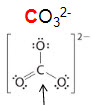
Which of the following statement is correct about CO32- ?

a)

The hybridisation of central atom is Sp3

b)

Its canonical structure has one C--O single bond and two C=O double bonds

c)

All C--O bond lengths bond lengths are equal

d)

Canonical structures are less stable

30.

The types of hybrid orbitals of nitrogen in NO2+,NO3- and NH4+ respectively are expected to be

a)

Sp, Sp3, Sp2

b)

Sp, Sp2, Sp3

c)

Sp3, Sp ,sp2

d)

Sp2,sp3,Sp

31.

The correct decreasing order of the boiling points of H2O and NH3 is:

a)

H2O > NH3

b)

NH3 > H2O

32.

Which of the following molecule is T shaped?

a)

SF4

b)

ClF3

c)

H2O

d)

NH3

33.

Which of the following statement is correct regarding SF4 molecule?

a)

SF4 molecule is bent shaped

b)

SF4 molecule hasTrigonal bipyramidal shape

c)

SF4 has SP3d hybridisation

d)

SF4 has SP3d2 hybridisation

34.

Which of the following statement is wrong?

a)

The combining atomic orbitals must have same or nearly same energies

b)

The extent of overlapping betwen the atomic orbitals of the two atoms shold be large

c)

The combining atomic orbitals must have different energies

d)

The combinig atomic orbitals must have the same symmetry

35.

In which of the following substances will hydrogen bond be strongest?

a)

HC

b)

H2O

c)

HI

d)

H2S

36.

Which of the following angle corresponds to sp2 hybridisation?

a)

90°

b)

120°

c)

180°

d)

109°

37.

Which of the following statement is not correct from the view point of molecular orbital theory?

a)

Be2 is not a stable molecule

b)

He2 is not a stable molecule

c)

Bond strength of N2 is maximum amongst the homonuclear diatomic molecules belonging to the second period.

d)

The order of energies of molecular orbitals in N2 molecule is

σ2s < σ* 2s < σ2pz < (π2pX = π2pY) < (π*2pX = π*2pY) < σ*2pz

38.

Which of the following pair is expected to have the same bond order?

a)

O2 , N2

b)

O2+, N2

c)

O2 , N2+

d)

O2, N2

39.

Which of the following statement is wrong for hyrogen bond?

a)

Hydrogen bond is weaker than covalent bond

b)

Hydrogen bond is stronger than vander waals forces of attraction

c)

Intermolecular hydrogen bonding is weaker han intramolecular hydrogen bond.

d)

none of the above

40.

What are isoelectronic species?

a)

same number of electrons

b)

same number of neutrons

c)

same number of protons

d)

All the above

41.

The geometry of a molecule with 4 bonded pairs of electrons and 0 lone pairs of electrons

a)

Tetrahedral

b)

Trigonal Planar

c)

Bent

d)

Trigonal Pyramidal

e)

Linear

42.

Is this molecule polar or non-polar?

a)

Polar

b)

Non-polar

43.

Is this molecule polar or non-polar?

a)

Polar

b)

Non-polar

44.

Is this molecule polar or non-polar?

a)

Non-polar

b)

Polar

45.

Is this molecule polar or non-polar?

a)

Non-polar

b)

Polar

46.
In covalent bonds, electrons are ___________.
a)
transferred
b)
gained
c)
lost
d)
shared
47.
In a polar covalent bond, electrons are shared ___________.
a)
equally
b)
unequally
c)
between non-metals with similar electronegativities
d)
between a metal and a non-metal
48.
In this Lewis structure, the symbol above F means...
a)
electrons are being transferred to Fluorine
b)
electrons are less attracted to F than H
c)
electrons are more attracted to F than H
d)
Fluorine has formed a cation
49.
This is an example of a __________ bond.
a)
non-polar covalent
b)
polar covalent
c)
ionic
d)
metallic
50.
What geometry will this molecular structure have?: PH3
a)
bent
b)
tetrahedral
c)
linear
d)
trigonal pyramidal
51.
What geometry will this molecular structure have?: H2S
a)
bent
b)
tetrahedral
c)
linear
d)
trigonal pyramidal
52.
What geometry will this molecular structure have?: CCl4
a)
bent
b)
tetrahedral
c)
linear
d)
trigonal pyramidal
53.
Will this molecule be polar or nonpolar? H2S
a)
polar
b)
nonpolar
54.

What is the molecular geometry for this molecule?

a)

Bent

b)

Trigonal pyramidal

c)

Trigonal planar

d)

Linear

55.
Choose the correct shape for this molecule:
a)
Bent
b)
Linear
c)
Tetrahedral
d)
Trigonal pyramidal
56.
Which statement is TRUE, based on the diagram provided?
a)
atomic orbital overlap to produce sigma bond
b)
s orbital overlap to produce π bond
c)
s orbital overlap with s orbital to produce sigma bond
d)
p orbital overlap to produce π bond
57.
Which molecule will undergo sp3 hybridization?
a)
CO2
b)
NH3
c)
SO3
d)
NO2
58.
Carbon atom undergo
a)
sp hybridization
b)
sp2 hybridization
c)
sp3 hybridization
d)
dsp3 hybridization
59.
Carbon atom undergo
a)
sp hybridization
b)
sp2 hybridization
c)
sp3 hybridization
d)
dsp3 hybridization
60.
Sulfur atom undergo
a)
sp hybridization
b)
sp2 hybridization
c)
sp3 hybridization
d)
dsp3 hybridization
61.
Carbon atom undergo
a)
sp hybridization
b)
sp2 hybridization
c)
sp3 hybridization
d)
dsp3 hybridization
62.

BMO is formed due to

a)

Constructive Interference

b)

Destructive Interference

c)

Different sign of wave function

d)

Both 2 & 3

63.

NBMO is formed due to

a)

Constructive Interference

b)

Destructive Interference

c)

Non matching symmetry

d)

Both 1 & 2

64.

Sigma bond is formed when overlapping takes place along (if z-axis is inter nuclear axis)

a)

x-axis

b)

y-axis

c)

z-axis

d)

All axis

65.

Which sub shell has more stability????

a)

3d

b)

4p

c)

5s

d)

4d

66.

Which sub shell has more stability????

a)

3d

b)

4p

c)

5s

d)

4d

67.

Sigma bond is formed when overlapping takes place along (if z-axis is inter nuclear axis)

a)

x-axis

b)

y-axis

c)

z-axis

d)

All axis

68.

Which orbital has nodal plane????

a)

BMO

b)

ABMO

c)

NBMO

d)

All of these

69.

Which is pie bond combination????

a)

2s-2s

b)

2s-2px

c)

2px-2px

d)

None of these

70.

If 3 AOS take part in bonding, they results in

a)

1 BMO , 2 ABM0

b)

3 NBMO

c)

1 BMO, 1 ABMO

d)

1 BMO, 1 ABMO, 1 NBMO