
 Worksheets
Chemistry Revision Q6 Grade 9
Total questions: 72
Worksheet time: 36mins
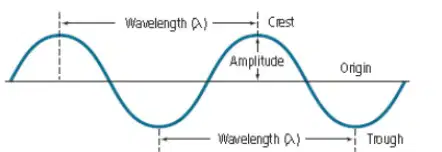
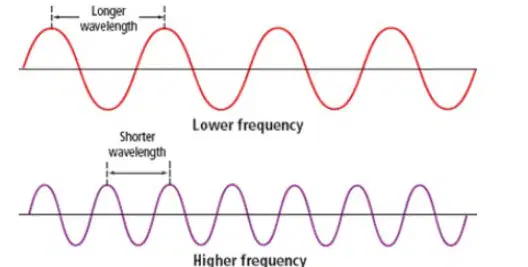
The wavelength of a wave is measured from
crest to crest
crest to trough
origin to crest
origin to trough
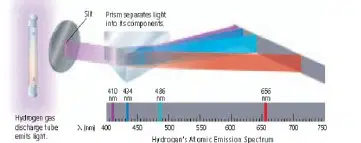
What is the energy of a single photon of light from hydrogen's 656 nm emission? Use h = 6.626 × 10⁻³⁴ Js and c = 3.00 × 10 8 m/s.
1.30 × 10⁻³¹ J
1.45 × 10-48 J
3.30 × 10 18 J
3.03 × 10⁻¹⁹ J
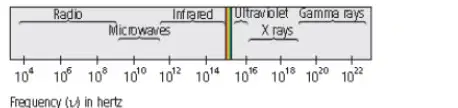
Which of the following electromagnetic waves has photons of the highest energy?
microwaves
infrared
x-rays
ultraviolet
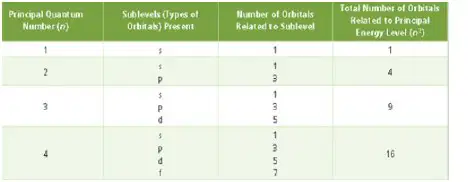
What is the maximum number of electrons that can be present in each principal energy level of hydrogen?
n
n^2
2n
2n^2
The concept that all moving particles have wave characteristics is attributed to _____________.
de Broglie
Thomson
Heisenberg
Bohr
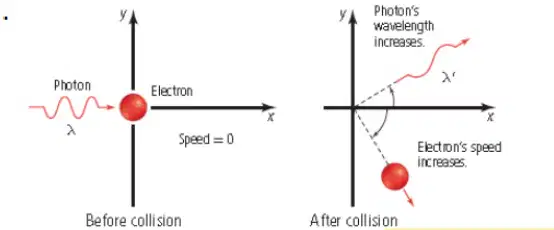
In the figure above, why must the photon's wavelength increase after the collision?
The photon changes direction.
The photon changes speed.
The photon gives up some energy to the electron.
The photon starts spinning.
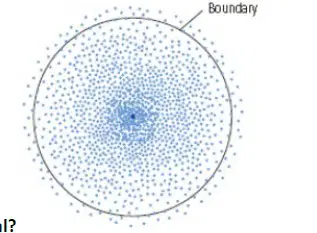
In the figure above, why are there dots beyond the 'boundary' of the atomic orbital?
the boundary encloses the volume in which the electron is found 90% of the time
the boundary is three-dimensional, while the picture shows only two dimensions
experimental error
the boundary encloses the volume in which the electron is found 50% of the time
What is an electron dot structure?
An element symbol surrounded by dots representing its valence electrons.
An element symbol with a positive charge.
An element symbol surrounded by its innermost electrons.
A filled noble gas in brackets plus the remaining electron configuration expressed by filled orbitals.
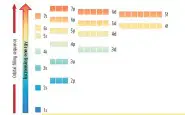
Why does the 4s orbital begin to fill before the 3d orbital?
The 4s orbital is lower than the 3d orbital in the aufbau diagram.
s orbitals always fill before d orbitals.
The 4s orbital is to the left of the 3d orbital in the diagram.
The 4s orbital has higher energy than the 3d orbital.

Which of the following statements expresses Hund's rule?
Electrons in orbitals must possess opposite spins.
Electrons with the same spin fill all orbitals.
Single electrons with the same spin must occupy each equal-energy orbital before additional electrons with opposite spins can occupy the same orbitals.
P orbitals may contain up to six electrons.
What is the frequency of yellow light, which has a wavelength of 5.56 x 10⁻⁷ m?
1.85 x 10 15 Hz
1.85 x 10 15 m/s
5.40 x 10 14 Hz
5.40 x 10 14 m/s
The part of the electromagnetic spectrum that humans can see is the ________.
visible spectrum
infrared spectrum
ultraviolet spectrum
a, b, and c
A wavelength of 500 nm is associated with the _______ portion of the electromagnetic spectrum.
visible
infrared
ultraviolet
microwave
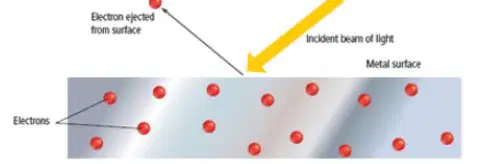
In the photoelectric effect, increasing the frequency of the light increases the ________ of the ejected electrons.
number
energy
size
wavelength

If a radio station were to increase its frequency from 94.5 MHz to 99.1 MHz, what would happen to the station's wavelength?
The wavelength would not change.
The wavelength would go up.
The wavelength would go down.
The wavelength would double.
The Heisenberg uncertainty principle states that ____________.
no two electrons in the same atom can have the same set of four quantum numbers
two atoms of the same element must have the same number of protons
it is impossible to simultaneously know the precise position and velocity of a particle
electrons of atoms in their ground states enter energetically equivalent sets of orbitals singly before they pair up in any orbital of the set
The ground state of hydrogen corresponds to the _________.
zeroeth energy level
first energy level
second energy level
highest energy level
Which of the following statements is true?
Each set of d orbitals contains seven orbitals.
Each set of d orbitals can hold a maximum of 14 electrons.
The first energy level contains only s and p orbitals.
All s orbitals are spherically shaped.
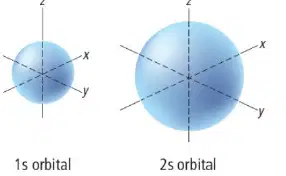
What is the primary difference between the 1s and the 2 s orbitals?
Shape
Size
number of electrons
number of neutrons
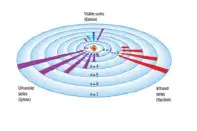
In the Bohr model of the hydrogen atom, which of the following transitions results in light you can see?
n = 6 to n = 1
n = 6 to n = 2
n = 6 to n = 3
n = 6 to n = 4
The principle that states each electron occupies the lowest energy orbital available is the ______________.
aufbau principle
uncertainty principle
exclusion principle
photoelectric principle
The valence orbitals in an atom are the ___________.
innermost orbitals
second energy level
d orbitals
outermost orbitals
How many valence electrons does a group 1A metal atom have?
1
2
3
4
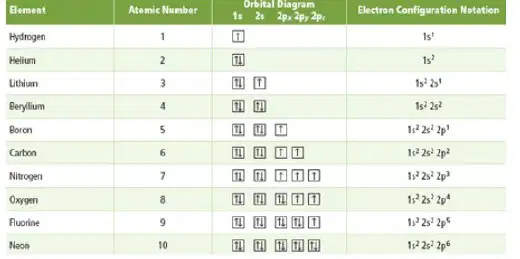
What would be the proper noble gas notation for oxygen?
[Ne]2s2 2p4
[Ne]2s2 2p1
[He]2s2 2p4
[He]2s2 2p1

Given the above electron dot structure, what further information is required to find the identity of element X?
the number of valence electrons
the period in which the element is found
the number of neutrons
the electric charge
Which of the following are poor conductors of heat and electricity?
metals
metalloids
nonmetals
alkaline earth elements
Which group on the periodic table is known as the alkaline earth metals?
group 1A
group 2A
group 8A
group 7A
Halogens are good disinfectants. Which of the following is a halogen?
N
O
Cl
Fe
Why was Mendeleev's periodic table widely accepted?
He organized the first 14 known elements.
He predicted the existence and properties of undiscovered elements.
He was the first to notice a pattern of similar properties among elements.
His periodic table listed all of the elements in the correct order.
Which group on the periodic table is known as the halogens?
group 1A
group 2A
group 8A
group 7A
Which of the following elements is a metalloid?
As
Na
W
F
Atoms that lose electrons to form positive ions are __________.
nonmetals
metalloids
metals
noble gases
Most of the elements in groups 16 through 18 are classified as:
alkali metals.
inner transition metals.
nonmetals.
alkaline earth metals.
Which scientist first arranged elements by atomic number?
Mendeleev
Lavoisier
Newlands
Mosely
Which category of elements have the property of being malleable and ductile?
gases
metalloids
metals
nonmetals
Which category of elements have the property of being malleable and ductile?
gases
metals
metalloids
nonmetals
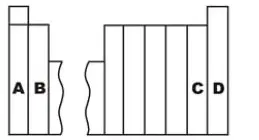
Which region contains the alkaline earth metal family of elements?
A
B
C
D
Which is the halogen that is in Period 5?
Bromine (Br)
Strontium (Sr)
Iodine (I)
Xenon (Xe)
According to _________________ periodic table, the physical and chemical properties of elements are periodic functions of their atomic weights.
Dmitri Mendeleev’s
John Newlands’
Henry Moseley’s
Lothar Meyer’s
Which category of elements is commonly used to make computer chips and solar cells due to their ability to conduct electricity only under certain conditions?
metals
metalloids
nonmetals
noble
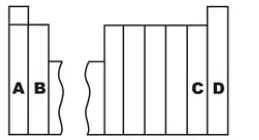
Which region contains the halogen family of elements?
A
B
C
D
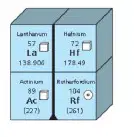
Why do atomic numbers jump by 15 from left to right in the section of the periodic table shown above?
The missing elements have not yet been discovered.
The missing elements are all radioactive.
The missing elements form the lathanide and actinide series, usually found below the periodic table.
The missing elements do not exist.

Looking only at the box below, what can you say for certain about the element immediately to the right of oxygen on the periodic table?
The element is gas.
The element's name will begin with the letter P.
The element's atomic weight will be 18.
The element will have atomic number 9.
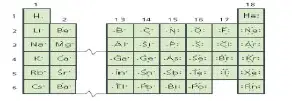
Why are both hydrogen (H) and cesium s-block elements, when hydrogen has one electron and cesium (Cs) has 55?
All blocks contain at least one element from each period.
The s-block includes only the most reactive elements.
Blocks of elements on the periodic table are based only on an element's valence electrons.
They have identical electron configurations.
Atoms of elements in group 1 have _________________________.
one electron in their outermost energy level
two electrons in their outermost energy level
seven electrons in their outermost energy level
eight electrons in their outermost energy level
Which of the blocks on the periodic table contains the most elements?
s block
p block
d block
f block
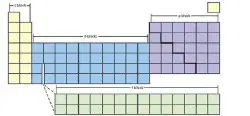
What makes the d block wider than either the s block or the p block?
The d sub-orbital can hold ten electrons, making the d block ten elements wide.
The elements in the d block are more important than the elements in the rest of the table.
The d block is the most researched area of the periodic table.
The elements in the d block are all metals.

From the table below, determine the atomic number of the noble gas at the end of period 5.
18
36
54
52
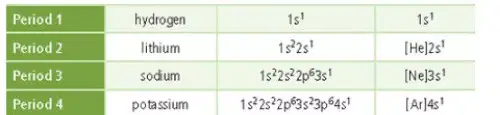
What characteristic do atoms in the same group of elements share?
They have the same atomic mass.
They have the same number of electron orbitals.
They have the same number of valence electrons.
They have similar physical properties.
Elements in the d block are also known as _______________.
alkali metals
alkaline earth metals
transition metals
lanthanide metals
Which of the following is the general valence electron configuration for the alkaline earth elements?
ns1
ns2
ns2np1
ns2np2
Elements in the same group have the same:
atomic radius.
nuclear charge.
energy level of outer electrons.
number of valence electrons.
Identify the period and group of the element that has the electron configuration [Ne]3s2 3p3.
period 2, group 2
period 3, group 1
period 3, group 13
period 3, group 15
Which of the following classifications describes the element with the electron configuration [Ar]4s2 3d10 4p5?
stable metal
stable nonmetal
unstable nonmetal
unstable metal
What is the electron configuration of the element in group 14 and period 4 of the periodic table?
[Ne]3s2 3p4
[Ar]4s2
[Ar]4s2 3d10 4p2
[Kr]5s2 4d2
Which of the following electron configurations represents the most chemically stable atom?
[He]2s2 2p3
[Ne]3s2 3p5
[Ne]3s2 3p6 4s2 3d5
[Ne]3s2 3p6
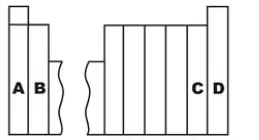
Which region contains elements with two valence electrons?
A
B
C
D
Which of the following elements is a metal?
Sulfur (S)
Nitrogen (N)
Magnesium (Mg)
Carbon (C)
Atoms with large ionization energy values are __________.
more likely to form positive ions
less likely to form positive ions
most likely to lose their outer electrons
lacking valence electrons
Which of the following elements is most likely to form a negatively charged ion?
I
Br
Cl
F
Which of the following is an ion?
O2-
HCl
C
lithium-3
Where would you expect to find the smallest atoms?
upper left
upper right
lower left
lower right
Which element has the lowest first ionization energy?
Li
Na
K
Cs
The ionic compound, sodium chloride, is formed from atoms of the elements sodium and chlorine. What happens to the size of each atom when it forms an ion?
Sodium increases in size and chlorine increases in size.
Sodium increases in size and chlorine decreases in size.
Sodium decreases in size and chlorine decreases in size.
Sodium decreases in size and chlorine increases in size.
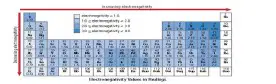
What group generally has the greatest electronegativity?
alkali metals
alkaline earth metals
noble gases
halogens
Atomic radii cannot be measured directly because the electron cloud surrounding the nucleus does not have a clearly defined:
charge.
mass.
outer edge.
probability.
The trend in the atomic radii as you move down the group 1 elements is partially due to:
decreased distance of outer electrons.
increased nuclear charge.
increased number of electrons in outer energy level.
shielding by inner electrons.
A(n) _________ is an atom, or bonded group of atoms, that has a positive or negative charge.
halogen
ion
isotope
molecule
An atom becomes negatively charged by:
gaining an electron
gaining a proton.
losing an electron.
losing a neutron.
How many electrons does an atom generally need in its outer level to be the most stable?
4
8
10
12
What is the trend in atomic radii as you move from left-to-right across a period.
generally, decreases
generally, increases
remains the same
varies randomly
In which of the following pair is the second particle listed larger than the first?
K , Ga
Pb , C
Br, Br−
Li, Li+

