wayground logo

Free Printable Worksheets

Font size

S
M
L
XL
Worksheets

Chemistry Midterm Review 2023

Total questions: 75

Worksheet time: 3hrs 49mins

Name
Class
Date
1.

When an atom loses an electron, it becomes a

a)

positive ion

b)

negative ion

c)

neutral ion

d)

neutral atom

2.

Why do all bonds form?

a)

so the number of protons equals the number of electrons

b)

so an atom can become unstable

c)

to fill the outermost energy level

3.
Ionic bonds are between...
a)
Metal and Non-metal
b)
Non-metal and Non-metal
c)
Metal and Metal
4.
How are ionic bonds formed?
a)
Transfer of electrons
b)
Sharing of electrons
5.
Ionization energy is the...
a)
energy needed to remove the outermost electron.
b)
ability of an atom to attract electrons from another atom.
6.
Electronegativity is the...
a)
energy needed to remove the outermost electron.
b)
ability of an atom to attract electrons from another atom.
7.

Which subatomic particle has a positive charge?

a)

proton

b)

neutron

c)

electron

8.

Which subatomic particle has a neutral or no charge?

a)

proton

b)

neutron

c)

electron

9.

Which subatomic particle has a negative charge?

a)

proton

b)

neutron

c)

electron

10.
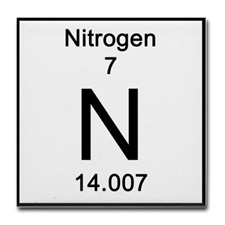
What is the number of protons that the element in this image contain?
a)
14
b)
7
c)
15
d)
18
11.
What is the atomic mass of "F"
a)
9
b)
18
c)
17
d)
19
12.

Which subatomic particles contribute the least to the mass of an atom?

a)

Neutrons

b)

Protons

c)

Electrons

13.
What is an isotope? 
a)
A charged atom
b)
An atom with different amounts of neutrons
c)
An atom with different amounts of protons
d)
A neutral atom
14.
Different isotopes have...
a)
different masses
b)
different atomic numbers
c)
different electrons
d)
different protons
15.
How many neutrons does a Sodium 24 isotope have?
a)
12
b)
13
c)
14
d)
15
16.
How many neutrons does a Flourine-14 isotope have?
a)
4
b)
5
c)
9
d)
14
17.
The majority of elements on the periodic table are
a)
man made.
b)
nonmetals.
c)
metals.
d)
gases.
18.

In the modern periodic table developed by Henry Moseley elements are arranged by:

a)
atomic mass
b)
atomic number
c)
valence electrons
d)
number of isotopes
19.
An atom has 10 protons, 15 neutrons and 10 electrons what is its mass number.
a)
20
b)
10
c)
5
d)
25
20.
Which two subatomic particles make up the nucleus of an atom?
a)
Protons and Electrons
b)
Neutrons and Electrons
c)
Electrons and Protons
d)
Protons and Neutrons
21.

Which particles have about the same mass?

a)

proton & neutron

b)

proton & electron

c)

neutron & electron

d)

neutron & positron

22.

What is an Isotope of an element?

a)

atoms of a particular element that have the same number of protons and neutrons, but different numbers of electrons

b)

atoms of a particular element that have the same number of atomic mass, but different atomic number

c)

atoms of a particular element that have the same number of protons, but different number of neutrons

d)

atoms of a particular element that have the same atomic mass and the same atomic number

23.

What is an Ion?

a)

An atom that has a net positive charge

b)

An atom or molecule that has a net positive or negative charge

c)

An atom that has a net negative charge

d)

An atom that has a net positive or negative charge

24.

What is an Anion?

a)

a positively charged ion

b)

an ion that has no charge

c)

a negatively charged ion

d)

an ion that has a double charge

25.

Nickel-59 has how many neutrons?

a)

30

b)

31

c)

32

d)

33

26.

76 protons and 114 neutrons

a)

Osmium-114

b)

Osmium-76

c)

Osmium-190

d)

Osmium-190.23

27.

Rubidium has two common isotopes, 85Rb and 87Rb. If the abundance of 85Rb is 72.2% and the abundance of 87Rb is 27.8%, what is the average atomic mass of rubidium?

a)

85.468 amu

b)

37 amu

c)

85.6 amu

d)

86.4 amu

28.

How do you calculate mass number for an atom?

a)

Mass x percent

b)

Protons + Electrons

c)

Protons + Neutrons

d)

Neutrons + Protons + Electrons

29.

What electron configuration matches an oxygen atom?

a)

1s22s22p63s2, 3p64s23d104p5

b)

1s22s22p4

c)

1s22s22p6

d)

1s22s22p63s23p64s23d1

30.

Identify the Electron Configuration for Aluminum (Al)

a)

1s2 2s2 2p6 3s2 3p1

b)

1s2 2s2 2p6 3s2 3p3

c)

1s2 2s2 2p6 3s2 4p1

31.

Valence electrons are located...

a)

inside the nucleus

b)

in outer space

c)

on the outermost orbit of an atom

32.
a)

10

b)

2

c)

8

d)

18

33.
a)

14

b)

4

c)

3

d)

28

34.

The elements in this group all have 5 valance electrons.

a)

Group 5

b)

Group 15

c)

Group 3

d)

Group 18

35.

Which of the following element is an example of Halogen

a)

Sodium

b)

Magnesium

c)

Fluorine

d)

Carbon

36.

Highly reactive first family of the periodic table...

a)

Alkali metal

b)

Noble gases

c)

Rare earth metals

d)

Neon

37.

Which family(group) of metals have two electrons in the outer most energy level?

a)

Lanthanides

b)

Halogens

c)

Oxygen family

d)

Alkaline earth metals

38.

Which of the following element is a liquid at room temperature?

a)

Carbon

b)

Mercury

c)

Fluorine

d)

Antimony

39.

The horizontal rows in a periodic table are known as

a)

Groups

b)

Columns

c)

No name

d)

Periods

40.

The vertical columns in the periodic table are known as

a)

Groups

b)

Elements

c)

No name

d)

Periods

41.

NaCl is a compound formed between

a)

Alkaline earth metal /Halogen

b)

Alkali metal/Halogen

c)

Halogen/Alkaline earth metal

d)

None of the above

42.
As you move down a group, atomic radius increases because - 
a)
you add more and more neutrons
b)
you add more and more protons
c)
you add more and more shells (energy levels)
d)
you add more atomic mass
43.
The atom with the largest atomic radius in Group 18 is - 
a)
Ar
b)
He
c)
Kr
d)
Rn
44.
As you move across the periodic table from left to right, the atomic radius decreases.  This is because - 
a)
the number of protons increases, so attraction to electrons increases
b)
the number of energy levels increases
c)
the number of electrons increases
d)
the atomic mass increases
45.
Electronegativity is...
a)
the ability of an atom to attract/ accept electrons
b)
the ability of an atom to lose electrons
c)
the energy required to remove an electron from a specific atom
d)
how easy it is to make friends. 
46.
Which has the greater Electronegativity: 
N or C?
a)
C
b)
N
47.
Electronegativity __________ from left to right within a period and __________ from top to bottom within a group.
a)
decreases, increases 
b)
increases, increases
c)
increases, decreases 
d)
stays the same, increases
48.
[Ne]3s23p1 is the noble gas configuration for which element?
a)
scandium
b)
boron
c)
nitrogen
d)
aluminum
49.
What is the noble gas configuration for Neon?
a)
[Ne]
b)
[He]2s22p6
c)
[F]2p1
d)
[Ne]2s21p6
50.

Which of the following is not a correct designation for a sublevel?

a)

zz

b)

p

c)

d

d)

f

51.
There are 4 different types of subshells (orbitals) s,p,d,f.
a)
true
b)
false
52.

Each orbital can hold how many electrons?

a)

5

b)

4

c)

8

d)

2

53.
Where are electrons of an atom found?
a)
Nucleus
b)
Electron Cloud
c)
Some are in the nucleus and some in the electron cloud.
d)
They are moving everywhere.
54.

Which of the following is a positively charged particle found in the nucleus of an atom?

a)

Electron

b)

Proton

c)

Neutron

d)

Quark

55.

Which particle carries no charge?

a)

Neutrons

b)

Electrons

c)

Protons

56.
All orbitals of equal energy are occupied by one electron before any single orbital is occupied by a second electron.
a)
Aufbau principle
b)
Pauli exclusion principle
c)
Hund’s rule
d)
Core Notation
57.
Which guideline, Hund’s rule or the Pauli exclusion principle, is violated in the following orbital diagrams?
a)
Hund's
b)
Aufbau's
c)
Pauli's Exclusive
58.
Which guideline, Hund’s rule or the Pauli exclusion principle, is violated in the following orbital diagrams?
a)
Aufbau's
b)
Hund's
c)
Pauli exclusive
59.
Electrons occupy orbitals of lowest energy first is part of what electron configuration rule?
a)
Hund’s Rule
b)
Aufbau Principle
c)
Pauli Exclusion Principle
60.

Which of these atoms is the most electronegative?

a)

Bromine

b)

Fluorine

c)

Hydrogen

d)

Potassium

61.
The desire for an element to have 8 atoms around it is called 
a)
Octet Rule
b)
Resonance
c)
Ionization energy
d)
Electronegativity
62.

Ionic bonds are formed by transferring an electron from a ​​ (a)   to a ​ nonmetal.

Choose from the below words
metal
metalloid
nonmetal
63.

The Kinetic Molecular Theory states that:

a)

Particles within liquids and gases are moving, but they are not moving within solids.

b)

Particles within gases are moving, but they are not moving in solids and liquids.

c)

All matter is made of moving particles.

64.

Which state of matter has particles with the lowest average kinetic energy?

a)

Solid

b)

Liquid

c)

Gas

65.

Absolute Zero is defined as:

a)

The lowest temperature which can be achieved by scientists.

b)

The lowest temperature which can be recorded on a thermometer.

c)

The theoretical temperature at which all particles stop moving.

d)

The temperature of a cold block of copper.

66.

At Point A, the beginning of observations, the substance exists in a solid state. Material in this phase has a ____________ volume and ___________ shape.

(a)  

67.

Is the substance gaining or losing energy? (Diagram D)

a)

Gaining

b)

Losing

68.
What happens to particles when they are heated?
a)
They speed up and spread out
b)
They slow down and compress
c)
They stop moving
d)
They move closer together and speed up
69.

A substance's heating curve is shown in the graph. What is its melting point?

a)

100 C

b)

60 C

c)

80 C

d)

-60 C

70.
True or false: melting and freezing occur at the same temperature!
a)
True
b)
False
c)
I don't know
71.
What line segment represents only the solid state?
a)
A-B
b)
B-C
c)
C-D
d)
D-E
72.
Which phase change increases the molecule's freedom of movement?
a)
Melting
b)
Freezing
c)
Condensing
73.

What is the name of the polyatomic ion NO3-1?

a)

nitrite

b)

nitrogen oxide

c)

nitrate

d)

nitrogen

74.

What is the charge of the hydroxide ion?

a)

+1

b)

0

c)

+2

d)

-1

75.

What is the formula for the ammonium ion?

a)

HCO3-1

b)

Am4+1

c)

NO3-1

d)

NH4+1