Wayground logo

Free Printable Worksheets

Font size

S
M
L
XL
Worksheets

Basic Electricity and DC Circuits

Total questions: 40

Worksheet time: 24mins

Name
Class
Date
1.

_____ is an electric device which easily closes or opens an electric circuit.

a)

Filament

b)

Electric bulb

c)

Electric switch

d)

Electric cell

2.
What is a circuit?
a)
an outlet or switch
b)
a path which an electric current flows
c)
a poor conductor
3.
What is an electric current? 
a)
the flow of electricity 
b)
electricity moving in only one direction
c)
a switch that gives power
4.
A light bulb will shine brighter when
a)
An extra light bulb is added to the circuit
b)
An additional battery is added
c)
A smaller battery is used
d)
The switch is open in the circuit
5.
what is this symbol for?
a)
light bulb
b)
switch
c)
battery
d)
resistor
6.
this is the symbol for a _____?
a)
switch
b)
light 
c)
battery
d)
wires
7.
A student is building a circuit that will convert electrical energy into light energy. What materials does the student need to complete his circuit?
a)
Wire, battery, and bulb
b)
Battery, switch, and wire
c)
Switch, bulb, and battery
d)
Bulb, wire, and switch
8.
The picture shows an electrical circuit. This circuit is a series circuit because: 
a)
It has 3 light bulbs.
b)
The same current flows through all three light bulbs.
c)
It uses a single battery.
d)
The electrical current has more than one path to flow through
9.
A correct statement of Ohm’s Law is:
a)
I= V R
b)
V ∝ I
c)
V = IR
d)
both b and c
10.
As the resistance of a circuit increases, the current will...
a)
increase
b)
decrease
c)
stay the same
11.
What is the Voltage of a circuit that has a resistance of 5 Ω and a current of 2 A?
a)
25 V
b)
10 V
c)
2.5 V
d)
0.4 V
12.
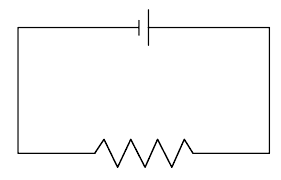
This circuit has a 24 volt battery and the resistor is 8 ohms. How many amps are running through the circuit?
a)
3 Amps
b)
192 Amps
c)
2 Amps
d)
4 Amps
13.

In which of the following circuits will all of the remaining light bulbs go out if bulb 3 burns out?

a)
b)
c)
d)
14.

The flow of charge is known as ___.

a)

static

b)

current

c)

resistance

d)

voltage

15.

A measure of electrical potential energy is known as ___.

a)

watts

b)

amps

c)

volts

d)

ohms

16.

According to Ohm's law, greater voltage results in ___ current.

a)

lower

b)

no

c)

greater

d)

negative

17.

A ___ circuit has more than one path for current.

a)

series

b)

parallel

c)

perpendicular

d)

dual

18.

What does the electronic schematic symbol shown represent?

a)

an AC current source

b)

a DC current source

c)

an ammeter

d)

a voltmeter

19.

What does the electronic schematic symbol shown represent?

a)

an AC current source

b)

a DC current source

c)

an ammeter

d)

a voltmeter

20.

What does the electronic schematic symbol shown represent?

a)

Wire

b)

Resistor

c)

Battery

d)

Switch

21.

What is the total resistance in the circuit?

a)

10 ohms

b)

6 ohms

c)

4 ohms

d)

2.4 ohms

22.

What is the total current through the battery?

a)

0.75 A

b)

1.5 A

c)

3 A

d)

0.33 A

23.

What is the current through the 2 ohm resistor?

a)

0.75 A

b)

1.5 A

c)

3 A

d)

0.33 A

24.

What is the current through the 4 ohm resistor?

a)

1.5 A

b)

3 A

c)

2 A

d)

0.75 A

25.

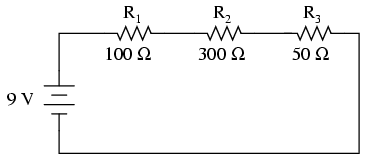
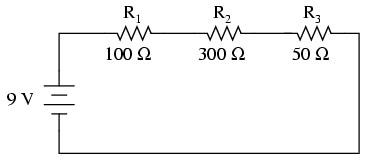
The total resistance in this circuit is

a)

100 ohms

b)

450 ohms

c)

400 ohms

d)

30 ohms

26.
The total current through this circuit is
a)
0.02 amps
b)
0.09 amps
c)
50 amps
d)
9 amps
27.
The voltage dropped across the 300 ohm resistor is 
a)
6 V
b)
9 V
c)
2 V
d)
30 V
28.
In a parallel circuit which of the following is the same value throughout the circuit?
a)
Voltage
b)
Current
c)
Resistance
d)
Charge
29.
What is a benefit of using a parallel circuit?  
a)
It gets confusing.
b)
There are no problems.
c)
If one light goes out, it does not affect the others. 
d)
If one light goes out, they all go out. 
30.

The following are advantages of a series circuit EXCEPT:

a)

Series circuits do not overheat easily.

b)

Easy to install and easy to repair and maintain

c)

All loads in a series circuit have the same current.

d)

If one load fails, all loads in the circuit will not function.

31.

The following are disadvantages of a series circuit EXCEPT:

a)

It is difficult to control the load individually.

b)

It is easy to install, repair and maintain the circuit.

c)

It is difficult to identify the damaged light bulb in the circuit.

d)

Since voltage is not equal for every load, not all loads will have the same brightness.

32.

The following are advantages of a parallel circuit EXCEPT:

a)

Loads are easy to control.

b)

If one load fails, other loads can still function.

c)

Large volume of conducting wires will be needed.

d)

Every load connected in parallel circuit gets an equal amount of voltage.

33.

The circuit does not overheat easily. It is a/an...

a)

advantage of series circuit.

b)

advantage of parallel circuit.

c)

disadvantage of series circuit.

d)

disadvantage of parallel circuit.

34.

It is easy to control the load individually. It is a/an...

a)

advantage of series circuit.

b)

advantage of parallel circuit.

c)

disadvantage of series circuit.

d)

disadvantage of parallel circuit.

35.

Adding more loads may cause overloading in the circuit. It is a/an...

a)

advantage of series circuit.

b)

advantage of parallel circuit.

c)

disadvantage of series circuit.

d)

disadvantage of parallel circuit.

36.

If one bulb is damaged in the circuit, other bulbs will still function. It is a/an...

a)

advantage of series circuit.

b)

advantage of parallel circuit.

c)

disadvantage of series circuit.

d)

disadvantage of parallel circuit.

37.

The no of electrons present in 1C :

a)

0.625X 10¹⁸

b)

6.25 X 10¹⁸

c)

62.5 X 10¹⁸

d)

625 x 1018

38.
The power of an appliance is...
a)
the amount of voltage going through it 
b)
the amount of energy transferred per second
c)
the amount of charge that passes through per second
39.
Calculate the electric power of an electrical appliance in which 10 A of current is flowing through a resistor of 2 ohms.
 
Remember: V=IR and P=VI
a)
80 W
b)
200 W
c)
2.5 A
d)
22.5 KJ
40.
The voltage supplied to a circuit is 17 V and the current running through is 10 A. What is the power generated?
a)
170 W
b)
170 A
c)
1.7 V
d)
1.7 W