Wayground logo

Free Printable Worksheets

Font size

S
M
L
XL
Worksheets

DNA, Cell Reproduction, RNA, Protein Synthesis Review

Total questions: 54

Worksheet time: 5hrs 30mins

Name
Class
Date
1.

What is the monomer for Nucleic Acids?

a)

Amino Acids

b)

Monosaccharides

c)

Nucleotides

d)

Fatty Acids

2.
DNA and RNA are examples of 
a)
Carbohydrates
b)
Lipids
c)
Proteins
d)
Nucleic Acids
3.
Genetic information is stored within
a)
Proteins
b)
Lipids
c)
Nucleic Acids
d)
Carbohydrates
4.
The sequence of mRNA is AGUACA. Which of these is the sequence of tRNA?
a)
UCAUGU
b)
AGTACA
c)
AGUACA
d)
TCATGT 
5.
Which of the following identifies the processes correctly?
a)
X;Translation; Y:Replication; Z:Transcription 
b)
X:Replication; Y:Transcription; Z:Translation
c)
X:Transcription; Y:Replication; Z:Mutation
d)
X:Replication; Y:Mutation; Z:Translation
6.
Which is the mRNA molecule that would be transcribed from this DNA template:
TGGCAAGTACGT
a)
ACCGTTCATGCA
b)
UGGCAAGUACGU
c)
UCCGUUCUUGCU
d)
ACCGUUCAUGCA
7.
What is the correct amino acid for the following codon:
 AUG 
a)
Val
b)
Met
c)
Tyr
d)
Gly
8.
The sequence of DNA below is part of a gene. How many amino acids are coded for by this segment?
a)
4
b)
8
c)
12
d)
20
9.
One difference between DNA and RNA is that....
a)
Only RNA has the base Uracil
b)
only RNA contains the base Thymine
c)
only RNA contains the base Cytocine
d)
only RNA contained the base Guanine
10.
What is the relationship between a protein, the cell, and DNA?
a)
DNA is produced by protein which is produced in the cell
b)
Protein is composed of DNA which is produced in the cell
c)
DNA makes RNA which produces protein in the cell
d)
A cell is composed of DNA and protein
11.
What process is taking place?
a)
Transcription
b)
Translation
c)
Replication 
d)
Transfering
12.
What are the 4 nitrogen bases of RNA?
a)
adenine, thymine, cytoplasm, and guanine
b)
adenine, thymine cytosine, and guanine
c)
adenine, uracil, cytosine, and guanine
d)
adenine, thymine, cytosine, and glucose
13.

What are DNA and RNA nucleotides made of?

a)

Sugar, Phosphate, and Nitrogenous Base

b)

Phosphate, Adenine, and Nitrogenous Base

c)

Sugar and Phosphate

d)

Phosphate and Nitrogenous Base

14.

Which of the following statements is correct?

a)

DNA and RNA must stay inside the cell nucleus.

b)

DNA stays in the cell nucleus and RNA can leave the nucleus.

c)

RNA stays in the cell nucleus and DNA can leave the nucleus.

d)

DNA and RNA can go into and out of the cell nucleus.

15.

What process synthesizes mRNA from DNA?

a)

Translation

b)

Transcription

c)

DNA Replication

16.

What process goes from mRNA to a protein?

a)

Transcription

b)

rRNA

c)

DNA Replication

d)

Translation

17.

What mRNA sequence is made from the following DNA sequence?

GTAGTCA

a)

UATUAGA

b)

ACGACTG

c)

CAUCAGU

d)

CATCAGT

18.

What is the main function of a tRNA molecule?

a)

It carries the instructions to make proteins

b)

It forms part of the ribosomes

c)

It strings together complementary RNA and DNA strands

d)

It brings amino acids from the cytoplasm to the ribosomes
19.

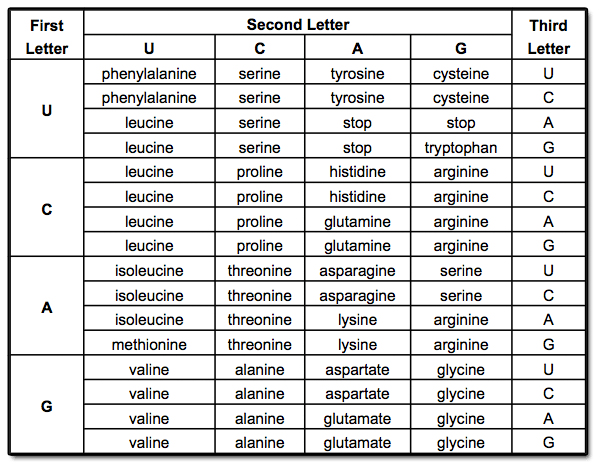
What amino acid is represented by the codon UUA?

a)

Phenylalanine

b)

Tyrosine

c)

Leucine

d)

Stop codon

20.

What process is going on in this photo?

a)

Transcription

b)

Translation

c)

DNA Replication

d)

All the above

21.

Where in the cell does translation occur?

a)

Nucleus

b)

Mitochondria

c)

Ribosome

d)

Chloroplast

22.

What is the three-nucleotide sequence on mRNA that codes for a single amino acid?

a)

Anticodon

b)

Codon

c)

Protein

23.
Does the order of amino acids in a protein matter?
a)
YES!
b)
NO!
24.

What is the correct amino acid sequence for the mRNA code?

AUG CCA GUA

a)

Met-Pro-Ala

b)

Met-Pro-Val

c)

Tyr-Gly-His

d)

Tyr-Gly-Arg

25.

How many amino acids are coded for by this sequence of nucleotides?

ATG GGA ACT CCA

a)

4

b)

2

c)

6

d)

12

26.
Where do mutations occur?
a)
DNA and RNA
b)
DNA 
c)
RNA
d)
mRNA and tRNA
27.

A mutation can occur if a base pair is ____________, deleted, or substituted for another.

a)

modified

b)

added

c)

transferred

28.

A mutation in which only one nucleotide is altered is called a:

a)

Frameshift Mutation

b)

Deletion Mutation

c)

Point Mutation

d)

Insertion Mutation

29.

Another name for a point mutation is:

a)

Substitution

b)

Frameshift

c)

Insertion

d)

Deletion

30.

ATTTGAGCC- Original

ATTGAGCC - Mutated

The example above is an example of a

a)

Insertion

b)

Point mutation

c)

Deletion

d)

Substitution

31.
What mutation has occurred here? 
T-G-A-C-C-A
T-G-A-G-C-A
a)
Substitution
b)
Deletion
c)
Insertion
d)
Frameshift 
32.
Which of the following would result in a frameshift mutation?
a)
Insertions only
b)
Substitution only
c)
Deletion only
d)
Insertions and Deletions
33.
DNA molecule segment is : TTACGCAAG
The mutated DNA segment is TTCGCAAG. This is an example of ___ mutation.
a)
Substitution
b)
Deletion
c)
Insertion
d)
Inversion
34.

A mutation is defined as:

a)

A change in the cell's structure

b)

Anything that changes in an embryo

c)

Any change in the physical features of a human

d)

A change in the DNA sequence

35.
ATTTGAGCC- Original
ATTGAGCC - Mutated
The example above is an example of a 
a)
Insertion- Frameshift
b)
Deletion- Substitution
c)
Deletion -Frameshift
d)
All of the above
36.
What mutation has occurred here? 
T-G-A-C-C-A
T-G-A-G-C-A
a)
Substitution
b)
Deletion
c)
Insertion
d)
Frameshift 
37.
Why are insertion and deletion (frameshift) mutations so harmful?
a)
They change all of the codons from the mutation on down the line, which changes the amino acid sequence
b)
They insert things that an organism doesn't need.
c)
They often delete things that organisms need.
d)
Insertion and deletions are not any more harmful than substitution mutations.
38.
Identify the DELETION mutation form the following: 
ATG CCA AAT
a)
ATG TCA AAT
b)
ATG CCT AAA T
c)
ATC CA  AT
d)
ATG CCA AAT
39.
Identify the SUBSTITUTION mutation form the following: 
ATG CCA AAT
a)
ATG TCA AAT
b)
ATG CCT AAA T
c)
ATC CA  AT
d)
ATG CCA AAT
40.

What type of mutation is shown in the diagram?

a)

Point mutation - missense

b)

Frameshift Mutation - deletion

c)

Frameshift Mutation - addition

d)

Point mutation - nonsense

41.
Mitosis is a type of ________________ reproduction.
a)
Sexual
b)
Asexual
42.
How many daughter cells are produced in mitosis?
a)
1
b)
2
c)
4
d)
6
43.
Fruit fly body cells have 8 chromosomes. After mitosis, you would expect a resulting fruit fly daughter cell to have ...
a)
16 chromosomes.
b)
46 chromosomes.
c)
8 chromosomes.
d)
4 chromosomes.
44.
Replication is when __________.
a)
the cell makes a copy of its DNA in nucleus 
b)
the cell forms 2 identical cells
c)
the cell produces 2 sets of organelles
d)
the cell continues to complete the same function
45.

Mitosis makes sure that all daughter cells are _____.

a)

genetically identical, diploid

b)

genetically identical, haploid

c)

genetically diverse, diploid

d)

genetically diverse, haploid

46.
In binary fission how does the DNA of the daughter cells compare to the DNA of the parent cell? 
a)
It is only half of the amount of DNA found in the parent.
b)
It is identical.
c)
It is a mix of the parent's DNA.
d)
It has some similarities and some differences.
47.

This picture shows which process?

a)

mitosis

b)

meiosis

48.

A cell that has a full set of chromosomes is called a______ cell.

a)

haploid

b)

diploid

c)

triploid

d)

hetrolpoid

49.

What are the three parts of a nucleotide?

a)

nucleic acid base

b)

nitrogen base

c)

deoxyribose

d)

sugar

e)

phosphate

50.

Which of the following correctly pairs the bases for DNA?

a)

A-C and G-T

b)

A-G and T-C

c)

A-T and C-G

d)

A-A and T-C

51.

What is genetic continuity?

a)

The genetic information of the parent cell and daughter cells are different

b)

The genetic information of the parent cell and daughter cells are identical

c)

The genetic information of the parent cell and daughter cells are a mixture

d)

The genetic information of the parent cell and daughter cells are similar

52.

What must occur before any cell division?

a)

DNA splitting

b)

DNA exchaning

c)

DNA replication

d)

DNA transcription

53.

What is the difference between mitosis and binary fission?

a)

mitosis occurs in cells with a nucleus while binary fission occurs in cells with no nucleus

b)

mitosis occurs in cells with no nucleus while binary fission occurs in cells with a nucleus

c)

both mitosis and binary fission occur in cells with a nucleus

d)

both mitosis and binary fission occur in cells with no nucleus

54.

What is the complementary strand for this strand of DNA?


TAG ACG GGC

a)

ATC TGC CCG

b)

CCG ATC ATC

c)

TGC CCG ATC

d)

TAC CCG TGC