wayground logo

Free Printable Worksheets

NEW

Font size

S
M
L
XL
Worksheets

Unit 4 Chemical Reactions and Equations

Total questions: 31

Worksheet time: 33mins

Name
Class
Date
1.
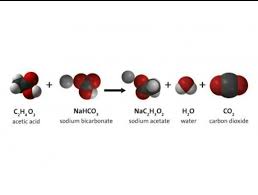
Which is the name of the kind of solid substance formed in this figure?  
a)
aqueous 
b)
precipitate
c)
acid
d)
synthesis 
2.
Provides evidence that a chemical reaction has occurred. 
a)
dissolving 
b)
melting
c)
formation of a gas
d)
bending
3.

How many Carbons are present on the reactant side?

a)

1

b)

2

c)

3

d)

4

4.

Is this chemical equation balanced? Why or why not? Choose the BEST answer.

a)

Yes, the amount of atoms for each element are equal on both the reactant and product side.

b)

No, the carbons are not the same number on both the reactant and product side.

c)

No, neither the carbons or hydrogens are the same amount on both the reactant and product side.

d)

No, none of the elements (carbon, hydrogen, or oxygen) are the same amount on both the reactant and product side.

5.
The left side of the equation below is called
a)
Products
b)
Reactants
6.
The right side of the equation below is called the
a)
products
b)
reactants
7.
In a chemical reaction
a)
The atoms of the reactants always stay together to form the products
b)
The atoms of the reactants unbond, rearrange, and then rebond to form the products
c)
New atoms are formed which combine to make the products
d)
Some atoms disappear while others multiply to form the products
8.
Which of the following is a chemical change rather than a physical change 
a)
boiling water at 100 C
b)
chopping up a piece of wood. 
c)
cooking a cake 
d)
ice carbon dioxide sublimating to gas 
9.
What does the Law of Conservation of Mass state?
a)
Matter cannot be gained or lost in a chemical reaction.
b)
Matter can only be lost in a chemical reaction.
c)
Matter can only be gained in a chemical reaction.
d)
Matter can be gained and lost in a chemical reaction. 
10.

A silver ring reacts with compounds containing sulfur in the air to form silver sulfide, a black substance that makes up the tarnish on the surface of silver objects. To remove the tarnish from the ring, students placed it in a pan lined with aluminum foil and added hot water. Baking soda was added to the hot water and stirred. Students made observations about the process.

Which observation of this process provides evidence of a chemical reaction?

a)

Hot water heated the aluminum foil.

b)

The liquid solution changed color.

c)

The pan was lined with aluminum foil.

d)

The hot water cooled.

11.
Which of the following is a chemical reaction?
a)
Water freezes.
b)
Sugar dissolves in water.
c)
Salt and pepper are mixed in a dish.
d)
Iron rusts.
12.
When two substances were combined, bubbles were produced and the temperature dropped.  This most likely means that:
a)
a chemical reaction took place
b)
the two substances had low boiling points
c)
one substance dissolved in the other
d)
the two substances are non-reactive
13.
Before a chemical reaction, the total mass of two reactants is measured to be 40 grams.  After the reaction, what should be the total mass of the products?
a)
0 grams
b)
20 grams
c)
40 grams
d)
80 grams
14.
Which observation would most likely indicate that an exothermic reaction has occurred?
a)
a color change
b)
the production of gas bubbles
c)
an increase in temperature
d)
a decrease in temperature
15.
All of the following are indicators of a chemical reaction except one.  Which one is NOT an indicator that a chemical reaction has taken place?
a)
he production of heat or light
b)
a color change
c)
the production of gas bubbles
d)
the dissolving of one substance in another
16.
A balanced chemical equation is one in which:
a)
the number of atoms of each element is the same in both the reactants and the products.
b)
the same compounds are present in both the reactants and the products.
c)
the reactants and the products have equal densities.
d)
 the reactants and the products have equal volumes.
17.
Which observation would most likely indicate that an endothermic reaction has occurred?
a)
a color change
b)
the production of gas bubbles
c)
an increase in temperature
d)
 a decrease in temperature
18.
Suppose the mass of two reactants totals 10 grams.  After the chemical reaction, what should be the total mass of the products?
a)
0 grams
b)
5 grams
c)
10 grams
d)
20 grams
19.

Sodium bicarbonate is a __________________.

a)

Reactant

b)

Product

20.

Color change, formation of a precipitate, formation of a gas, odor change and temperature change are all signs of a ...

a)

Physical Change

b)

Chemical Change

21.

What is a compound?

a)

2 atoms

b)

2 or more different element combined

c)

2 different element combined

d)

2 atoms combined

22.

Differences between chemical change and physical change?

a)

Chemical change is new substance

b)

Physical same substance

c)

All above

23.
How many O's are in Al₂(SO₄)₃
a)
4
b)
12
c)
7
d)
24
24.
Number of H in 3(NH₄)₂CrO₄
a)
4
b)
2
c)
8
d)
24
25.
How many atoms are there TOTAL in:
H2SO4
a)
6
b)
5
c)
7
d)
3
26.
How many elements are in C6H12O6?
a)
1
b)
2
c)
3
d)
4
27.

How many different elements are present in H2COCH2

a)

5

b)

4

c)

3

d)

2

28.

4CF2Cl2

a)

C = 4, F = 4, Cl = 2

b)

C = 1, F = 8, Cl = 8

c)

C = 4, F = 8, Cl = 8

d)

C = 1, F = 4, Cl = 8

29.

C3H5(NO3)3

a)

C = 3, H = 5, N = 3, O = 9

b)

C = 3, H = 5, N = 1, O = 9

c)

C = 9, H = 15, N = 3, O = 9

d)

C = 9, H = 15, N = 1, O = 3

30.

How many atoms are present if there is no subscript following the element symbol?

a)

0

b)

2

c)

only 1

d)

1 million

31.

How many elements are present in this compound? (Careful!)

Mg2As3COHNi2

a)

2

b)

4

c)

6

d)

10