
 Worksheets
PRA PSPM 1 DP014
Total questions: 40
Worksheet time: 40mins
Select the list which contains only SI basic units.
liter, meter, second, watt
joule, kelvin, kilogram, watt
candela, kelvin, meter, second
joule, newton, second, watt
The metric prefix for one one-thousandth is
mili
centi
kilo
mega
A quantity that can be measured is a
base quantity
physical quantity
derived quantity
scalar quantity
Physical quantities that cannot be derived from other physical quantities are
base quantity
derived quantity
physical quantity
scalar quantity

Describe this graph
constant acceleration
constant deceleration
object move to the left
constant velocity

Which graph(s) represents a constant velocity?
a and c
b and c
c
a and b


Describe this graph
object move to left
constant acceleration
increasing displacement
zero acceleration
Describe this graph
constant acceleration
constant deceleration
object move to the left
constant velocity
A 5 N force is applied to a 3 kg ball to change its velocity from +9 m/s to +3 m/s. The impulse on the ball is ______ N s.
-2.5
-10
-18
-45
A force is ____.
a push or pull that can cause movement
a magnet
when someone does not work
In which scenario is work = 0 J ?
Pushing a stationary wall
Pulling a trolley car
Pushing a book across the table
Dropping a set of keys from a height, h.
The coefficient of kinetic friction between a large box and the floor is 0.21. A person pushes horizontally on the box with a force of 165 N for a distance of 2.8 m. If the mass of the box is 72 kg, what is the total work done on the box? (Round your answer to a whole number)
51
49
47
45
An object weighing 20 N moves horizontally toward the right a distance of 5.0 m. What is the work done on the object by the force of gravity?
The work done on the object by the force of gravity is 50 J.
The work done on the object by the force of gravity is zero joules.
The work done on the object by the force of gravity is 4.0 J.
The work done on the object by the force of gravity is 0.25 J.
The work done on the object by the force of gravity is 100 J.

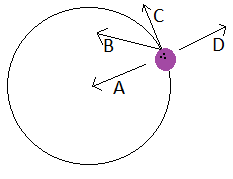
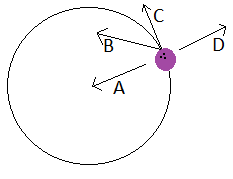
Centripetal force is an acceleration of an object moving in circular path whose direction is _________________________of the circular path and whose magnitude is equal to the square of the speed divided by the radius.
towards the tangent
towards the centre
towards the minimum point
towards the maximum point
In uniform circular motion, the magnitude of the _______________________of an object is constant but the __________ is continually changing.
speed, acceleration
speed, direction
acceleration, speed
acceleration, velocity
________________________ defined as the number of revolutions (cycles/rotations) completed in one second.
frequency
period
distance
centripetal acceleration
A body with a definite shape that doesn't change is:
period
angular acceleration
rigid body
radius of gyration
The number of complete revolutions per second is:
frequency
period
torque
rotational inertia
A line on which the centers of circles lie is:
lever arm
angular momentum
period
axis of rotation
The angle through which a point, line, or body is rotated in a specific direction and around a specific axis •
angular velocity
angular displacement
radian
degree
A change in angular velocity divided by the time required to make this change is:
torque
velocity
angular velocity
angular acceleration

During process A, from state 1 to state 2, the temperature of the ideal gas
stays the same
increases
decreases
is half as much
During an adiabatic process, a sample of gas does 400 J of work on the environment. What change occurs with the internal energy of the gas?
The internal energy increases by 400 J.
The internal energy doesn't change.
The internal energy decreases by 400 J.
There is not enough information if we don't know how much heat was added or removed.

Process B on the PV diagram is an ______________ process.
adiabatic
isobaric
isochoric
isothermal
What is heat?
the amount of thermal energy in an object
an object's internal kinetic energy
the transfer of thermal energy from one object to another
the amount of energy needed to raise the temp of an object

