wayground logo

Free Printable Worksheets

NEW

Font size

S
M
L
XL
Worksheets

Honors Unit 4 Review

Total questions: 46

Worksheet time: 46mins

Name
Class
Date
1.
What particles make up light?
a)
Photons
b)
Neutrons
c)
Protons
2.
Light behaves like both a particle and a ______.
a)
Mass
b)
Wave
c)
Current
3.
What color has the shortest wavelength, or the highest frequency?
a)
yellow
b)
blue
c)
red
d)
violet
4.
The full spectrum of light energy is called the__________
a)
broad spectrum
b)
electromagnetic spectrum
c)
helium spectrum 
d)
natural light spectrum
5.
Which wavelength of visible light has the lowest energy?
a)
Red
b)
Yellow
c)
Orange
d)
Blue
6.
Which of the following types of radiation has the shortest wavelength and the highest frequency?
a)
Radio Waves
b)
Infrared
c)
Visible
d)
X-Rays
7.

A wave with a large wavelength will have a ______ frequency and _____ energy

a)

high, low

b)

high, high

c)

low, high

d)

low, low

8.

Ground state means that an electron is...

a)

at its lowest possible potential energy

b)

in the first shell of an atom

c)

laying low for the weekend

d)

removed from an atom

9.

In order to go from ground state to an excited state, an electron must

a)

emit energy

b)

absorb energy

c)

rotate

d)

wiggle

10.

When an electron returns to ground state from an excited state, the atom will

a)

emit energy

b)

absorb energy

c)

rotate

d)

wiggle

11.

What element has the following electron configuration? [Ar] 4s23d104p3

a)

As

b)

P

c)

Se

d)

Ga

12.
In a stable atom, the atomic number is equal to...
a)
neutrons
b)
electrons
c)
atomic mass
d)
what is a stable atom?
13.
1.  What is the shape of an s orbital?
a)
sphere
b)
dumbbell
c)
double dumbbell
d)
TOO COMPLEX TO KNOW IT.
14.
How many electrons can each p orbital hold?
a)
6
b)
3
c)
2
d)
4
15.
Which is associated with more energy? 
a)
2p
b)
2s
c)
3p
d)
1s
16.
How many orbitals are in the f sublevel
a)
1
b)
3
c)
5
d)
7
17.
What is the correct electron configuration for Selenium
a)
1s22s22p63s23p64s24d104p4
b)
1s22s22p63s23p64s23d104p4
c)
1s22s22p63s23p64s23d104p3
d)
1s22s22p63s23p64s24d104p43
18.
What is the maximum number of electrons that an orbital can have?
a)
1 electron
b)
2 electrons
c)
3 electrons
d)
4 electrons
19.
What atom matches this electron configuration?
[Xe] 6s2 4f14 5d9
a)
Mercury
b)
Gold
c)
Platinum
d)
Thallium
20.
Bromine is found in which block?
a)
s
b)
p
c)
d
d)
f
21.

Which electron transition releases a photon with the greatest energy?

a)

n = 6 to n = 3

b)

n = 5 to n = 3

c)

n = 4 to n = 3

d)

n = 7 to n = 3

22.

In what family is this element found?

1s22s22p63s23p64s2

a)

alkaline earth metal

b)

alkali metal

c)

noble gas

d)

halogen

23.

Which "rule" explains why the two electrons in an orbital have opposite spin?

a)

Pauli Exclusion Principle

b)

Hund's Rule

c)

Heisenberg Uncertainty Principle

d)

Bohr's Rule

24.

How many valence electrons are in an atom of zinc?

a)

2

b)

10

c)

12

d)

8

25.

Which does NOT have the same number of electrons as the others?

a)

S2-

b)

Ar

c)

K+

d)

Mg2+

26.

What is the electron configuration of Fe3+?

a)

[Ar] 4s2 3d3

b)

[Ar] 4s1 3d4

c)

[Ar] 3d6

d)

[Ar] 3d5

27.

Which has the greatest number of unpaired electrons?

a)

Zn2+

b)

F

c)

O2-

d)

C

28.

What is the electron configuration of a Zr2+ cation?

a)

[Kr] 5s2 4d2

b)

[Kr] 4d2

c)

[Kr] 5s2

d)

[Kr] 5s2 4d4

e)

[Kr] 5d2

29.

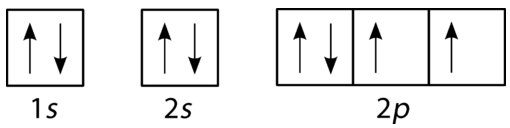
What element is represented by this orbital diagram?

a)

C

b)

B

c)

N

d)

O

30.

If an electron moves from n=2 to n=4 ...

a)

it absorbs energy

b)

it releases energy

31.

Ions of two isotopes of iron are

53Fe2+ 56Fe2+

Which statement is correct?

a)

The ions of both the isotopes have the electronic configuration 1s2 2s2 2p6 3s2 3p6 4s2 3d6

b)

The ions of both the isotopes contains 26 neutrons

c)

53Fe2+ has fewer protons than 56Fe2+

d)

56Fe2+ has the same number of protons and electrons as 53Fe2+

32.
Which element is depicted from this orbital diagram
a)
Fluroine
b)
Neon
c)
Chlorine
d)
Argon
33.

True or False: The ground state is the highest energy state of an atom.

a)

True

b)

False

34.
The electron configuration of an atom is 1s22s22p6.  The number of electrons in the atom is 
a)
3
b)
6
c)
8
d)
10
35.

Which of the following is the noble gas (shorthand) configuration for iodine (53I)?

a)

[Ar] 4s24d104p5

b)

[Kr] 5s24d105p5

c)

[Xe] 5s25d105p5

d)

[Xe] 6s25d106p2

36.
Which atom has the largest atomic radius?
a)
potassium
b)
rubidium 
c)
francium
d)
cesium
37.
As you move down the periodic table atoms get bigger.  This is because ____________.
a)
The atoms have more mass.
b)
The atoms have more protons.
c)
The atoms have more energy levels
d)
The atoms have more nuetrons
38.
As you move across the periodic table atoms tend to get smaller because, ______________.
a)
the atoms have more mass.
b)
the atoms have less mass
c)
the atoms have more protons.
d)
the atoms have less electrons.
39.
Atoms that have a high electronegativity, _______________.
a)
give up their electrons more easily.
b)
hold on to their electrons more tightly.
c)
have more electron shells.
40.
Electronegativity is...
a)
how good an atom is at attracting electrons
b)
the ability of an atom to lose electrons
c)
the energy required to remove an electron from a specific atom
d)
how easy it is to make friends. 
41.

A Noble Gas atom with the largest atomic radius is -

a)

Ar

b)

He

c)

Kr

d)

Rn

42.
The element with the largest electronegativity in the halogens is - 
a)
At
b)
F
c)
Cl
d)
Br
43.

The element with the lowest electronegativity in Period 3 is -

a)

Na

b)

Cl

c)

Ar

d)

Mg

44.
Which periodic group has the smallest atomic radius?
a)
Alkali metals
b)
Halogens
c)
Noble Gases
d)
Transition metals
45.
Atomic radius generally increases as we move __________.  
a)
down a group and from right to left across a period 
b)
up a group and from left to right across a period 
c)
down a group and from left to right across a period 
d)
up a group and from right to left across a period 
46.
Which element has the smaller atomic radius: potassium (K) or bromine (Br)?
a)
potassium (K)
b)
bromine (Br)