Wayground logo

Free Printable Worksheets

Font size

S
M
L
XL
Worksheets

Geometry Honors Q2 Exam Review

Total questions: 77

Worksheet time: 3hrs 0mins

Name
Class
Date
1.
How many lines of symmetry does this shape have?
a)
1
b)
2
c)
4
d)
8
2.
How many lines of symmetry does this shape have?
a)
1
b)
2
c)
3
d)
4
3.
How many lines of symmetry does this shape have?
a)
0
b)
1
c)
2
d)
4
4.
How many lines of symmetry does this shape have?
a)
0
b)
1
c)
2
d)
4
5.
How many lines of symmetry does this shape have?
a)
1
b)
2
c)
4
d)
6
6.
A circle has ______ number of lines of symmetry
a)
4
b)
5
c)
6
d)
infinite / countless
7.
What is the order of rotational symmetry for the shape below?
a)
0
b)
1
c)
2
d)
3
8.
What is the order of rotation in the recycling symbol?
a)
1
b)
2
c)
3
d)
1,000
9.

Find the order of rotational symmetry in this shape.

a)

2

b)

3

c)

4

d)

5

10.
Identify the smallest angle of rotation that maps the image to itself.
a)
180°
b)
360°
c)
90°
d)
No rotational symmetry
11.
Identify the smallest angle of rotation that maps the image to itself.
a)
90°
b)
180°
c)
45°
d)
60°
12.
Identify the smallest angle of rotation that maps the image to itself.
a)
72°
b)
180°
c)
144°
d)
45°
13.
Write a rule for the translation.
a)
 (x -1, y  + 2)
b)
 (x -2, y  + 1)
c)
 (x +2, y  - 1)
d)
(x +1, y  -  2)
14.
Point (-5,2) is reflected over the y axis.  Where is the new point located?
a)
(5,2)
b)
(-5,-2)
c)
(-5,2)
d)
(5,-2)
15.
Apply the following rule to the point (-5,6):
(x,y)-->(y,-x)
a)
(-5,-6)
b)
(5,-6)
c)
(6,5)
d)
(-6,5)
16.
Identify the transformation.
a)
Reflection across y axis
b)
Reflection across x-axis
c)
180 Rotation
d)
Translation 2 units down
17.
How many degrees was the figure rotated?
a)
90 degrees counterclockwise 
b)
180 degrees
c)
90 degrees clockwise
18.
If you were to rotate ABCD 180°  about the origin, what would the coordinate of A' be?
a)
(-5, 5)
b)
(-3, -5)
c)
(-5, 3)
d)
(-3, 3)
19.
If you were to rotate ABCD 180° about the origin, what would the coordinates of B' be?
a)
(0, 0)
b)
(-6, -5)
c)
(-1, 3)
d)
(-6, 2)
20.
If you were to rotate ABCD 180° about the origin, what would the coordinates of B' be?
a)
(0, 0)
b)
(-6, -5)
c)
(-1, 3)
d)
(-6, 2)
21.
What is the angle of rotation for this counterclockwise rotation about the origin?
a)
90°
b)
180°
c)
270°
d)
360°
22.


 (x,y)⟶\left(x,y\right)\longrightarrow  

a)

 (x+1,y−3)\left(x+1,y-3\right) 

b)

 (x+3, y−1)\left(x+3,\ y-1\right)  

c)

 (x+4, y−3)\left(x+4,\ y-3\right)  

d)

 (x+1, y−1)\left(x+1,\ y-1\right)  

23.
State the line of reflection.
a)
Reflection across y-axis
b)
Reflection across x-axis
c)
Reflection across x = 1
d)
Reflection across y = 1
24.
What transformation is happening?
(x, y) ----> (x + 2, y - 3) 
a)
slide up 2, left 3
b)
slide right 2, up 3
c)
slide right 2, down 3
d)
slide left 3, right 2
25.
Reflect the point (2, -4) over the y-axis.
a)
(-4, 2)
b)
(-2, 4)
c)
(-2, -4)
d)
(2, 4)
26.
If you were to rotate ABCD 180°  about the origin, what would the coordinate of A' be?
a)
(-5, 5)
b)
(-3, -5)
c)
(-5, 3)
d)
(-3, 3)
27.
Triangle A is rotated 90° clockwise with the origin as the center of rotation to create a new figure. Which rule describes rotating 90° clockwise?
a)
(x,y)→(y, -x) 
b)
(x,y)→(-x,-y)
c)
(x,y)→(-y,x)
d)
(x,y)→(x,y)
28.

Is triangle ABC congruent to triangle A'B'C'?

a)

Yes. There is a rigid transformations that carries ABC to A'B'C'. That is a 90o clockwise rotation.

b)

No. There are no rigid transformations that carry ABC to A'B'C'.

c)

Yes. There is a rigid transformations that carries ABC to A'B'C'. That is a reflection across the y-axis.

d)

Yes. There is a rigid transformations that carries ABC to A'B'C'. That is a reflection across the x-axis.

29.
A charter plane travels from Barrow, Alaska, to Fairbanks. From Fairbanks, it flies to Nome,
and then back to its starting point in Barrow.
Which of the three legs of the trip is
the longest?
a)
Fairbanks to Nome
b)
Nome to Barrow
c)
Barrow to Fairbanks
d)
Anchorage to Fairbanks
30.
Three cell phone towers are shown at the right. The measure of angle M is 10° less than the measure of angle K. The measure of angle L is 1° greater than the measure of angle K. Which two towers are closest together?
a)
M and L
b)
L and K
c)
K and M
d)
L and J
31.
In disc golf, a player tries to throw a disc into a metal basket target. Four disc golf targets on a course are shown at right.

Which two targets are closest together?
a)
1 and 2
b)
2 and 3
c)
3 and 4
d)
4 and 1
32.
In disc golf, a player tries to throw a disc into a metal basket target. Four disc golf targets on a course are shown at right.
Which two targets are farthest apart?
a)
1 and 2
b)
2 and 3
c)
3 and 4
d)
4 and 1
33.
The distance from Jacksonville to Tampa is 171 miles. The distance from Tampa to Miami is 206 miles. Use the Triangle Inequality Theorem to find the range for the distance from Jacksonville to Miami.
a)
0 mi < d < 35 mi
b)
0 mi < d < 377 mi
c)
35 mi < d < 377 mi
d)
-35 mi < d < 377 mi
34.
In Jessica’s room, the distance from the door D to the closet C is 4 feet. The distance from the closet to the window W is 6 feet. The distance from the window to the door is 8 feet. On a floor plan of her room, triangle CDW is drawn. Order the angles from least to greatest measure.
a)
angle C, angle D, angle W
b)
angle D, angle C, angle W
c)
angle W, angle C, angle D
d)
angle W, angle D, angle C
35.
Walking paths at a park are shown. Which route represents the greatest distance?
a)
A to B to D
b)
A to D to B
c)
C to B to D 
d)
C to D to B
36.
a)
A
b)
B
c)
C
d)
D
37.
a)
A
b)
B
c)
C
d)
D
38.
If ∆LMK ≅ ∆LMT, then
∠K ≅ ____
a)
T
b)
∠T
c)
∠M
d)
∠L
39.
What does CPCTC stand for?
a)
Congruent parts of congruent triangles are congruent
b)
Corresponding parts of congruent triangles are congruent
c)
Corresponding parts of corresponding triangles are corresponding
d)
Corresponding parts of congruent triangles are Canadian.
40.
Which theorem below cannot be used to prove congruent triangles?
a)
SAS
b)
AAA
c)
SSS
d)
AAS
41.

Which theorem below could never be used to prove congruent triangles?

a)

ASA

b)

SSS

c)

SSA

d)

AAS

42.

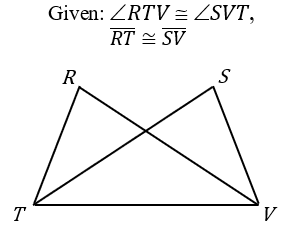
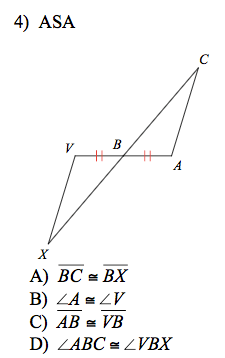
Which theorem below could be used to prove triangle congruence in the diagram below?

a)

ASA

b)

AAS

c)

SAS

d)

None of the above

43.
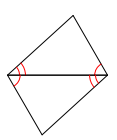
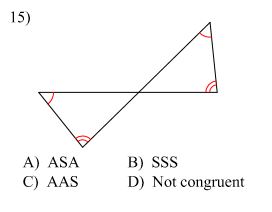
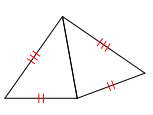
How are the triangles congruent?
a)
AAS
b)
SAS
c)
ASA
d)
SSS
44.
a)
A
b)
B
c)
C
d)
D
45.
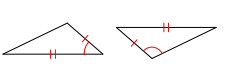
Are these triangles congruent?
a)
Yes, by ASA
b)
Yes, by SAS
c)
No they are not congruent
d)
Not enough information to know for sure
46.
What additional information is required to prove the 2 triangles are congruent by ASA
a)
A)
b)
B)
c)
C)
d)
D)
47.

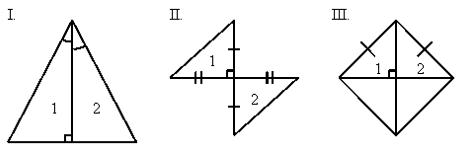
For which situation could you prove

∆1≅ ∆2 using the H-L Theorem?

a)

I only

b)

II only

c)

I & II

d)

I & III

e)

III only

48.

Which of the following are NOT sufficient to prove two triangles are congruent? Choose all that apply.

a)

SSS

b)

AAA

c)

ASA

d)

SSA

e)

AAS

49.
How are the triangles congruent?
a)
SAS
b)
SSS
c)
AAS
d)
HL
50.
How are the triangles congruent?
a)
Not congruent
b)
SSS
c)
ASA
d)
SAS
51.

Which of the following is a correct statement and reason for the proof shown?

a)

JK‾≅JK‾\overline{JK}\cong\overline{JK} ; Reflexive

b)

∠M≅∠L\angle M\cong\angle L ; Reflexive

c)

MJ‾≅LK‾\overline{MJ}\cong\overline{LK} ; Midpoint Theorem

d)

MK‾≅LJ‾\overline{MK}\cong\overline{LJ} ; Hypotenuse Congruence

52.

Which of the following is a correct statement and reason for the proof shown?

a)

∠P≅∠Q\angle P\cong\angle Q ; SAS

b)

∠P≅∠Q\angle P\cong\angle Q ; CPCTC

c)

∠P≅∠Q\angle P\cong\angle Q ; SSS

d)

∠P≅∠Q\angle P\cong\angle Q ; SSA

53.

Which of the following is a correct statement and reason for the proof shown?

a)

FG‾≅FG‾\overline{FG}\cong\overline{FG} ; Reflexive

b)

FG‾≅FG‾\overline{FG}\cong\overline{FG} ; Midpoint Theorem

c)

\overline{DG}\cong\overline{DG} ; Reflexive

d)

DF‾≅FE‾\overline{DF}\cong\overline{FE} ; Midpoint Theorem

54.

Which of the following is a correct statement and reason for the proof shown?

a)

FG‾≅FG‾\overline{FG}\cong\overline{FG} ; Midpoint Theorem

b)

FG‾≅FG‾\overline{FG}\cong\overline{FG} ; Reflexive

c)

DG‾≅GE‾\overline{DG}\cong\overline{GE} ; Midpoint theorem

d)

DF‾≅FE‾\overline{DF}\cong\overline{FE} ; Definition of a Bisector

55.
a)
100°
b)
80°
c)
90°
d)
180°
56.
What are complementary angles?
a)
Angles that add up to 180°
b)
Angles that add up to 90°
c)
Angles that are equal to each other
d)
Angles that are opposite of each other when lines intersect.
57.
What are supplementary angles?
a)
Angles that add up to 180°
b)
Angles that add up to 90°
c)
Angles that are equal to each other
d)
Angles that are opposite of each other when lines intersect
58.
What are vertical angles?
a)
Angles that are adjacent to each other
b)
Angles that add up to 180°
c)
Angles that are opposite of each other when lines intersect
d)
Angles that add up to 90°
59.

If ∠COB is 124°, then what is ∠BOD? How are they related?

a)

56°, they are supplementary because they form a linear pair

b)

90°, they are complementary

c)

124°, they are vertical

60.

Which angle is the same side interior angle to angle 4?

a)

angle 3

b)

angle 5

c)

angle 6

d)

angle 8

61.
Which pair of angles are alternate exterior angles?
a)
Angle 7 and Angle 4
b)
Angle 2 and Angle 6
c)
Angle 8 and Angle 1
d)
Angle 2 and Angle 8
62.

2x and 10x are two angles that are supplementary. What do the angles measure?

a)

30°,150°

b)

5°,10°

c)

15°, 75°

d)

90°, 180°

63.
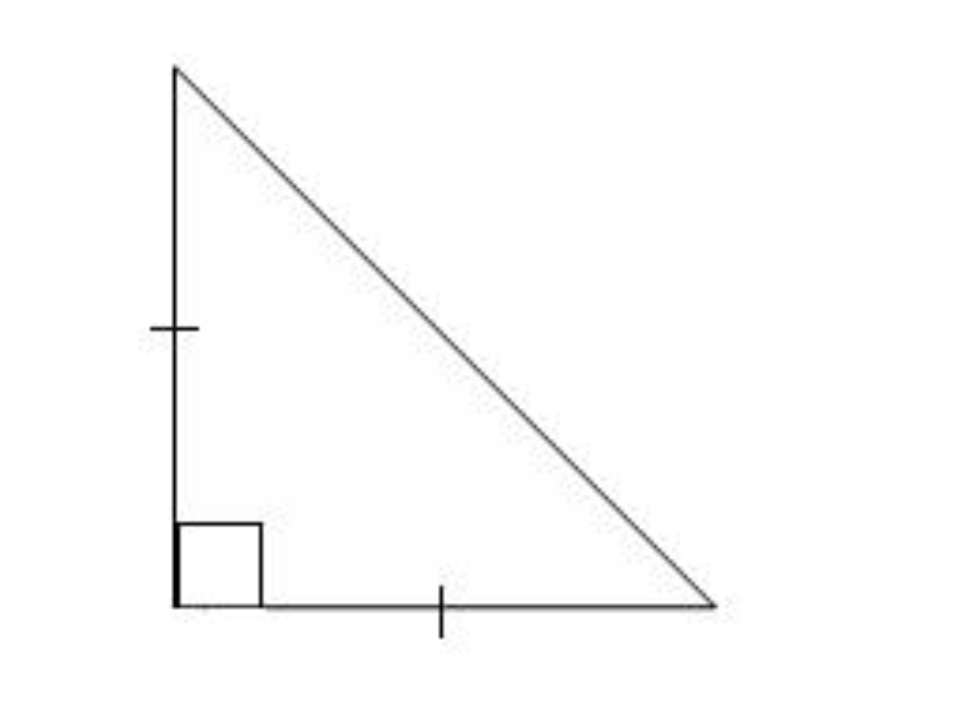
Classify the following triangle in as many ways as possible. 
a)
Right, Equilateral
b)
Obtuse, Scalene
c)
Obtuse, Equilateral
d)
Right, Scalene
64.
Which type of triangle is pictured?
a)
Equilateral Triangle
b)
Right Isosceles Triangle
c)
Obtuse Scalene Triangle
d)
Obtuse Equilateral Triangle
65.

Solve for x.

a)

A

b)

B

c)

C

d)

D

66.

Solve for x.

a)

A

b)

B

c)

C

d)

D

67.

Solve for x.

a)

A

b)

B

c)

C

d)

D

68.

Solve for x.

a)

A

b)

B

c)

C

d)

D

69.

Solve for x.

a)

A

b)

B

c)

C

d)

D

70.

Find the indicated angle. (What is ?)

a)

91°

b)

81°

c)

89°

d)

109°

71.

Find the indicated angle measure. (What is ?)

a)

51°

b)

37°

c)

167°

d)

41°

72.
Use the Perp Bisector Theorem to find PQ
a)
10
b)
3
c)
-2
d)
5
73.
Use the Perp Bisector Theorem to find  AD and  BC
a)
5;12
b)
16;4
c)
12; 16
d)
5;16
74.

Find the measure of  QA‾\overline{QA}  

a)

4

b)

-4

c)

16

d)

28

75.

Find the measure of  ∠NJZ\angle NJZ  

a)

38

b)

90

c)

52

d)

128

76.
Solve for x.
a)
6
b)
5
c)
-11
d)
4
77.
Solve for x.
a)
7
b)
9
c)
-11
d)
-8