wayground logo

Free Printable Worksheets

NEW

Font size

S
M
L
XL
Worksheets

Information Processing in Animals

Total questions: 28

Worksheet time: 15mins

Name
Class
Date
1.

Even when it is cold outside, the human body maintains an internal temperature of 98.6 °F. Which term describes the maintenance of balanced internal condition?

a)

mitosis

b)

homeostasis

c)

endocytosis

d)

photosynthesis

2.
A rat approaches a piece of rotting fruit, smells it, takes a small bite, and then runs away. Which statement best explains the reason for the rat’s behavior? 
a)
The rat runs away from the fruit to process the new sensory information.
b)
Sensory receptors in the rat’s whiskers respond to input about the texture of the fruit.
c)
                The rat’s chemical receptors detect chemicals in the fruit that alert the rat to possible danger.
d)
Information gathered by the rat’s auditory receptors signal that the environment around the fruit is not safe.
3.
This diagram shows the steps involved when chemical receptors in the nose detect different scents. Which statement describes the next two steps in the process? 
a)
Nerves pass the signal to the brain, where it is processed.
b)
The scent is carried by red blood cells to the brain in blood
c)
Hormones carry the scent through the body to be interpreted
d)
If the scent is familiar, it causes a memory to become activated.
4.
One of the characteristics of living things is that they respond to external changes in their environment so that their internal environment stays as stable as possible. Name an environmental change that an animal must respond to in order to keep a stable internal environment. 
a)
birds have feathers
b)
the environments gets very cold or very hot
c)
an earthquake happens
d)
pollution
5.
Explain what might happen to an organism if it could not adapt to an external change.
a)
It will have offspring that adapt
b)
It will die
c)
It will attack other animals
d)
It will seek out new life and new civilizations
6.

What are three types of sensory receptors?

a)

chemical, formical and sensical

b)

chemical, electrical and kinetic

c)

chemical, mechanical and electromagnetic

d)

chemical, potential and processing

7.
A baby moose is born and, within hours, can stand, run and walk. Is this learned behavior or innate behavior?
a)
learned
b)
innate
8.
A dog remembers that if he tries to attack a skunk, he will get sprayed and smell really awful. Is this learned behavior or innate behavior?
a)
innate
b)
learned
9.
If the environment gets cold, we will often shiver in order to:
a)
keep body temperature the same as the external temperature
b)
decrease body temperature
c)
increase body temperature
d)
regulate blood pressure
10.
The maintenance of an organism’s internal environment is called:
a)
compensating
b)
homeostasis
c)
balancing
d)
routine
11.
The "cause" for something to happen is the
a)
response
b)
effect
c)
stimulus
d)
homeostasis
12.
The "effect" of a given stimulus is the...
a)
response
b)
stimulus
c)
cause
d)
result
13.
a body system that controls and coordinates all body activities through electric impulses/messages between brain, spinal cord and nerves.
a)
endocrine system 
b)
nervous system
c)
nerve
d)
neuron
14.

This image is a...

a)

Dr. Seuss tree

b)

neuron

c)

skin cell

d)

red blood cell

15.
Messages are sent throughout the nervous system by specialized cells called
a)
neutrons
b)
neurons
c)
nucleus
d)
Normans
16.
Neurons that pick up information from our surroundings (our senses) are called
a)
sensory neurons
b)
interneurons
c)
motor neurons
d)
pick-up neurons
17.
The function(s) of the nervous system is(are)
a)
receiving information
b)
responding to information
c)
maintaining homeostasis
d)
all of these
18.
Your senses of taste and smell rely on _______________ in the air and food.
a)
light
b)
pressure
c)
chemicals
d)
sound
19.
The set of actions taken by an organism to respond to a stimuli is a 
a)
behavior
b)
homeostasis
c)
sensory receptor
d)
neuron
20.
Behaviors that do not require learning or experience
a)
learned
b)
innate
21.
Information that is stored in the brain
a)
behavior
b)
response
c)
stimulus
d)
memory
22.

How does memory guide the actions of an animal?

a)

Animals can remember things that have happened long ago.

b)

Animals can avoid actions that have been harmful to it in the past.

c)

Memories will not be passed on from parents to offspring.
23.

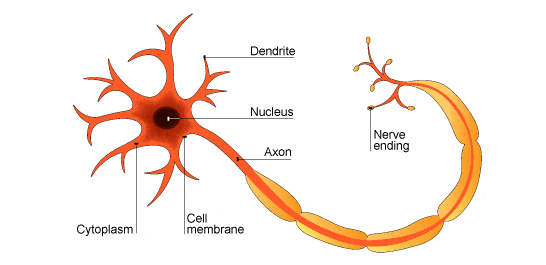
What level of structure is represented by the diagram?

a)

organ

b)

organ system

c)

cell

d)

tissue

24.

The brain has 3 major sections that send and receive signals to control all the activities that keep a person functioning efficiently. Which major section controls breathing and heart beat?

a)

cerebellum

b)

cerebrum

c)

brain stem

d)

cortex

25.

Any change inside or outside your body that causes a response is a ____.

a)

axons

b)

stimulus

c)

reflex

d)

neurons

26.

Small part of the brain that controls muscle movements, balance and coordination.

a)

cerebellum

b)

brain stem

c)

cortex

d)

spinal cord

27.

The largest part of the brain where thinking takes place is the ____.

a)

cerebellum

b)

cerebrum

c)

brain stem

d)

cordial stem

28.

The brain sends a message to the ________ through motor neurons.

a)

skin

b)

lungs

c)

muscles

d)

nose