wayground logo

Free Printable Worksheets

NEW

Font size

S
M
L
XL
Worksheets

Organisms Use Strategies to Be Successful in Their Environment

Total questions: 23

Worksheet time: 23mins

Name
Class
Date
1.

Which feature helps an animal hide from other animals?

a)

looking like a dangerous animal

b)

being the same color as the place it lives (camouflage)

c)

having sharp claws or a strong shell

d)

having only a few young and caring for them

2.
This word means to stay alive.
a)
trait
b)
reproduce
c)
adaptation
d)
survive
3.
I am an animal that lives in the arctic. I have adaptations that allow me to survive in my environment. Which of the following is an adaptation that will allow me to survive the arctic?
a)
thick white fur 
b)
speed
c)
digging in the ground 
d)
short, fluffy tail 
4.
Anything that helps plants or animals survive in their environment is known as a(n) __________________.
a)
Roots
b)
Habitats
c)
Adaptation 
d)
Adoption
5.
Which underground structural adaptation has the function of storing food and water for the plant?
a)
bulbs
b)
tubers
c)
roots
d)
spores
6.
Desert animals of Western Australia match their colour to their surrounding to
a)
be not seen by their predator
b)
avoid being caught by their enemies
c)
get away safely when in danger
d)
all the above
7.
Most bird species have hollow bones to...
a)
Allow them to swim.
b)
Make them lighter during flight.
c)
Help them store food.
d)
Help them find a mate.
8.
An octopus can change its color to match its surroundings. This is an example of which type of behavior?
a)
camouflage
b)
mimicry
c)
cooperative behavior
d)
estivation
9.
examples:  claws, teeth, beak, echolocation
a)
aquatic animal adaptations
b)
winter adaptations
c)
seasonal behaviors
d)
feeding adaptations
10.
How do adaptations help animals?
a)
To escape animals
b)
to hunt for food
c)
to survive in their habitats
d)
All of these are correct
11.
Which type of leaf adaptation is best for getting sunlight in a very shady area? 
a)
A--thin leaf with waxy covering
b)
B--big, broad leaf
c)
C--thin, modified leaf with waxy covering
d)
D--medium-sized leaf with indented edges
12.
any difference between individuals of the same species
a)
adaptation
b)
gene
c)
variation
d)
naturalist
13.
examples of external structures important to feeding
a)
fins, legs, tail, wings
b)
beak, teeth, mouth, claws
c)
ears, tongue, eyes, nose
d)
fur, feathers, shell, horns, tusks
14.
When every organism of a given species has died
a)
Natural Selection
b)
Homeostasis
c)
Extinction
d)
Selective Breeding
15.
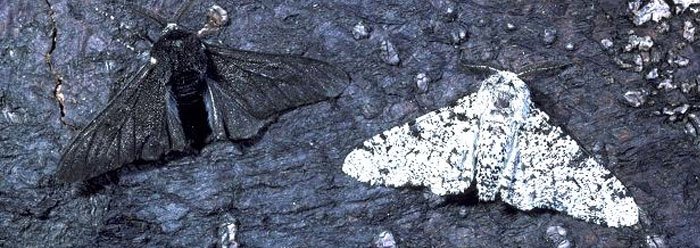
The trees these moths used to live on were white, but have been covered in soot from coal factories. Which moth will be more successful in this environment?
a)
Dark moth
b)
Light moth
c)
Both will be equally successful
d)
Neither will be successful
16.
Since the 1800s humans have stopped burning coal, and the trees have returned to their original color. Which moth will be more successful in this environment?
a)
Dark moth
b)
Light moth
c)
Both will be equally successful
d)
Neither will be successful
17.

Which of these statements best describes what Darwin observed on the Galapagos Islands?

a)

The finch population on each island was unique due to Natural Selection

b)

The finches on the islands ate seeds and nuts, but no insects

c)

The finches on the islands were the same as the finches in Ecuador

d)

The finches could produce offspring only with finches from other islands

18.
Organisms that are better adapted to the environment survive to pass traits to their offspring
a)
Natural Selection
b)
Homeostasis
c)
Selective Breeding
d)
Extinction
19.
What is the advantage of having different shaped beaks?
a)
To look different from other species.
b)
To be able to eat the food readily available in the environment.
c)
To protect itself against predators.
d)
To protect itself against prey.
20.
Why are advantageous traits more likely to be passed onto offspring?
a)
Because they are more likely to survive and reproduce.
b)
Because they come from dominant alleles.
c)
Because they come from recessive alleles.
d)
Because the trait is an acquired phenotype.
21.

Individuals with favorable traits survive, reproduce, and pass their genes onto their offspring. This is called

a)

Mutation

b)

Adaptation

c)

Evolution

d)

Natural Selection

22.

What is the correct explanation for what is happening in this graph?

a)

There are a lot of average-sized beaks

b)

There are no beaks

c)

There are a lot of small beaks only

d)

There are a lot of small and large beaks, but not average-sized ones

23.

Given this graph predict what will happen to the future wolf population?

a)

Population will decrease

b)

Population will increase

c)

Population will not change